The Vortex Reference is the first IEM of the Hong Kong cable maker Vortex. It is a rather unusual release, in the sense that it serves a precise purpose. We’ll get to that soon.
I have bought this unit with my own money, at full retail price. It’s available, for example, at Nihilo (non-affiliated link).
First, let’s get the technical details:
+ Drivers: 4-Driver Configuration (2 x Passive MEMS Tweeters, 2 x Dynamic Drivers)
+ Sensitivity: 102db/mW
+ Impedance: 23 ohms
+ Cable 1 in box: Approx. 1.2m Ultra Series Titan silver-plated copper cable, 4.4mm
+ Cable 2 in box: Approx. 1.2m Zenith Series Iris silver-plated copper cable, 4.4mm (source).
The packaging is quite ingenious. Once the paper sleeve is removed, you are greeted with a fairly large box (23x14x8cm) of a suede-like material, pleasant to the touch. Lift the lid and in the upper half, the two IEMs are revealed in all their beauty. The bottom half holds a wallet-like warranty card and the carrying case. Speaking of which, it is huge (13x10x5,5cm). Inside the box, the two cables, each with its own cable binder (nice touch). The material of the case is leatherette, with a grainy texture. It has a press-fit lid, which makes it difficult to open.

Turning to the upper half of the box, under the insert holding the IEMs, there is an opening hosting a mirror polishing cloth and a case of tips, from Nostalgia Audio. Upon inspecting the box, I noticed it is composed of two trays, attached magnetically to the outer layer, and which can be removed independently from each other. I find this a nice touch, as you can store things in them. They could have been more generous with the tips, only three pairs for such an expensive set seems a bit lackluster.
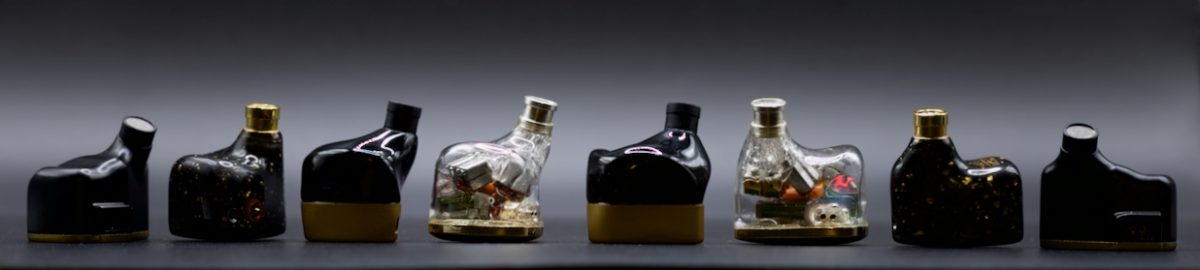
The shells are wonderfully built, with the body made of aluminium, a mirror-polished edge and a beautifully understated faceplate.
The shells themselves remind me of the IE900, with its machined grooves. Except that Vortex has a wave-like model carved in the shell walls. The S/N is placed on the nozzle lip and there is a single vent located at the apex of the shell. Despite the vent, sometimes I hear one single “crack” when pushing them into my ears, but only if I do it too quickly.

The 2pin port is flush, but the cables that come with it have recessed connectors. While some may scoff at this “miss-match”, I like it because I can use these two cables with any IEM, not just those with flush connectors.
Cable(s)
Titan is a thick 2-wire cable, in the quality I’ve come to expect from any Vortex product. It is rather stiff and unwieldy, so not the best option for wearing them on the go.

The second cable, Iris is significantly thinner and easier to wear. It still looks nice and it matches the IEMs not only sonically, but also optically.

Pairing
In theory easy to drive, but they require some power to shine. R2R sources are best (like the powerful MUB5). I would recommend staying away from warm sources, as Reference are quite bassy by nature. Adding Brise Tsuranagi OE to the chain increased bass control and added a bit of lushness to the sound. However, SP3000 is fine on its own and, of course, the more powerful N2 has no issues to power them.
In terms of tips, no particular challenges, everything worked. They are quite responsive to tips rolling, and you can easily alter the bass/treble balance with this inexpensive solution.
Sound
The Vortex Reference has a deep, cavernous, multi-layered bass, able to retrieve countless details in many genres. While it reaches quite low, providing an underlying rumble, like the droning of heavy machinery, it also spices this up with many flourishes. The main bass driver is very fast, even pieces like Nile, being reproduced accurately and without fusing the blast beats into mashed potatoes. Of particular interest is the bass drum, which has such a deep impact, I can almost feel it in my chest. While it isn’t the first IEM to offer such an effect, most of the others had at least one BCD. Reference achieves this in the absence thereof, which is even more commendable. With the Titan cable, the bass seems to be a bit more present, while Iris keeps it more in check, trimming down the elasticity a bit.
The mids are a mixed bag for me. Reference has an energetic upper mids-forward presentation and a clean, almost palpable separation between the mid bass and lower mids. What this means in practice is that male vocals have a deep, resonating dimension with good texture and excellent clarity, with the vocal fundamentals feeling slightly distant or central-recessed. This distance, however, is totally dependent on the music.
However, downtuned distorted guitars sound shy, almost thin, lacking that low frequency resonance responsible for most of the chug, as if the bass is turned down on the cabinet. This is probably due to the marked scoop from 200Hz upwards, making a full recovery much higher, around 1,5 kHz.
In stark contrast, the upper mids being boosted, both the attack and the sustain of the higher notes on guitar are excellent, leading to good texture, excellent upper mids buzz and a bite that makes all the guitar solos a pleasure to listen to. They sound…electrified. This makes Reference very good for stuff like prog rock, and heavy metal, in contrast with genres relying heavily on downtuned guitars and deep, heavy powerchords.
The voices are, in general, taking a small step back on the stage, enhancing the impression of depth. The clarity is astounding, almost better than real life. In addition, the timbre accuracy is top notch, both male and female voices sounding natural, with no added extra warmth, nor metallic tint. Not warm, not cold, just right. I find the male voices to appear a bit closer compared to female ones, but the difference is not significant.
It takes careful selection of music to get the most of these IEMs; if the record has the voices already a bit remote, Reference will amplify that, and if the track is congested, the voice tends to dissipate a bit in the mix, meaning that they are more or less at the same depth with the rest of the instruments. For most of the time though, the voices have no problem rising above the instrumentation.

If the voice is a bit nasal, Reference will expose that (without amplifying it), so you might be surprised sometimes. However, switch to other IEMs and you’ll notice that the nasality is and was always there. There is no romanticizing of the voice, it is presented with a brutal honesty, the naked voice, so to speak.
The treble is one of the highlights. The energy is great, there is sufficient sizzle, air and everything in between. The timbre is good, cymbals sounding natural and with good note weight, but not quite at Storm’s level. The level of details is one of the highest I’ve encountered, very close to the richness of tones of Annihilator, and certainly matching X. What they bring to the table is a sharp, detailed edge, like a combination of BA and EST. There is some shimmering, but well controlled, with a touch more realism than many EST implementations. With some cables, like the Vesper 8W, the treble has even better note weight and good spatial spreading, making live performances really spark.
Violins take advantage of the high resolution with a nice “scratch” and pop to the front of the mix with ease.
Brutally transparent, Reference will reveal any sibilance present in your tracks, but in most cases it is not disturbing. It can be tuned down with narrow bore tips, or with cables, but they remain prone to sibilance.
Stage and imaging
The most striking aspect of Vortex is the stage/imaging. The stage is wide, tall and deep, all at the same time, with a surround-like effect. The bass seems to be coming from a diffuse source, like emanating from the edges of the sound field, while the cymbals take their logical space near the top of the stage. Guitars are mostly placed near the center, just below voices. The voices are dead central and, as mentioned, with a slight tendency to sound vaguely remote. I wouldn’t call this a fault, but a feature. Listening to Therion’s Leviathan, the organ seems to come from the front, pass by your ears, and travel further back. It’s an outwards going scene, the music doesn’t end its voyage once it enters your head, but it continues to travel past you. This effect is noticeable in all directions, giving Vortex a semi-spherical presentation, in other words, you are in the middle of the music.
The various elements are arranged and intertwined with surgical precision, in a way that reminds me of the famous Mysticraft Hex. This panoramic presentation allows you to focus and register various details with a high selectivity. You want the bass guitar? No issue. Voice? – just focus on it. Even the difference between rhythm and lead guitars is as clear as if drawn with a fine liner.
Cables
Reference is very responsive to cable rolling, to the point that they included two cables in the original package.
After having tried some more cables, I am quite happy with the shielded Nightcraft 8w Vesper. The stage is as large as the stock Titan, but with layering that is more natural, with less defined “boundaries” between various elements. It’s neither a step up, nor down, just a different flavour. However, what Vesper does is to soften the passage between mid bass and lower mids to the upper mids, slightly flattening that big V. What it does wonderfully, is to reduce the sub bass or better said, dissipate it better in the available space, pushed to the edges, so it is no longer that prominent. The voices get a gentle push forward, but the biggest change is in the treble, which is a bit thicker, more weighty and it has a more cutting edge. It’s snappy, while maintaining airiness and that crystal clear quality I’ve appreciated from the beginning, only now, the notes are thicker, spreading more spatially.
Unique Melody Fantasy has quite a marked effect on Reference: it shaves off some treble, it diminishes sibilance and adds more body and weight to the mids, in particular lower mids. Sub bass is tempered down, so the whole delivery is more balanced. The details have less defined edge and the overall sound is more lush, but with less rumble. This set is, indeed, very versatile.

Plus Sound Quad Copper is similar with Vesper 8w, but it reduces the bass a bit and continues the flattening of the curve, thus reducing the V shape further. It lends a more musical presentation, with not so fast transients, and not the same pitch-black background. It is somehow similar to the Iris stock cable, but with a bit more lower mids grunt.
EA Eros S (pure silver litz and pure copper litz) has a profile similar to the Iris stock cable, less bassy, narrower stage, with the treble being more edgy, thicker, but also a bit rougher, and somehow not having the same flow as the other cables, with the splashes being too loud. The dip in the lower mids is largely compensated for and the overall presentation is a bit harsh and I miss the extra bass brought about by the other cables. The voice is rather forward, compared with other cables, but also more sibilant. But most importantly, this cable brings more low frequency chug.
Cross Lambda Apollo and Apollo GT.
Both these cables have reduced the V shape signature to a much more balanced one, cut some resonance from the treble and brought Reference to a more traditional tuning. Sub bass is toned down a bit, the mid bass seems to flow more fluidly, as if Reference has shed some weight, while the lower mids have more body, which also brings more grunt in distorted guitars. The voices are a teeny bit more forward and the treble is smoother. The stage is more spherical than with Titan, which was more elliptical. Add the AK SP3000 to the mix and Reference is easily one of the most fun IEMs, but one I can listen to for hours.

Comparisons
Compared to Maven III
Maven III is described by Unique Melody as having a V tuning, so it should be a good point for comparison. Reference has a warmer tuning, which can only be described as a massive V, unapologetically energetic and dynamic, with a big bass shelf, but a free-flowing, liquid bass, with the mobility of BA bass, rather than a DD one. Lower mids are more textured on Maven III’s, while upper mids have a richer texture on Reference. Maven III has more natural sounding treble, while the use of MEMs in Reference means good energy and air, but Maven III manages to push a slightly more realistic timbre, at least for genres like metal or rock. In terms of resolution, Vortex Reference is a step above, although Maven III has received a boost by comparison with its older brother, Maven II.
In the lower mids, Reference is smoother, less textured, thus diverging from Maven III, while in the upper mid it catches up and even surpasses Maven III. Reference is vaguely more sibilant than Maven III.
Choosing between these two is a simple matter of preference between a more balanced, analytical approach (Maven III) or a warmer, bassier, more analog-like traditional V sound (Vortex Reference). If you want the most natural and sparkly cymbals, Maven III is a viable option, but if you prefer electronic music, or if you are chasing aggressive edge over the most accurate timbre, Reference comes highly recommended, with its powerful bass and less spark in the treble, while maintaining the air.
Compared to NGaudio Erebus
Erebus has a much fuller, but significantly narrower stage than Reference. The lower mids have more body (ranking amongst the best, for me), while with a little less sub bass and more articulated mid bass, Erebus is a dream for metal. Lower mids are a lot more textured and more forward, bringing weight exactly where is needed, in the heavy power chords. Another notable difference is the upper mids, where Erebus doesn’t lose any breath and pushes the voices forward. The treble is more tonally accurate and with a sharper edge on Erebus. Reference fights back with more enveloping bass, much larger stage and more clarity across lower and upper mids. In terms of dynamics, Reference is more lively, more fun oriented, infusing music with an augmented sense of urgency. On the long run, this could have the potential to become tiring, but much to my surprise, even after 3 hours of listening, I still don’t want to take them out of my ears.
Compared to UMxMusicteck Pentara
Pentara is somehow similar to Maven III, with more sub bass and more energy in the upper mids and highs. Reference is darker than Pentara in the upper mids and brighter in the treble. Pentara has the voices more forward than Reference and provides more body in the lower mids. All in all, Pentara is more of an all-rounder with its flatter profile, while Reference, despite the name is the more fun oriented one.
Compared to Aroma Fei Wan
Fei Wan maintains more warmth throughout the lower frequencies, having more full bodied sounding mids, making voices and guitars sound a bit thicker, a bit more real. Like Reference, Fei Wan has energetic, upfront upper mids, and adrenaline filled treble. While Fei Wan has overall a more natural sound, in terms of bass, Reference is one step above, with more energy in sub bass and a cleaner, faster delivery, perfectly decoupled from the mids. When it comes to treble, either of these two can satisfy even the most hardened treble heads. Ultimately, the differentiating factor is the vocals weight, with Reference being a bit thinner than Fei Wan.
In order to mix&match things up a bit, here and there I’ve included also other IEMs in the comparisons, usually IEMs that I find very good with those respective genres/songs.
Songs
Rime of the ancient mariner – Iron Maiden (live version)
Reference has a very energetic and detailed presentation, with sizzling cymbals and fast-sounding guitars. The voice is just a touch on the strident side. The bass sounds extremely detailed, the guitars have a higher tone than usual and they are beautifully highlighted by Reference, but there is a bit of a missing link between them. The voice is quite remote, which is again, not surprising, since this a live recording.
As it is usually the case with live recordings, some of the bass is missing. Erebus does a good job, but its mid-centered bass is no match for Reference’s muscular approach. It does make up in the guitar section, with both rhythm and harmony sounding electrifying and dynamic. The gallop at its best. Dickinson’s voice, dead in the middle, acts like a bridge between the two (L/R) guitars, making the whole sound more cohesive.
Pentara
Salvation – Paradise Lost
I use this to test for grit and low mids grunts. The guitars on this track create a wall of sound, with sustain being more important than fast transients. Reference does a pretty good job, despite not being the most chug-worthy of the IEMs tested. The voice is deep, cavernous, filled with anger and desperation and I am happy to hear the growl in Nick Holmes’s voice conveyed to perfection by Reference. The harmony guitar is loud and clear, a good match for Paradise Lost. Also, the cymbals cut like a thousand blades, with good, thick notes and long-ish decay.
A clear difference between the two cables here, Titan has a larger sub bass, larger stage, the sides of the stage are larger, while Iris has a more narrow, less tall stage. The cathedral-like sound, with Titan, is a better match here.
Erebus has more lower mids energy and a warmer voice, but it is lacking that detailed guitar sound of Reference. Also, the warmer approach works less with the gothic sound. The interplay between the bass guitar and the two guitars is very good, but I wish the sound was colder.
Pentara takes the two and combines them into a perfect sound, with large and tall stage, menacing leads and voice, a brilliant contrast between the warm bass and the cold cymbals, making the goth in me really happy (well, unhappy, like any goth worth his salt). The tension it builds towards that short break is palpable; you could break it with a hammer.
Elysian X is another one with a decluttered lower part of the spectrum, only to add a lot of energy later, in upper mids. With outstanding clarity, this must have been the springboard for one of my other favourites, Tet. Large sounding, detailed and with nerve-tingling upper mids. While somehow similar in sound to Vortex Reference, it has less bass and more spatial expansion of the treble. Also, X is one of the grittiest IEMs in my collection. Voices are remote, like Reference’s.

Fade to Black – Dire Straits
This song fits Reference like a glove. The larger-than-life stage is well filled with sound, everything is highly detailed, and it creates a magical atmosphere. The superposition of the guitar, cymbals and organ is of such nature that everything has its own space, but they are all in focus at the same time. There is no smearing of any kind, while the voice sounds detailed and human – it may seem a bit cold in the beginning, but once you get used to it, you realize is just natural and devoid of any external influence.
Erebus is more coloured, but in a tasteful way. More intimate, softer edges without falling into syrupy but maybe less microdynamics than Reference.
Pentara shines once more, although I must admit, the difference over Reference is rather small. Pentara has a lusher mid range, making the guitar sound even more melancholic, in particular during the solo, while the voice is a bit rounder.
Interestingly enough, each of the IEMs is very good here, being impossible to pick a favourite. I can only assume this is down to the spot on production that doesn’t need any further enhancements via the sound chain.
Godzilla (feat. Serj Tankian) – Bear McCreary
Film music, useful for testing stage, imaging and overall balance. Reference has a large sound with the lower mids sounding just a touch shy.
Intoxication is more bassy, thanks, no doubt to its elevated mid bass and lower mids. While the stage is large enough, I do wish it was a bit larger. This piece has a lot going on at the same time and Intoxication’s all upfront approach is a little bit too much of the good stuff. Outstanding clarity towards the end and the last drums sound huge. A bit more air up top could have been nice.
Pentara has the same cinematic presentation, dynamic, with lots of bass and very impactful drums. The difference between the two is minimal on this track, with Pentara having a bass that seems to descend a bit further into my chest.
Ma meilleure ennemie – Stromae
This shows another face of the Reference, ready to shake you to the core. The bass hits like a sledgehammer, while Stromae’s voice sounds phoned in (production choice). The female voice in the second verse suffers from some sibilance, but by the time Coldplay enters the game, the sibilance is all but gone. The amount of air is very good and the stage is panoramic.
Intoxication has less rumble but more mid bass and voices more forward. For me, the bass is just too much, but the voices are just pure gold. I had to lower the volume a bit to keep things pleasant. Not because it was shouty, but because of too much bass. The treble is more subdued compared to Reference, but still detailed.
Erebus presents a more forceful image, with a lot of the music pushed forward, including the voices. It works quite well, but for this genre, I prefer stage and sub bass more than mid bass. The voice is a bit warmer and more full-bodied with Erebus.
Pentara strikes as hard as Reference, with that latino rhythm being overpowering. I prefer Reference, where the accent was less on the rhythm or lower mids and more on stage and imaging.
Voie sur ton chemin – Techno Remix
Cathedral-like sound in the beginning, until that bass announces its imposing presence. What I like particularly on this track, is Reference’s ability to separate the original (the choir) from the techno part. After the 2:20 mark, those synths sound like jolts of electricity, not unlike electro-shocks. Nothing feels overwhelming.
Erebus has too much mid bass for this track, and it sounds too intrusive, forcing me to immediately turn down the volume.
Fei Wan is like an extended Erebus, with more focus on sub bass and more ecstatic upper mids and treble.
Maven III is trailing Pentara, with less sub bass intensity and a “too clean” rendition. Pentara, on the other hand, hits like a hammer, but it doesn’t have that organic sound of Reference.
Elysian X surprised with a strong sub bass and an open, expansive sound. The sound is more fluid, with the cymbals very forward, very lively. Voices are a bit pushed forward, but in this case I wouldn’t say I prefer them nearer or farther.
See me – Memento Mori
Sub bass test. I swear I can feel my eyes bulging out in the rhythm of the music. What I love, is the lean bass. It punches very low, it recovers quickly and it is ready to hit you again. There are many layers to the bass, not just rumble, but blink and you’ll miss them, that’s how fast the driver in Reference is.
The only one that can keep up with that bass is Pentara. Fei Wan does also a decent job, but the Reference’s bass is simply more forceful, with a wider reach. The smaller stage can make it feel overwhelming, though.
Elysian X is slightly bright here, but the spatial effects are very impressive. The bass is, however, a couple of steps down from the likes of Reference and Pentara.
Adagio in G minor – Mac Quayle
The violins sound detailed and woody, but a little bit more weight in the lower notes would have been appreciated. Nice feeling of open space and grandness. Very transposing
Erebus sounds more woody, warmer, more pleasant, but it lacks that grandness of Reference. The intimate presentation does not play to its advantage this time.
Opeth – Eternal rains will come
Superbly produced album, allowing Reference to shine. I particularly enjoy that muffled, physical sound of the bass drums, nicely placed at the bottom of the stage. Employing MUB 5, for a fuller lower register. The cathedral-like stage is nicely layered in height, depth and width. Bass guitar has great articulation, while the voice is placed at the right distance. A very slight coloration of the treble is present, but not distracting. It simply adds a bit of flavour.
Erebus is darker, with the bass guitar more elevated, even more articulated than Reference. It’s not intrusive, but certainly competing for attention with the rest of the music. The voice is less detached from the rest.

Aphex Twin – Produk 29
Reference has the bass to move you. And it’s putting it to good use. Combined with the large stage, the presentation is wide and clear. The sharp and textured treble brings a nice contrast, keeping the whole presentation aerated, but dense. One of my favourites for this song.
Erebus has decent sub bass, but it simply cannot compare with the Reference. Combined with the narrower stage and a more closed in sound, it is easy to prefer Reference for this one. Fei Wan expands on that and it has a more organic bass, with larger stage than Erebus, but not quite as big as Reference’s.
Pentara has the matching bass, with deep, low rumble and good physicality, all in a large stage. However, Reference sounds a bit more organic, as if it were a living creature. I admit, I may have a slight bias towards V shaped sound signatures.
Conclusions
The Vortex Reference is a bold and surprising set. By straying from the target-curve-chasing, forward-midrange presentation common to modern flagships, Vortex took a calculated gamble with an unapologetic V-shaped tuning.
The deep lower-midrange scoop (200 Hz−1.5 kHz) means certain tracks relying on heavy, downtuned guitar chug can sound a bit thin. Furthermore, its brutal transparency will not hide inherent track sibilance.
When it comes to pros, the list is quite a bit longer, ranging from deep, physical bass impact, laser speed and precision and energetic, airy treble.
With its layered, large stage, Reference is very good for instrumental music, trading a bit of sound density for a panoramic presentation. Vocal centered music works quite well, and they smash it with film music, thanks to the cinematic presentation. They work very well with vocal central music and EDM. Also, the kind of space rock Muse plays is a good match for Reference’s high clarity.
In addition to all these talents, Reference is very responsive to cable rolling, which in itself is a great use case.
The Vortex Reference is a bold release. By straying from the target-curve-chasing, forward-midrange presentation common to modern flagships, Vortex took a calculated gamble with a unapologetic V-shaped tuning.
