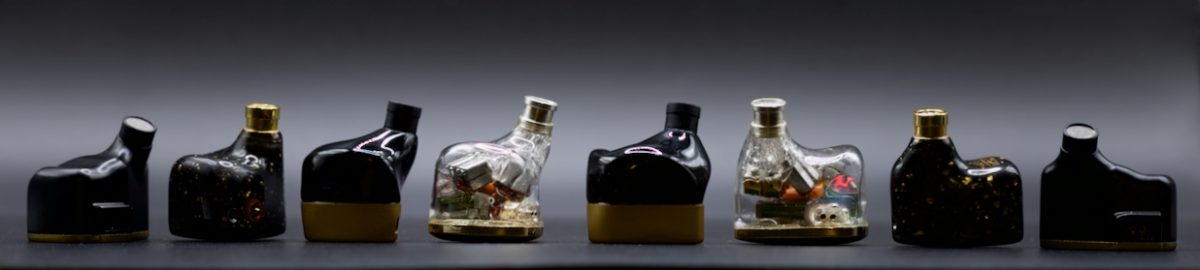
Thanks to the generosity of a friend, I was able to spend some time with the Luxear Valor.

The Valor’s complex configuration includes one dynamic driver, one planar driver, four Knowles balanced armature drivers, and four Sonion electrostatic drivers per side. It has a sensitivity of 109,6 dB SPL/mW and an impedance of 9 Ω, making it an easy to drive IEM where source pairing doesn’t pose any problems.
Some of the key technologies are: Micro‑Precision Magnetic Alignment System (MPMA). With aerospace-grade assembly and rigorous acoustic control, it ensures consistent, high-fidelity sound performance that meets professional standards.
Equipped with the P.S. (PrimeSuper) Nano Acoustic Core Coating. Its precision-engineered nanostructure enhances diaphragm rigidity, effectively suppressing unwanted resonance and standing waves. This reduces distortion at its source and refines the sonic foundation, enabling more accurate diaphragm movement and faster transient response. It delivers tight, powerful bass while maintaining an expansive soundstage and preserving a warm, natural tonal character. (Source)
The shells are comfortable, with a sculpted form, that fitted me without any issues. The shells themselves are made of dark grey resin with iridescent pigment therein. The metal nozzles are protected with a metal mesh, and there is a single vent, next to the 2 pin slot, which is flush with the body of the IEM. And yes, the cable is equipped with recessed 2 pin plugs. While I know some people consider this a fault, as one who couldn’t use some 2 pin cables on certain IEMs, exactly because of flush plugs and sunk-in ports, I tend to prefer this slight mismatch, for improved compatibility.

The faceplate is the first sign you are in the presence of a slightly different kind of beast. Said face plate is made of brass, submitted to a special ageing technique, the final aspect being similar to bronze. A really nice touch. While I find the idea very cool, I must admit that it is very difficult to make up any details on that faceplate. By taking a picture and studying it on my computer, I was able to tell a knight is represented, but with the naked eye is either a knight or just a bunch of lines, depending on the angle. A bit of a missed opportunity here…

The cable is an 8 wire Gold, Silver and Copper Alloy of good quality, with round braiding, which gives it extra suppleness. It is feather-light and has low microphonics (except when rubbing against the plastic zipper of my fleece jacket).
The rectangular carrying case is large enough to comfortably lodge the IEMs with the cable attached thereto, and even with an upgrade cable, something like the Nightcraft Vesper, which is quite hefty.

Sound
The general direction of the tuning is a bass-boosted neutral-warm one, with smooth treble and natural mids.
The bass is evidently the star of the show here, being one part of the spectrum that really stands out from the rather balanced overall sound. Valor has very good extension, the sub bass hitting like a train. I had to check twice to make sure there’s no BCD in there, as both the amplitude and fullness of bass a more akin to UM’s Pentara or Noble Spartacus, both sporting multiple BCDs. Think of Valor as an IEM having the bass extension of Pentara, but with the decay profile of Maven 2. In other words, the best of two worlds, deep extension combined with a natural decay, making for one of the most satisfying bass renditions in any IEM. There is a caveat here, how dependent the sound is on the tips used (more on that, later). The bass fills the stage nicely, coming at you from no specific point in space, unlike some IEMs where the heavy bass tends to hang around the bottom of the stage. It is as if the bass is somehow floating. At the same time, the drums placement is logical, bass drum at the bottom, central snare and higher up toms, with good spacing between them. The speed is good, fast double bass drums sounding like a machine gun, with fast attack, each stroke clearly separated from the rest.
Mid bass is neither neglected, nor swallowed up by the ample sub bass. On the contrary, it shines, with rich texture and distinct articulation, like a logical extension of said sub bass towards the mids.
Mids are the most uneventful part of this set, and this is meant in a good way. The sound is so natural that most of the time you forget you are listening to an IEM. The overall texture is leaning towards smooth, with a bit more grit in the lower mids and slightly smoother upper mids. For me, this translates into a soft advantage for male voices, appearing fuller, more textured and thus clearer. Female voices are wrapped in a very fine veil. I would classify this not as a fault, but rather as a feature, as if the tuner of this IEM was not after the crystal-clear playback of voices, but a more mysterious one. Sibilance is, in general, very well controlled, with only rare exceptions. Even when present, it is not enough to detract from the listening pleasure.
Treble is smooth, this set aiming for countless hours of listening, completely free of fatigue. The energy is quite moderate, the overhead air is impressive, and the extension is very good. A bit on the dry side, the treble does not have the usual sizzle of EST+BA combos, nor the thick texture of single DD’s. But It is, in fact, a revelation: one of the best planar implementation for treble. I usually prefer a bit more energy, but I can certainly appreciate the lack of fatigue associated with Valor, while maintaining a high level of details (see, however, the note under Sources).
The cymbals are not suspended in thin air, as it happens with some sets, they are surrounded by other elements. What distinguishes the Valor from other IEMs is the amount of air surrounding the cymbals on all sides. Each stroke manifests in its own space – almost like a physical cavity – extending almost equally on all three axes… likea tiny echo, it gives the impression of a cavernous space surrounding said cymbals.
A hint of planar timbre is present in the treble, usually audible when there are multiple splashes in rapid succession. However, most of the time, the timbre is correct. In typical planar manner, the attack is fast, but the body is somewhat lacking, compared to the masters like Storm or X.

Stage and imaging
Valor has a large stage, with equally good height and depth. It is one of the nicest I have heard, with a good 3D quality to the sound. The instrument separation and holographic imaging are also top notch, almost giving Pentara a run for the money (Pentara has 3 BCDs helping achieve a globular stage). Without a doubt, one of the biggest selling points of Valor. The sound density is also good, with no hollow voids in the stage.
Tips
In the case of Valor, tips are of paramount importance, as they can turn it into either a bassy beast or a civilized all-rounder. With Eletech Baroque, both regular and stage, the bass was overwhelming and I wasn’t able to appreciate them to their full potential. Enter green Tangzu Tang Sancai (normal bore) and the bass is reduced and put back in its place. These are the very same tips I use when measuring IEMs, but for listening they are usually a bit on the small size (the green is M), while the L is too large.
Spinfit CP145 reduced the treble too much, so I steered clear of these. Spinfit Neo offers a good combination of comfort and sound quality.
Cables
With the standard cable being aesthetically and ergonomically satisfying, I had little motivation to seek an upgrade cable. However, I did try a couple more options: The Nightcraft Spectre 4W added a touch of bite to the treble, allowing cymbals to pop out a bit, while slightly improving bass tightness.
Sovereign 2w appears to clarify female voices, while shifting the weight-center back towards the lower frequencies. The treble sounded a bit thicker, but the increased weight in the bass is not what I was looking for.
Eletech’s 5th Ode brings a plus of clarity to the mids, while the bass articulation is enhanced, and the overall sound is more rounded, reminding me a bit of a tube amp sound. Again, the changes are diminutive.
Overall, I do not find Valor to be very responsive to cable rolling, the differences being rather small. For most of the listening experience, I have used the stock cable.

Sources
Quite a sensitive set, so source pairing does not pose any problems. A particular synergy with Audma’s Brioso is notable, with MUB5 being also very good. Nipo N2 was another good pairing, but only in medium gain; the high gain setting pushed the sub bass a bit too far for me, although it did so while maintaining good control, but except for rap, I found it a bit overwhelming.
With the Astell&Kern SR35, one of my favourite ultra-portable sources, it sounded surprisingly balanced, but, as expected, the stage and details were reduced compared to Brioso or MUB5. The treble was a bit more energetic, but I did notice some more planar glare in the treble, though (note: a slight fatigue appears to be building up when using SR35 as a source).
Comparisons
The best contenders would have been the Forté Ears Mefisto (2DD,4BA,1 nano planar) and Volk Stella (1DD, 5BA, 4EST and 2 planar), due to their similar architecture. With none of these available to me and not wanting to rely on memories, I chose some of the best IEMs in my collection for this purpose, the Elysian X, UM Pentara and Mysticraft Myth.
Compared to UM Pentara
Pentara has 3 BCDs, but no planars. Despite this difference, I find it the closest to Valor in general tuning (from what I have at hand), hence the comparison. While the bass is similar in quantity, the Pentara’s one is dryer, faster and thus a bit colder, while the Valor bass is oozing warmth. Valor has a longer rumble, while Pentara seems to have a bass that penetrates deeper into your skull. Mid bass is more forward in Valor, but in terms of micro details, Pentara manages to come on top.
A notable difference is the midrange clarity, where Pentara is one step ahead, with Valor having a more relaxed approach, slightly more closed-in and a bit veiled. The highs follow the same pattern, with Pentara being more energetic and having a more natural timbre versus Valor’s less emphasized treble, characterized by a slight planar sheen from time to time. In terms of air, the difference between them is relatively small, with Valor offering more air on top of the cymbals.
Valor has a bit more energy up top, while Pentara is more restrained, but with thicker texture and note weight.
I have already mentioned the excellent imaging of Valor, but Pentara is even more impressive in this regard, helped by a more three-dimensional soundstage. I find the depth on Pentara to really push the envelope of what is possible into an IEM, while Valor is more conventional in this regard.
Both are rather bassy IEMs, with a mild W profile, so both play nice with almost any music.

Compared to Myth
Mysticraft Myth is the exponent of a new generation of IEMs, with impressive technologies inside and a reasonable price tag. Its driver configuration is 1xDD, 4xBA and 2xmicroplanar for highs. They don’t play in the same league, the only reason for the comparison being the somehow similar configuration.
Compared to Myth, Valor has larger stage, more ample sounding bass, and more energetic and detailed treble. The midrange is somewhat similar, but Valor has far better imaging and instrument separation. For an IEM costing almost four times as much, this was to be expected. Myth manages to hold its ground fairly well, being hard to imagine the huge price gap between them.
Compared to Elysian X
X (1DD,4BA,4EST) is one of the most lively IEMs in my collection. It has quite an aggressive pinna gain, lean bass and very good imaging. By comparison, Valor is warmer and calmer. X has a more accurate timbre, and it is more transparent, being capable of playing any music while creating the right atmosphere. In contrast, Valor imbues the music with its character, meaning that music will be portrayed in a way more similar to Valor than to that music played through another setup. This is immediately apparent when listening to albums produced in the early ‘80s, where Valor sorts of re-interpret the sound according to modern standards, while X transports you back in time.
Listening to Maiden’s “Rime of the Ancient Mariner”, is a good display of the differences between X and Valor. The former is snappy, dry and precise, tiny details in the mids and bass area being more easily identifiable, while the latter present a bassy, booming version, with crystal clear cymbals, nicely placed in their own echoing chamber, but lacking some of the initial note weight.

Some songs
2PAC – Trading war stories
I always listen to this album, as the production is very peculiar, the treble being too forward and a bit piercing, with high chances of sibilance. Valor does a good job, maintaining a good level, while, amazingly so, the sibilance is not a problem. I expected more sibilance, but I am happy to be wrong.
The cymbals remain at the upper limit of comfort, increase the volume too much and you are crossing into piercing territory.
Pentara has a lot more energetic presentation, with the cymbals occasionally being unpleasantly piercing.
Just like Pentara, Elysian X is almost too intense for this song. Pushing the Nipo N2 into high gain, tends to elevate the sound, bringing more control to the upper mids and treble and increasing bass energy.
All-in-all, an easy win for Valor, which sounds as if made for this music.
Joe Bonamassa – Life after dark
This track is very good at revealing even the slightest shouty peak in the mids. There is nothing to complain about here, with Valor being rather well balanced, despite its hefty bass shelf. The “Sh” sounds are a bit harsh, but unless cranking up the volume, the sound is rather enjoyable. The guitar solos have good bite and the bass line is very easy to follow. With it’s laid-back approach, Valor lets you enjoy music, without focusing too much on details.
Pentara suffers from the same harsh “sh” sounds, while the overall sound is brighter and colder. The faster bass is an advantage here, making the whole song sound leaner and cleaner.
Elysian X, with its lively mids, offers a more convincing guitar tone, cleaned of any lingering bass influences, with occasional harshness in the upper mids, but in such rare instances that those moments feel more like accents of the music. The treble is tucked behind the upper mids, but it has excellent timbre and air.
Soen – Unbound
With the voice a tad pushed back, this song appears very appropriate for highlighting the technicalities of Valor. The grunt right before the second verse is clearly audible, while the bass is here to offer support to the rest, not to steal the show. The only niggle is a bit of sibilance. Interestingly enough, the treble appears a lot more energetic on this song than others.
Not really a fair fight, this being, in my opinion, the genre that works best with Pentara. There are more details available without even requiring you to willingly turn your attention to them. The grittiness is dialed up compared to Valor, with a more clear separation between bass and mids. Some could argue that this clear separation lacks cohesion, but I do prefer closer to neutral tunings, and I like a clear mid range, especially on guitar heavy tracks.
Elysian X continues from where Pentara left off, adding even more grit and sparkle, as if the instruments are plugged directly into my nerves. Due to the way it builds the stage, X offers the impression of everything being in focus at the same time. I certainly prefer this high-octane sound, but for some people the calmer, warmer Valor might be better suited.

Gretel – Unbloom
Energetic indie piece, with a grating sound, reminiscent of Nirvana. Sort of a reminder that music is a way to express oneself. The sound is one of the grittiest I heard outside metal. I find Valor to have a too much of a warmifying effect on this songs, slightly taking away from the dark atmosphere.
Pentara with it’s colder tone is better suited to maintain the atmosphere, the whole antithesis of denying the changes by embracing them. While Valor adds a romantic air, Pentara, on the contrary makes the song sound like a twisted, gothic fairytale.
The song pushes the X over my comfortable edge, the beginning being too exuberant and forcing me to quickly lower the volume. Once a comfortable level is reached, the sound gets better, X highlighting the guitar and the voice, placed centrally and crystal clear.

Angine de poitrine – Mata Zyklek
This band was recommended by a fellow head-fi-er. I find it totally mental and despite it’s apparent simplicity, a good test of technicalities.
Valor has tight, but forceful bass, leading the charge, with life-like bass drum and very good bass details (the sound of fretting the bass, audible in the beginning), with the cymbals forward and the mids sounding a little closed in. This makes for a more “conventional” sound, while other IEMs make this music sound really crazy.
Pentara is equally detailed, the entire lower part of the spectrum being as intense as Valor’s, but at a faster pace. The mids are more forward than Valor’s, but less so than X’s. The bass has more slam than Valor.
Elysian X offers a droning sound in the beginning, that is well in line with the whole music of the two brothers from Quebec. Fast and muscular bass, with well controlled treble and distinct layering. I could hardly think of a better choice for this music.
Sting – Be still my beating heart
Valor sounds large and warm, with a lot of details in Sting’s voice and nicely detailed treble. While the bass guitar is the loudest instrument, the voice keeps a central spotand the words are for the most part easy to understand. However, I wish that bass were less present and the voice a bit elevated on top of the mix.
Pentara has a clear advantage here, sounding bigger, wider, deeper and more holographic. Sting’s voice on Valor carries a bit more warmth but it appears more blended in, whereas Pentara makes it pop. Overall, Valor offers a calmer sound, better suited for evenings, and pure enjoyment listening, rather than critical listening, while Pentara is showing off micro details and had more bite in the treble, somewhat inviting you to examiner all these small things, while ignoring the music.
X takes a different direction, pushing the voice further back, but maintaining its separation from the rest of the elements. Since I am a great admirer of Sting’s voice and way of singing, I tend to prefer IEMs that highlight his voice.
Conclusions
Luxear Valor was a pleasant surprise, being as fun as Trifecta for me, with its big sounding bass and added warmth. What impressed me in particular is the way it copes with metal, since Valor is, in general, a smooth and well-behaved IEM. To hear the extra grit in the lower mids was one of the highlights of the time spent with Valor. While a good all-rounder, there is a caveat: everything tends to sound similar, Valor’s strong character influencing the sound a bit more than I am used to. Even with the skinniest tips that ensured a good seal, I still found Valor too warm for my taste. Where it shines is rap, pop, dance, ambiental, OST (thanks to its large soundstage and woofer-like sub bass), trip hop and similar genres. It has all the required details for classical music (texture, resonance), with violins having the right texture, but it all depends on your tolerance to warmth. Personally, I find it too warm to be my preferred set for classical music, but, as usual, YMMV.
For rock in all its varieties, it is surprisingly good, with an important mention here as well: some of the older albums sound a bit like modern remixes, which could be a little disconcerting sometime – as much as I enjoyed Whole Lotta Love with the extra bass, it sounded too modern, too polished (besides, there’s no need to make Bonham’s toms sound even bigger). Play modern albums, though, and you’ll get instant gratification.
There’s a lot to like about Valor, well built, and even slightly out of norm, which is a plus in my view, good cable that doesn’t require an upgrade, comfortable (subjectively, of course), easy to drive, detailed and forgiving with poor recordings. Its lack of urgency make it a better match for slower music rather than, say Painkiller (Judas Priest), which pushes the treble into uncharted territory, while the bass is lingering a tad too long.
