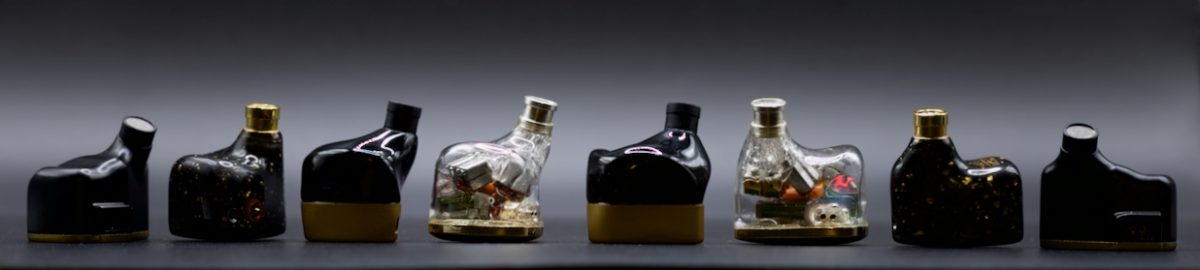
Prime Ti is a single 12mm magnetostatic driver IEM, housed in, as the name says, Ti shells, with a mirror-like polish. We’ve seen this before on the Cadenza 12.

This unit was sent on a tour to EU by @MicDavism141 (over at head-fi.com forum), in collaboration with Rhapsodio, the boutique IEM maker from Taiwan/Hong Kong. Many thanks!
The package was limited, due to customs restrictions: IEM, the Evolution Silver Ultimate 2W cable and the Giant cable (from Darker). No unpacking, therefore.
This write-up reflects the way I hear them, subject to influences due to anatomy, chain, music choice, previous experience. As usual, YMMV.
In order to improve readability, some in-depth passages are hidden under drop down arrows. Simply click on the arrow to see the content
In a nutshell
In terms of raw resolution, I think the Prime Ti fares very well, but the details are less discernible than my current darlings (Hex, Tet, Storm). You just have to reach out to them. No low-hanging fruits. Compared to IEMs like Storm, you might even say they sound muddy, but this would be a lazy and shallow evaluation. Prime Ti makes you work for those details.
I like the fact that it takes the transducer out of the equation, and they let me enjoy music. However, I don’t like their safe, bordering on boring, tuning. It simply isn’t for me. This is something that can be educated (the way we enjoy music is usually too bassy) or one can cheat, like I did with Brioso. That extra bass turned Prime Ti into a different beast altogether.
For those looking for a neutral set, I can hardly think of a more appropriate option. For those chasing extreme details, sets like Storm, Tet, Hex, APX Me, Pentara are better choices (some of which I own already).

Prime Ti and Mysticraft Tet
Comfort
While significantly smaller and lighter than V3, I have the same problem with them. Namely, they slowly slide out of my ears, until the seal is completely broken. I have tried a variety of tips, with limited degrees of success. I have settled on Penon Liquer Black, as they are a bit stickier and manage to keep the IEMs in my ears for a bit longer. I reckon Azla should work the same. The shells are shallower than Tet, but the angle of the nozzle creates this sliding effect for me.

In depth analysis of Prime Ti’s sound
Bass
This is one of the most strictly neutral sets I have evaluated recently, as a quick glance at its graph confirms it. It may look lean and bass light, but in practice, it delivers just enough quantity of bass without ever overpowering the mix. It’s not going to win any bass competitions, but I like how it gracefully steps out of the way. So, the rumble is subtle to almost non-existent; however, the articulation and muscularity in mid bass compensate for this. To simply call it a mids bass focused bass would be an injustice though, as it maintains a good balance. The texture is intricate—it doesn’t force itself upon you but rather sits patiently in the backdrop for you to discover. Prime Ti’s bass, then, is not obtrusive, it’s relaxed, waiting for you to acknowledge it’s presence. Imagine walking through a vineyard where all the grapes are equally ripe, equally good looking. You look left, right, you like all you see and are just waiting for the right moment to make your selection, postponing it and just taking in the beauty of the place. If you prefer a big, thunderous bass, look elsewhere.
Mids follow the same pattern, fluid flowing, neutral, with a slight dose of bohemian charm. Lush, but not overly so – without becoming syrupy, and organic without feeling thin or hollow. Note weight is average, well in line with its neutral tuning. The soft focus, with the details intimately blended into the music body, helps create an atmosphere of slight mystery surrounding the music. At times, this flat linearity can veer into sounding slightly safe or sterile, which acts as both a virtue and a flaw depending on the track.
Voices are well placed, dead in the center, at a comfortable distance, that feels intimate without becoming claustrophobic.
The highs are fairly energetic, with the mid treble accentuated, followed by good air. The details are good, but once more, delivered in a rather polite way, rather than the aggressive sharpness that I value so much in other sets. The mid treble tends to be on the hot side, but for most of the time it remains safe, helped maybe by the swift upper treble drop. The timbre carries a slight metallic sheen, reminiscent of a planar, albeit a good one, just like the supreme V3 before it. If I were to describe the treble in just one word, that’d be effortless. It does the job it’s supposed to do without fuss, without drawing too much attention.
Cymbal decay remains somewhat localized; I occasionally found myself missing the ultra-wide, shimmering dispersion of an Electrostatic (EST) array. Furthermore, the high-frequency response is heavily source-dependent: on sharper sources, cymbals can sound slightly splashy, whereas warmer or higher-tier sources allow the treble to bloom into a rounded, organic decay.
Stage and separation
The stage is large and tall, with good depth, rivaling Traillii JP. Instrument separation is rather decent, though expectedly limited by the single driver physics when compared with multi-brids like UM Pentara or Mysticraft Tet.
Pushing the volume up opens up the soundstage, sharpens dynamic contrast, and infuses the presentation with vital energy. This is NOT a set for whisper-quite listening, then.
Sources and cables
Sources
With Nipo N2 it gets a bit hot in the mid treble and the female voices lack that final touch of shimmery sparkle.
Audma Brioso fixes that, restores the shine to female voices and has a more delicate treble. The Brioso brought a welcome change, in the form of the bass adjustment knob. Adding a few dB of bass made things much more palatable for me. However, for testing I went back to zero.
AK SP3000 feels decidedly underwhelming; I guess this IEM needs a punchier, more dynamic source to come alive.
Surprisingly, the Hiby R8II was one of my preferred sources for Prime Time. It has given it a bit of V shape, which I really enjoyed.
Music used
Paradise Lost – Salvation
Prime Ti has massive sounding drums, establishing a direct lineage line with V3. Very little sibilance, like a slight shadow. Very good separation, in its own relaxed way, nothing forced, a sound that I can only describe as analog. There is a certain fluidity, no sharp edges anywhere, and even if this comes at the price of the rhythm guitar sounding a bit too chill, the end effect remains good. Some of that sense of tragedy is lost, again due to the atmosphere, not being somber enough.
IE900 (my only notable single DD) has a lot more dynamic sound, bringing a lot of atmosphere into the mix. Its stage does not have the height and depth of Prime Ti and the lower mids are definitely thinner than Prime Ti’s. It has more detailed treble, with a very sharp edge, a sense of urgency. This is right up my alley.
Traillii JP sounds very large, with very detailed treble slightly coloured mids and, of course, Mr. Holmes sounds sublime with Traillii. It’s another “bass light set”, so there are certain similarities, but Traillii has better separation and more detailed treble.
Dua Lipa – Levitating
Very strong L/R effect, perfect disco effect, complete with a virtual disco-ball. The bass is surprisingly strong, with the details surfacing effortlessly. Detailed, natural voice, well delimited from the background and a large, tall stage. This is as good as I’ve heard this song.
Tet presents a very different image, with lots of bass, huge stage extended in all directions, and a nice, sweet and detailed voice. The treble is darker, but not less detailed. Despite the stereo effects being less popping than with Prime Ti, I much prefer this presentation, with loads of macro-dynamism.
Boz Scaggs – Thanks to you
Prime Ti perfect match, reducing the bass of this song to acceptable limits (for me). The voice is free to shine, close, but not claustrophobic, clear with just a faint touch of warmth.
Traillii shines here, unsurprisingly.
Mozart – Piano concerto No. 20 III Rondo Allegro asai
Prime Ti is very good with its relaxed sound, creating a nice spatial soundscape. Traillii is the one to beat and this has not happened. I do have a strong affinity for Traillii, even after so many TOTL sets.
Bob James – Avalabop
Binaural recording at its best. The stage depth is crazy, and the rendition let’s you forget everything about gear and you just bob your head slowly. Plenty of details, the ghost notes and flares on the drum, the cymbals, everything is present. The piano has a full sound, the bass reaches low and gives that physical impression of moving air. I find Prime’s tuning to work best for this genre.
Traillii offers a different flavour. I enjoyed both equally.
Doors – Riders on the Storm
Traillii has clearer and more detailed highs, an even larger stage and the voice more upfront. At the same time, the voice is so emotionally laden. The ethereal beauty of the music is contrasting so starkly with the lyrics and the life-like thunders give it an extra dimension. The organ is also very forward, a lot more than Prime’s.
Prime has a bit of splashiness in the cymbals, the voice is more closed in, not as open as Traillii’s, while the biggest difference is the mid bass pushed forward significantly. The song is, luckily, light on bass, so it all works well. The two are close in term of performance, this not being the first Rhapsodio IEM with near-perfect voices. The organ solo gets just a bit too loud at times.
Music pairing
For albums having already a flat production, they seem to accentuate the highs, since there is no bass counterbalance, which can make them sound a bit flimsical (like Dio’s excellent The Last in Line – the production is too thin for Prime Ti). Switch to Opeth’s Windowpane and prepare to be immersed in a sense of depression, with full sounding music, having all the weight needed, making it easy to sink into melancholia. I would have preferred the guitar tone a tad darker, though. It’s almost too open, too cheerful.

Conclusions
As I sit here listening to Maiden’s epic Empire of the Cloud, I realise technical metrics like resolution and stage dimensions fade away, leaving pure musicality. I think the syntagm, speaker-like has been overused, so I’ll try to avoid it, difficult as it is. The sound does not seem to come for anywhere, it just exists inside your head, and in a small measure outside it too. No sharp details, no micrometric separation, but genuinely musical and transparent. Integrated. A very accomplished set that for me lacks the raw energy of V3, the savagery of its cymbals attacks and the boldness of female voices. But, hear me out, this makes it a good allrounder, provided you like a neutral set. By making this “normal” sounding IEM, some of the craziness built into the Rhapsodio IEMs is gone, leaving the space to a more mature approach. Maybe the next release will find the perfect balance between these two.
And the elephant in the room, the price. This set is in the Storm/Tet territory, with those being far more exciting. At this price, I expect more. Drop the safety net and add more excitement.
