IEM Technical Specifications
Drivers
2nd Generation Tribrid Technology
Dual Isobaric Dynamic Driver
Quad EST with ResoFlow
Titanium Chassis
Interestingly enough, FatFreq does not mention BAs, despite saying it is a tribrid. I guess it’s safe to assume some BAs are in there, as GMA had no less than 8 of them
Crossover
4 – Way Crossover System
Frequency Response
20Hz ~ 40kHz
Sensitivity
97dB @100mV (= 97dB@1mW) @1kHz
Impedance
10 Ohms@1kHz
Cable Technical Specifications
Spec: 24 AWG 8 Wires Smelting Process: UP-OCC
Casing: EA UltraFlexi™ Insulation Length: 120cm ± 5cm
Source
Disclaimer: This set is not mine. I got to spend an indecent amount of time with it, for which I am grateful to my good friend. Once I’m done, the set will be returned, so there is no pressure to like it/write nice things about it.

About me: I love metal, but it is not the only music I listen to. It does, however, make the majority of my library nowadays, with some jazz, and pop filling the gaps. Every now and then, I go in full classical mood and I listen to all I have, from the depressing ones to Bach and finishing with Spanish guitar. This influences my preferred tuning. I like lean sub bass, muscular mid bass, textured mids and sizzling, also textured, treble.
I already had the pleasure of trying for an extended period of time the previous GMA, Grand Maestro Anniversary. The unboxing there was great, but now it’s much better. I fact, the unboxing deserves a review of its own.
The package is huge, and inside the cardboard box, marked with EA and FF logos, well protected is the piano lacquered wooden exhibition box. The finish of the box is incredible, this thing feeling at home in any luxurious collection. No more golden locking mechanisms, simple brown box, letting the wood natural fibre show its magnificence.

Under the exhibition box is a second layer, a cardboard box containing the tips, warranty card, some cards about the IEMs and a full set of Con-X, as well as a small screwdriver for the impedance adapter provided in the box.

Opening the lid, you are greeted by the IEMs, the cable exposed like a watch and what must be the best-looking puck-style case. The size of this leather box is also XL, having a tray insert inside, underneath which the extra modules are located. I assume, the Con-X could also be placed there, since there is already a cutout for the key.

The cable, Ascendium, is a work of art in itself, from the precise braiding to the quality of the hardware, this cable looks and feels like a 4000€ piece. It is very comfortable, despite being an 8w, and it has very little microphonics. When the music is playing, is not even audible. I cannot think of any other cable I have liked more than this, in terms of physicality.


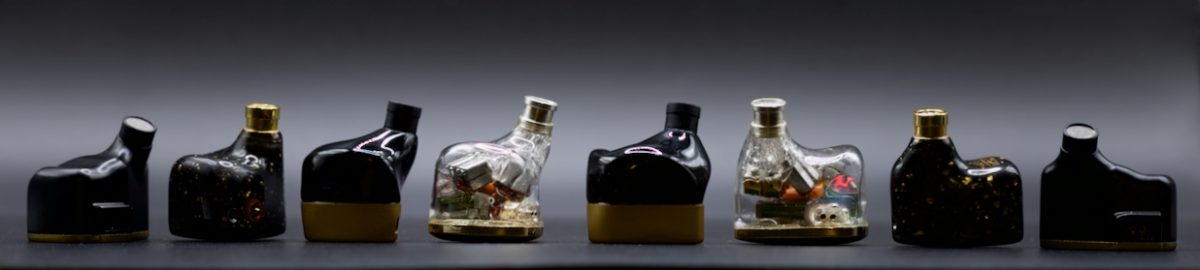
Turning to the shells, if the gold coating on the GMA seemed to be wearing off, this new gold plated brass face plate looks like it’s here to stay. The shells are made of titanium and they seem to have the exact same shape and dimensions as the GMA. Comfort was never an issue for me, not with GMA and certainly not with GMAFE.

There is a vent on the back of the IEM, just below the Vox switch. Switch that can be flicked while listening, with them in your ears, so the effect on the sound can be immediately acknowledged.
Look and feel-wise, a clear improvement over the GMA. As far as I understand, owners of GMA can upgrade to GMAFE. I hope it’s indeed the case, as I imagine someone who has bought GMA would feel frustrated otherwise.

Removing the modules is a bit of an unpleasant surprise. Say goodbye to your fingernails, fingertips and sanity. It’s unbelievably hard to get them out of the shell. The stage one is ok, but the tiny ones are a major pain. I do not remember GMA being so tough.
Now that we got the unboxing out of the way, let’s see what they sound like.
Bass
While the extension is impressive on its own, the control makes it even more enjoyable. The heavy bass notes send tiny ripples through the stage, but this can all stop in an instant when the music demands it. The decay can be quick, provided you give them enough power. Unlike Pentara, where the bass seemed almost too fast, GMAFE was a more relaxed decay, so that it seems just right to me.
With the stage modules on, switch low position can quickly become overwhelming in the low frequencies. The bass is quite forward, demanding attention and distracting from the voice. It is a matter of spatial placement, think of an onion where the inner layers are the bass, the outer ones being where the voice resides. The treble floats atop all this.
The silver modules, aptly named “reference”, bring the bass down to a more reasonable level, but some stage width is lost in the process.

The champagne modules also reduce the sub bass, so the focus is shifting to mid bass a little.
Mids
GMAFE has slightly warm mids, a nice coloration that seems to add to the music rather than take away from. GMAFE is a vocal head’s wet dream. The effect of activating the Vox switch is instant, voices and mids, in general, coming forward and being decluttered from the bass blanket. It’s like a fog light in the dark. There is a slight downside to this, the grit is taken away when activating the Vox switch. They are not very gritty to begin with, but the vocal switch takes even more away. The grit is important for me because I listen to a lot of metal, including death and black metal. The guitars have a very rugged, against-the-grain sound. Not to mention the voices. Amon Amarth or Behemoth simply don’t sound the same when you can’t hear those gnarling, full of spite, vocals. But not only there; some of my favourite female artists have a bit of huskiness in their voice, which, for me is a marker of realism (think Billy Eilish or Dua Lipa).
Coing back to GMAFE, the VOX switch turns them into the best balanced voice forward IEMs I have heard. Other IEMs have the voices forward (Jewel, Erebus, for example) but the GMAFE is the best implementation of this tuning. A very well executed W, with strong, enveloping bass and airy, detailed treble. I cannot emphasize enough how well this alternative tuning is implemented. Let’s just say that if on Pentara I stick mostly with the ON tuning, here I switched back and forth, listening to the same song time and again, and I like both tunings equally, although their presentation is different.
The champagne module adds a bit of weight in the lower mids, while shaving off some of the sub bass, which is obviously a good thing for me.
The black module goes in a somehow opposite direction, with less sub bass reduction, but a slight neutering of upper mids. Cutting some of the air to sub bass sounds to me to leave the remaining frequencies more decisive.


GMAFE (top) and GMA (bottom)
Highs
Detailed and airy, yet, to me, they are completely harshness free. They have an almost Anni 23-like quality. Some coloration is present, but for what is worth, they still sound mostly natural. In fact, more natural than Anni’s (I do love Anni 23’s treble, but to me its colour is what makes it the king of treble). Remarkable is the lack of a ceiling. Cymbals can extend upwards infinitely, thanks to the tall stage. This creates a great sense of immersion , in particular in combination with the stage module. The level of details remains as high as on the GMA, but now there is a better integration, you need to actively pay attention to the microdetails in order tonotice them. Personally, I prefer this more mature tuning, putting the music first. In this regard, GMAFE does sound more natural than GMA where the details are too in your face (comparing them from memory). Also from memory, GMAFE seems to have better thickness in the treble. This becomes even more apparent when moving away from the stage modules.
During the very crowded passages, the treble may get a bit on the thin side. Of course, this is something that I can normally solve with tips, but in this case, I was already using CP145, which are fairly narrow.
With the champagne module, switch down, there is a bit of sibilance, nothing serious, but it’s there. It was mostly absent with the Stage module.

While initially I like silver most, in time I ended up sticking to champagne.
The Vox switch unlocks a less bassy, more mids forward tuning, tastefully done, so that the overall sound is well balanced. This feature is priceless for me, as moving from Maiden’s TNOTB to Templar’s Conquering swords album, the production is quite dark; A simple flick of the switch fixes this in an instant. With the rising power, the ratio of bass to treble changes, but the switch gives you enough flexibility to adapt to any kind of music.
Switching back down, by pushing the voices further away, the stage is larger. I could even call it a landslide difference, and, as mentioned before, the change is instantaneous and it can be performed while listening, without taking the IEMs out of my ears, which is an added advantage.
The downside of the ease of operating the switch is that it can be moved by mistake, which nearly caused me a nervous breakdown first time I put them in, as one side was clearly louder than the other.
Cable rolling
Ascendium is clearly an integral part of GMAFE’s tuning, that part is clear to me now, but it is also a good quality cable, so I have cable rolled both ways.
GMAFE with Sov 2w brings a welcome excitement in the treble, while the voices are more focused. The difference is maybe more obvious in Vox off setting, with a bit more clarity on the voice and a tad more bite in the treble. The bass, with the stage module has a teeny bit more impact of the bass drum, and I dare say a slightly faster sound. What is more important for me, the mids carry a bit more grit, which combined with the rougher upper mids, make GMAFE more exciting. Of course, we are talking about minute differences, GMAFE remains a bassy, large sounding IEM.
With Spectre 4w, GMAFE sheds some of the bass, lifting a veil off the mids and mid bass, increasing impact and bringing more balance to the presentation. The stage remains large and the highs have a touch more bite and sizzle, while maintaining their thick texture. Personally, I love this flavour of GMAFE, brought closer to Storm. The effect is even more poignant in Vox mode, with the voices brought even closer than with Ascendium, while the stage maintains its grandness.
GMAFE with Vesper 8w shielded I expected this to be a heavily bassy combo, but I was so surprised. Sub bass remains largely the same, mid bass has less impact than Spectre (but about the same as Ascendium), while gaining a bit in resolution. The changes brought forth in the upper mids and treble are exactly what I needed, upper mids become a bit thinner, removing some of the colouration, the treble is less polite, more assertiveand ultimately more detailed. The trade off is more sibilance. Luckily, FF included an impedance adapter, that shaves that off, without adding even more bass and without neutering the treble (in Vox mode).

GMAFE with Ulan 8w This is the most bassy silver cable that I have. Sure enough, sub bass hits with improved force. The bass drum makes me feel its vibrations all the way to my chest, despite being full aware this is not possible. The voice is pushed back, and the upper mids have more texture. Cymbals are thinner and more crystalline, going in the direction of that shimmery EST implementation that was so popular last year or so. Ulan and Vox up is one of the best combos for GMAFE.
Tips rolling
First of all, GMAFE is very comfortable for me, despite the boxy shape. I had no issues whatsoever, no pressure building, just endless enjoyment. I recommend wide bore tips, as they let all the treble pass through unaffected. Baroque or JVC Spindot are my favs. The trick here is to go for the minimum size that gives you a good seal, as Baroque can bloat the bass if the size is too high.
Spinfit Neo adds to the holography, increasing the separation between instruments. Even Spinfit CP145 work well, the trick there is (for me) to not insert them so deep, as at full insertion point, they increase bass. A similar effect is obtained with Spinfit W1, which ended up being the ones I liked best.
Penon Liquer are an option if you want more bass, but for me they were unnecessary. Spinfit
Sources
They need power. Ungodly amounts, just like Storm and Asteria. Unlike Storm or Asteria that sounded ok even with weaker sources, GMAFE is almost laughing in your face when underpowered. The bass is rather flappy,the treble is shy and the mids are playing hide and seek. MUB5 in normal gain sounded pretty underwhelming. Crank it up to High+12V and the GMAFE starts shining. The bass is controlled and disciplined, the treble is more intense and the mids have a more dense sound. With some easy to drive IEMs, MUB5 is useless in high gain, as two clicks is already too much. GMAFE is soaking an impressive amount of power, making me wonder if they’ll start glowing in the dark (they do, but not like that).
Audma Brioso in normal gain is relatively ok, but once you flip up the two switches, the whole thing changes.
Nipo N2 is a very good match, since it has good control of sub bass and a bit more grunt in mid bass than other DAPs.
With AK SP3000 it sounded ok, but as the volume pushed into the upper 90s, some hissing was audible; once Tsuranagi was added to the chain, the hissing was gone, and this emerged as one of the best sources for GMAFE, albeit a bit too polished sometimes.
A nice surprise is the Nipo A100 dongle. This thing does not break a sweat driving GMAFE and it allows me to listen to it from my phone, no small feat.
The Apos Gremlin amp did great with GMAFE, adding a bit more of lushness, without extra warmth. Unlike GMA, the FE version does not need a R2R source to sound at its best, it just needs power.
Sound comparisons

VS Storm
When changing from GMAFE to Storm, is like the world has shrunk. There is no denying that GMAFE sounds larger, but in terms of depth, I think Storm still fares better. Another immediate difference, the bass is no longer there. I do love Storm’s bass and it is more than enough for me, but the GMAFE is on another level in terms of bass. While Storm’s bass has a liquid-like quality, getting into even the tiniest space in the stage, the GMAFE is like a doughnut, creating a thick layer of bass, in which the rest of the music resides. GMAFE’s bass is warmer and more sticky, while Storm’s is very nimble and a bit dryer.
Listening to Öldtürme Beni from Altin Grün, Storm shows it’s true class, with a perfect (for me) rendition of the song.
GMAFE is a lot bassier, with the mids a bit depressed and pushed back and with a slightly different treble distribution. There is less air in Storm’s treble, but it somehow sounds more logical, more the way I expect it. Despite GMAFE having more sub bass, I find Storm’s mid bass more muscular, more articulated. In the mids, both do a good job, with GMAFE sounding a bit closed in and Storm more open.
With the mids more forward and more energetic, Storm is the one that can get a bit shouty under certain circumstances, while GMAFE it’s rattling my head into oblivion long before it gets shouty.
GMAFE has certainly more wow effect to me, but it is a matter of preference. One is reference, the other is tastefully coloured.
Overall, I find Storm’s stage more to my liking, because it extends equally in all directions. Depth is certainly more impressive than GMAFE’s. I also prefer the more raw mids and the extra grit Storm provides.
Vs Pentara
Pentara is another wide stage wonder, characterised by a strong, muscular bass, with blazing fast decay, mid bass focused, natural, gritty mids and energetic and incisive treble.
Compared to GMAFE, the bass has less extension and less reach. Where the Pentara starts to roll off below 40Hz, GMAFE continues to climb like an aeroplane. The difference is immediately obvious, Pentara having a drier, less extended sub bass, but more articulation in the mid bass.
Mids are more natural and a bit leaner in Pentara. The voices are further than GMAFE with Vox on, but closer than GMAFE with Vox off, with very good details,much like GMAFE.
Treble is similar in energy and air, with Pentara having more bite. Just like GMAFE, Pentara can sound occasionally thinner than Storm in the treble. During congested passages, the cymbals sound a bit flimsy, lacking that heavy texture so present with Storm. Once more, Pentara is a little bit drier than GMAFE, sticking to the reference timbre in as far as I can tell.
In terms of staging, Pentara is like a 3D cinema. It is more holographic than other IEMs, but it keeps the music flowing naturally. It’ stage is spherical, like Storm’s. However, there’s a caveat, in rare occasions this large, panoramic presentation is too spectacular to sound natural, something I only noticed with acoustic instruments. Both leave me wondering how is it even possible to have such a large stage in an IEM.
GMAFE is warmer and, one could say, darker than Pentara. This also means that female voices on Pentara may sound a bit more clinical than on GMAFE, which, in turn is warmer and more engaging. Choosing the right source is important with all of these three IEMs.
Vs X
Not much of a comparison here, as one is the most lively IEM in my collection, with rough, lively mids, especially upper mids, making the guitars scream like none other, and with an electric treble (X), the other being rather polite, bassy, and in general well composed. GMAFE is a gentleman, while X is the semi-drunk punker, and I say this with a lot of love for X. Nothing makes music more alive than X with Nipo N2 or the Teac UD-507.
Vs GMA
From my notes, GMA was not as bassy, not as warm and maybe a little bit less engaging than GMAFE. The vocal switch was more than a gimmick for me, I have only used it for watching videos. The treble on GMA seemed more detailed, as it was more forward and maybe not as rounded as the current iteration of the Anniversary Edition. In addition, the layering of GMA was extraordinarily clear, as if lines were drawn between instruments. Very spectacular, turning “Empire of the clouds” into a real movie in my head. But, at times, this separation seemed unnatural. In conclusion, a much more analytical experience than GMAFE, which in turn is more musical and engaging.

Songs
Ne Obliviscaris Equus
GMAFE needs the Vox switch on with the Stage modules. Otherwise, there is simply too much bass to fully capture all the details of this piece. GMAFE has slightly more detailed treble at a first glance, but Storm does very well the texture of those highs. Despite GMAFE having more air and a bit more energy, Storm’s treble is a step ahead in terms of texture. The fact that Storm’s output is more linear, means there is more density around those highs, while with GMAFE leaves the top treble a bit exposed, due to its V shape.
Of the two, Storm appears more clear, although GMAFE with Vox switch on is very, very close. The quality of the treble is simply amazing, the only choice here is between the more airy GMAFE vs the more meaty Storm.
Like Storm, Pentara puts a lot of accent on mid bass, leaving the rest of the spectrum uncluttered. The separation between violin and the rest of instruments is exceptionally well done. All throughout the song, the bass guitar is providing a well articulated background, on which the rest of the elements are placed, each in its own space. The lower mids are nicely textured, with good grit, bringing Pentara closer to Storm than GMAFE in terms of overall tonality.
Floor Jansen – Mama
Vox is almost mandatory here, in order to make the best of Floor’s powerful voice. A touch of warmth to the voice makes it even more life-like. It does convey the feeling of live performance, and the very forward voice works wonderfully here. If in some occasions I found the stage modules to stretch the stage maybe a bit too much, it’s not the case here. It is quite fitting for a live performance.
Storm appears more open, with a more even presentation, the voice a bit further than GMAFE Vox up, but also with a higher placement, making the live presentation more life-like. A bit more assertive presence, with wonderful control of sibilance.
Pentara has the live feeling, maybe even more than the others, thanks to it’s panoramic presentation. The voice is central, with superb details, exceptionally clear and, like Storm, less coloured than GMAFE. The mids are less thick than GMAFE, but not lacking in any way. Plenty of air, too.

2Pac – Tradin’ war stories
Stage, Vox down. Ample bass, focused on sub bass. Sizzling treble, slightly recessed voices, but easy to understand the words, nonetheless. No sibilance, or very faint traces of it. The treble is a bit piercing. Vox on brings a bit more sibilance, but it also brings the voice really forward. The mastery of GMAFE is in full swing, as this tuning is as enjoyable as the other, although really different. The switch down will appeal to bass heads, while the other is for…wel, non bass-heads.
Storm struggles with this one, with the cymbals having way too much sizzle, but at least the sibilance is well controlled. The midbass is more evident here, cleaned of the extra sub bass, it allows me to appreciate what I consider to be the best bass player on a rap record – Corney Mims (my experience is, however, limited).
Pentara is as bright as Storm for this song, with the addition of a warmer, more elevated sub bass. There is a lot of mid treble, but in combination with the airy, large stage, works quite well.
Paradise Lost – Salvation
So many layers, it’s hard to believe I am listening through an IEM. The stage is large, and despite having a lor of low end grunt, some more graininess would have been a worthy addition. Alas, the drums fills show a very precise placement of the toms, while the voice has that cavernous quality. The silver modules were a better match than the stage ones. The amount of grit is average, GMAFE remains a well mannered IEM.
This one plays to Storm’s strong points, ruggedness, openness and balance. There is evidently less air than GMAFE with stage and Vox down, but Storm works its usual magic and keeps everything at perfect level all the time, something I have also noticed some months back, when looking at Erebus. The tension of the break is palpable. From the distance between toms, to the perfect separation of the two guitars, the contrast between the growling and clean voice, this is Paradise Lost at their best, presented in a manner only Storm is capable of.
Pentara once more is like a Storm with DD bass, in the sense that it sounds raw, rough and detailed. The surround-like bass sounds a tad less natural than Storm’s, but more natural than GMAFE’s. Bass drum has more impact than the former and guitars are more gritty.
David Gilmour – What do you want from me
Vox up: the guitar and voice are taking the center stage, with a pleasant surprise being David Gilmour’s raspy voice. So far, GMAFE was rather polite, but now the gloves are off and the voice is rich and textured. Natural. I can only conclude that the higher frequencies are less polished than the lower one, like the death metal growling. The charge is lead by the cymbals, with the bass following closely and the voice being a bit more distant than Storm. I feel the Vox up is a must here, granting a smoother transition from to his upper registers. The stage is enormous, even with the more reference Silver modules.
Once more, Storm appears brighter than GMAFE. The cymbals remain the main anchor, but the voice takes the second place now, with the bass being there for support. The vocal harmonies are something special.
Pentara is very detailed, but with a slight thinness in the lower mids. After GMAFE, everything sounds a bit thin, in fairness. The treble has good energy, right at the top of my comfortable range. The speed of Pentara’s bass is not really an advantage here.

Bolis Pupul – Frogs
Belgium has quite a lively electronic scene and the Bolis Pupul is one of the spearheads of this movement. This is the kind of music that gets 100% out of GMAFE. The bass is to die for, not only massively extended, but textured and detailed too. For this genre, I have all the mid bass I could possibly want and it plays nicely with both Vox on or off. My favourite was Vox off, larger than life bass with minimum bleeding into the mids.
Pentara has the bass that works best for me. Large, enveloping everything, with a subwoofer-like quality, but at the same time fast so there is no bleeding of any kind, every note has enough time to decay before the next one rises.
Louise Attaque – Ton invitation
Twenty years have passed, but when I listen to this song I’m suddenly transported back to the lab, listening to this CD on the computer attached to the HPLC machine. I’ve chosen this for testing the transparency of GMAFE. Suffice to say it passed with flying colours. A teensy bit of sibilance with the stage modules, but well within tolerable limits. It sounds like I’m in the studio with them with the switch down. Vox up and the sound changes to them singing in a small club. This mids centric tuning is even more natural than the bassy one.
Storm is more incisive and apparently more detailed. It’s actually just the fact that the bass is less intense, letting the details shine through easier. The voice is a bit clearer, just like the guitar. Once again my attention is drawn by the natural sounding cymbals, and the acoustic guitar.
Pentara has the best bass for this song, large, muscular, but fast and lean. It’s about precision, not quantity. The clarity is outstanding, and the mids are relatively thick, especially the lower mids, while the upper midsseem to have a small tuck compared to GMAFE and even Storm. This leaves the upper treble a bit exposed and might be problematic for some.

The tiny dots glow in the dark
Einar Solberg – 16
The realism of the burning wood and the harrowing atmosphere are early signs we are in the presence of a very detailed IEM. Einar’s voice sounds organic and emotional, and it remains constant all the time (some IEMs have issues keeping his voice at constant volume, so there have a bit of a pumping effect, but not GMAFE). I preferred the silver modules here, the stage is more intimate, but a tonality closer to reference.
Storm is equally detailed and realistic, with more pregnant lower mids, leading to a slightly more balanced presentation.
Pentara shines in the beginning, making me wish I had an open fireplace like the one in the songs. Einar’s voice is very close, every breath is audible, the tiniest inflections in his voice are clearly audible. The chorus singing “sixteen” has a transcendental quality. Later on, a slight harshness appears in the background vocals, which means some people might prefer GMAFE, with its more polished sound.

IEM rolling the Ascendium
Storm with Ascendium
A little emphasis on sub bass, slight recess on the mids and the cymbals have a thicker, shorter splash, a more dispersed, faster decay sound. The harshness/sibilance disappears from the Tradin’ war stories and overall, a better listening experience for this song. The same slight accelerated decay is audible with Floor Jansen and Ne Obliviscaris. The upper mids seems to be more polished.
Pentara with Ascendium
Similar to Storm, the highs gain a little thickness, a bit of air is lost, but the cymbals seem to resonate more horizontally (combined with the extra thickness/texture) but the upper mids lose some liveliness. The bass seems to shift focus from mid to sub, just a bit. Pentara is overall calmer, thicker, but the magic of its stock cable stage is somehow diminished.
X with Ascendium
It brings about the same changes, with a more obvious on the upper mids. X’s ruggedness is reduced and it becomes a safer, easier listening experience. Layering is not as precise as LL Venom’s, with some elements being now place in the same plane, amphitheatre-like stage X is building with its stock Venom. The treble is undergoing the same shortening-thickening transformation.
An interesting effect of Ascendium on Myth, where the treble is suddenly uplifted by removing any trace of planar glare, while the V is accentuated a little bit. Some roughness is lost here too. Ascendium is a calming/polishing cable, with excellent stage width and height, but less layering than other options.
Conclusions
Let’s first address the elephant in the room. GMAFE is expensive. More expensive than Storm and pretty close to HEX. Leaving aside the worthiness aspect, where each will have to decide for themselves, the crazy price comes with some nice features. First, the cable. Not only it feels sturdy and comfortable, but it comes with a full set of Con-X. A nice addition for the adepts of cable rolling. Second, the number of 8 tunings via modules and Vox switch, with two of these being easily accessible. While the difference between modules is not that huge, affecting mostly sub bass and stage, the difference brought forth by the switch is more obvious and immediate (you can switch while listening). A third, maybe less important aspect, is the unboxing experience. It’s the best I’ve had so far. The piano finished box, the large puck style carrying case, everything is built to impress.
In terms of sound, GMAFE remains true to FatFreq’s bass centric sound. Yes, it can sound like a brute force bass-head IEM, but it is much more than that. You can tame the bass, and bring some equilibrium with the silver modules, but this IEM will always remain a bassy one, with a detailed sound and good imaging.
Who is it for? First of all, bass lovers. They will rejoice with stage or black modules, that bring a larger-than-life bass, making it perfect for electronic, ambient and dance music. Then, of course, for those looking for a large stage. I haven’t heard to date something that sound larger than GMAFE. While this stage works very well with electronic music, for some rock/blues/pop songs, it may seem unnatural.
Who should stay away: those adverse to bass. This is a first and foremost bassy set. Also, if you want a reference tuned IEM and are looking at this, maybe Storm is a better choice. You can bring it closer to reference, but it will remain a warm and bassy set nonetheless.
All in all, a worthy addition to any IEM collection, and I, for one, feel lucky to have spent so much time with them.