
Introduction
Campfire Audio Trifecta is an IEM like no other, with three dynamic drivers placed into the corners of a triangle, all firing into a central acoustic chamber placed in the middle of said triangle. It created a big fuss when it was initially released in 2022. I had a chance to experience it at the HighEnd fare and I was shocked that such a big sound can come from such a small thing. That was the moment that reignited my passion for IEMs, after a long period of happily rocking only over ears. When my good friend offered a chance to spend a longer time with them, I accepted eagerly. Since there is much controversy surrounding this one, I figured it would be good to let the world know what I think of them. So, here it is, my unsolicited, unpaid, biased and passionate review.
Packaging
Trifecta arrives in a wooden box, with a cardboard sleeve. Lifting the lid and sliding it into its open position turns the case into a presentation support, especially if you make use of the tiny hand provided in the box.
In typical Campfire fashion, the box is well stocked, with the high quality leather pouch which is one of the most elegant solutions for storing IEMs, an IEM sock and another, textile pouch, hosting two cables. For, you see, Trifecta, in accordance with its name, comes with three cables. The environmentalist in me would have preferred just one cable with swappable terminations, but alas, Campfire is not the only brand taking this route, Sennheiser does it too with their IE900. The Time stream cable is of good quality and unlike other cables in the IEM sector is a flat one, rather than braided or coaxial cable. All three of them are the same, only the DAP side plug is different, 2,5 mm; 3,5 mm and 4,4 mm.

Also included in the box are some tips. Again, in a typical manner, Campfire included some foam tips alongside the silicone ones.
Lastly, provided in the box is a tiny hand, that can be inserted in a triangular opening in the lid, resulting in a nice exposing case.

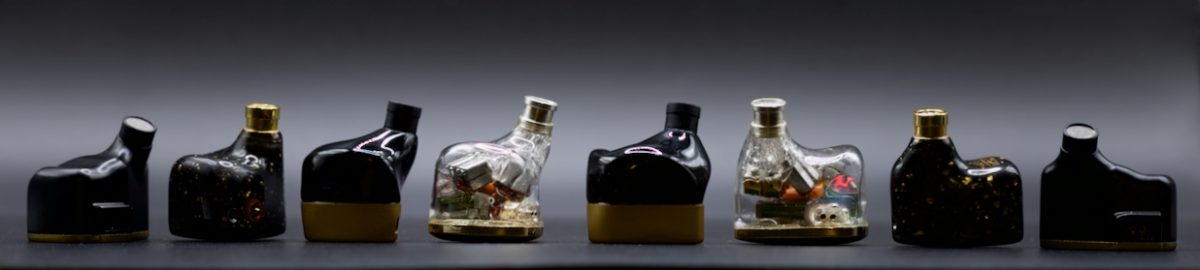
The shells are made of moulded nylon, and they are see-through, exposing the routing of the wiring inside. The choice of material means that they feel different from other IEMs. Unlike the resin used in other IEMs, the nylon is less likely to suffer from yellowing.
Comfort
The first time I encountered them, I had big issues determining how they were supposed to go in. The years have passed and my ears accommodated a lot of strange/big IEMs, so no issues now. Despite their bulky aspect, they are rather small, with a short stubby nozzle, and they sit perfectly in my ears. The drivers are individually vented, but despite that, I had a bit of pressure building up in one of my ears. Not enough to make me pull them out, but if you know you are sensitive to this, better try before you buy.
Tips
My favourite tips for Trifecta are the ePro Horn. These are very skinny, wide bore tips, letting all the treble through, while having a minimum effect on the bass. Honorary mention, Baroque stage. In any case, wide bore, skinny tips worked best for me.
Pairing
Trifecta is an easy to drive IEM, the official figures being:
Impedance 6.3 @ 1kHz
Frequency Response 5-20 kHz
SPL: 94db @ 1 kHz- 16.9 mVrms
THD less than 1%
While a DAP with loads of power is not a requirement, I have found the sound to be completely different between the AK SP3000 and the Quloos MUB5 powered by 12V DC, where the bass had a much tighter control and the treble had more air. A similar experience I had with Audma Brioso. Rather than being simply very warm, Trifecta seemed to soak up that extra power to clean up the bass and give more zing to the treble. Brioso was in the end, my favourite pairing for Trifecta.

Sound
The sound is very particular. First thing you notice is how large everything sounds. The stage is extended in all directions and even after all these years, I still can’t believe this is “just” an IEM. The stage extends on all three axes, like the number of drivers in each side. Maybe the width alone is not impressive in the world of Pentara, Asahi and others, but combined with the depth and height, it makes for an instant jaw dropping effect.
The second thing is the bass. An omnipresent, warm-ish kind of bass, that does not excel in speed, but it does so in naturalness and timbre. There is no microscopic detail here, it’s just a well matured sound, focused on integration, rather than exposing each and every nuance. There is a hefty bass shelf, extending all the way to the mids. The effect?! The bass can reach low, with good impact and slam. The source made a hell of a difference for me. With lower quality sources, the bass was all over the place, with excessive warmth and a sort of slobbery delivery. With better quality ones, the delivery is more precise, with more urgency and a faster attack. The decay is exactly what I expected from a DD. Mid bass is equally elevated, with the effect being a very muscular bass guitar, with good articulation and a meaty texture. Even on crowded tracks, there is a clear separation between the toms, bass and distorted guitars. If we really want to find some negatives, the speed, regardless of the source is not enough for extreme metal acts.
The passage from lows to mids is smooth, without much bleeding (again, source dependent). The mids do carry a bit of warm coloration, but it is not excessive. Male voices are full sounding, natural, with a good amount of granularity, both female and male voices sounding natural and pleasant. There is no harshness anywhere and a way of conveying the details in a holistic approach. Nothing sticks out, everything is harmonious to my ears. Listening to Jesse Cook’s acoustic guitar, you’d be hard pressed to recognize the bassy monster in Trifecta. Acoustic guitar has a warm, calm sound with a touch of smoothness. Both male and female voices appear a bit veiled. This becomes more apparent when switching between Trifecta and other IEMs, but during casual listening session it is hardly noticeable.
Treble is one of the areas that is particularly improved with a better quality chain. What I liked is the natural timbre of instruments, be it cymbals or violins. There is a lot of air, and the cymbals sound thick and credible, with the splashes perfectly controlled, the bells and the high hats present a bit remote in the mix, but still occupying a coherent space. There is a richness of textures that it is usually characteristic to top of the line hybrid setups. Not the fastest transients around, so don’t expect the kind of treble response of EST drivers. Nothing of that ethereal sound floating in thin air. Instead, Trifecta’s treble is more rugged than its mids and bass, which I find a nice contrast with the warm presentation. When I say rugged, do not think it’s shouty or harsh. Nothing like that, it’s simply unapologetically confident and perfectly expressed. Violins also benefit from this full sounding treble, having a hefty body.

Comparisons
Frankly, there is no set that gets even close to Trifecta, so I decided to compare them with the NGaudio Erebus, Muxicbox Steranko S40 and even Sennheiser IE900.
God’s Acre – Soen
Since exceptional circumstances ask for exceptional measures, I turned to the anachronistic record Lykaia, of Soen. They recorded this album by using analog equipment to have it sound more natural and vile. The production seems subpar on most of my sets. But Trifecta is not my run-of-the mill hybrid.
Trifecta sounds a bit shadowy, bass heavy, but it all falls into place. The bass is leading the charge, which is not so bad, as it sounds great. There is some bleeding into the mids, but it is all forgotten, since those mids are warm and natural. The voice, in particular, has enough space to shine and it does so with ease. The slightly muffled treble (partly a feature of this record, partly a feature of Trifecta) helps keep the mids afloat, by taking a back step both spatially and in terms of energy. The catch with this album is that there are several places where distortions are audible (I play locally saved files, ripped from CD in FLAC).
If normally I’d find that much bass annoying, in this case, for some reasons it is perfectly ok. The bass guitar is not just a backbone, it is integral part of the story.
The bass is rivalling Joel’s voice on this track. Plenty of flourishes are crystal clear, despite this not being a set focused on details. The guitar is secondary, this song is all about bass and voice. The voice is full of emotions, with a sense of laboured effort, further amplifying the drama of this said song. Then, all of a sudden, a riff that could have been taken from Metallica’s Orion breaks out. Listening to the dialog of guitar and bass is almost a mystic experience.
NGaudio Erebus brings the voice (and most instruments, really) one step closer. The bass guitar is even more articulated, but somehow more in the background compared to Trifecta. It is still easy to follow every nuance. The voice is unveiled and the words easier to understand. The cymbals sound cleaner and clearer, with more air and more definition. Funny enough, Erebus does not sound much leaner than Trifecta. The stage is a huge difference, going from Trifecta’s large stage to a much narrower one (I am pairing Erebus with LL Venom) but with more height and depth. Some low frequency distortion is audible (the quality of the recording), which is not a surprise for me.
Steranko S40 picks up more of the distortions, and this makes the whole experience a bit less enjoyable. The bass guitar has more clarity and articulation, the drums a bit of a sharper edge. The voice is more forward, sounding more natural, less shadowy. At the same time, the voice occupies a large part of the stage. That organic and vile vibe of the guitar is lost, though.
Moonhorse – Avatarium
One thing led to another and I am listening to Avatarium’s Moonhorse. There is a direct line connecting these two albums, and that is Marcus Jidell, guitarist in both bands. The production is not much different, another similarity between these two albums. A female singer this time, her voice being just as expressive as Joel Ekelöf’s. The bass is bordering on being overwhelming, but it manages, in extremis, to remain within acceptable limits, at least for me. This is thanks to it being not just a constant rumble, but more like a calculated, anchoring, living breath. There is an articulation characteristic to much faster, nimbler all BAs setups, but with the impact of a DD. The voice sounds raw and lively. The song has a succession of soft, melancholic vocal/acoustic guitar parts and heavy-handed distorted riffs, all under the lead of the characteristic bass sound of Leif Edling (co-founder of Candlemass). Trifecta does a good job at maintaining the sound output relatively constant, so you don’t have to fidget with the volume all the time.
Erebus set out to expose even the tiniest detail in this track. Which is good, as there is so much going on, from the Candlemass-like beginning to the looking glass on Jennie-Ann’s voice, this track is majestic. The faster part, starting around 3:50 is a perfect showcase of Erebus’ technical prowess; All instruments and the voice remain perfectly focused, culminating with the bass flourishes at 5:00 mark. The drums sound big, with less elasticity than Trifecta, enhancing the dramatic effect of the song.
S40 is not as detailed as Erebus, but more detailed than Trifecta. The bass has about the same elasticity as Erebus, band the voice is more smooth. The bass elasticity is exactly what is required for this kind of music. A bit of sibilance is my only complaint. That being said, I find Trifecta’s approach the best. This song is more about emotions and contrast than technical virtuosity.

The book of Boba Fett
Trifecta has all the attributes of a cinematic experience. Apart from the massive bass and the nice snappy percussions, you have the background chorus, with a depth inducing goosebumps. What is particularly enjoyable, is the constant rumble of the bass, it sounds as if the reserve is infinite and it go on like that forever.
Erebus has very nice separation, but the lack of width of stage does not play in its favour here. If only I could have the stage width of Trifecta with the clarity of Erebus….The tiny echoes can be heard for a bit longer. If I were to choose one, I would go for Trifecta.
S40 gets closer to Trifecta’s huge stage, while not being quite there. It falls right in the middle, it doesn’t have the large stage of Trifecta, nor the great drums impact of Erebus. While I cannot find any faults as such, both the other two IEMs felt more entertaining here, Trifecta with its deep reaching bas and Erebus with its dynamism. Not the best playing field for S40, so I have to give this one to Trifecta, which is entertaining enough to keep me listening for more music of this kind.
I, emperor – Sabaton
With Trifecta, the treble is a touch shy for me. The two guitars are chugging happily in the second verse, with enough body and grit. I could’ve sworn Trifecta is more civilised than this. It’s not the aggressive graininess of Pentara or Elysian-X, but it is decent effort overall. The notes are thick, but not syrupy. While the dynamic is strong, being virtually impossible to not pump my fists toward the ceiling, the first signs of imbalance are here. The constant pummelling of the drums and the elastic rubber band that is the bass, is quickly becoming too much and only a drop of volume can preserve my determination to carry on.
S40 is more open, the stage is wider, with better horizontal layering. This is a mids forward IEM, so the whole stage is a bit congested. I find the mids smoother than Trifecta’s, which is not necessarily a good thing. The bass is faster, with less elasticity, so the music seems to have more dynamism.
Compared to Trifecta, Erebus is brighter and more detailed. There is more grain in the lower mids, the two guitars sounding more rugged and a bit closer. The drums have a bit more edge, which in combination with the extra sparkle in the treble infuse the song with an extra shot of energy. If Trifecta has a more romantic presentation, with its massive stage, warmish and emotional sound, Erebus is in almost total contrast, with a speed focused presentation, blazing fast transients and a sense of urgency.

Your heart is as black as night – Melody Gardot
Voice comes through with clarity and is centrally placed. There is a nice layering of the accompanying piano, drums and trumpet. The trumpet, in particular, shows very good texture and it sounds grainy and well textured. The cymbals are placed behind, and they act like guiding lines, all directing to her voice. The level of details is more than satisfactory here, and the depressed treble serves its purpose admirably.
Erebus sounds much more airy, from the first notes. The voice is very close, very detailed, with an organic timbre. The trumpet sounds definitely more gritty and the cymbals carry more details. If I may try a plastic comparison, Trifecta is a double whipped cream, while Erebus is an airy mousse.
S40 is the reigning champion for this kind of music. The voice is perfect in all regards, timbre, warmth, energy, brought forward and very detailed. The cymbals have just the soft touch required for this slow tempo jazzy piece. The percussion is clear and delicate, and the trumpet is gritty, while the piano is so smooth.
Count Dooku – Aspentuck
Trifecta shines here with a large stage and perfectly placed sound effects. The song really opens up around the 2:15 mark and the way that alarm blare starts and stops it’s a testimony to Trifecta’s speed and precision. For when the bass comes to an abrupt halt, this is exactly what Trifecta does, it is as if the sound is frozen in an instant. The echo sends tiny ripples through the right side, slowly fading in the distance in a way that leaves the stage wide open and seemingly infinite. For this kind of music, there is very little that could be improved.
Erebus is doing its best but this track is not very suited for this kind of intimate presentation. It’s not bad, but simply nothing special.
S40 does a good job too, but nothing compares to Trifecta’s forceful, ballsy presentation.

Ugly side – Blue October
With Trifecta, when the voice started, it startled me, as it is very close. It doesn’t feel overwhelming though, but, when the whole band is in full swing, it does feel a bit congested. The bass is well controlled, giving a good sense of timing, in particular when it needs to stop rapidly. Trifecta is fast enough to preserve the integrity of the pauses. Changing to Audma Brioso brings a better sense of control to the lower end and a lot of clarity in the treble. Combined with the huge stage, I have to say, it makes for a compelling listening experience. There are moments when the bass feels overdone, but they are quite rare.
S40 does a great job here, the violin having more texture than I expected. The stage is fairly large, with instruments logically placed and in its typical manner with separation that is more looking to integrate everything harmoniously, rather than expose and dissect every instrument. Changing the source from MUB5 to Audma is like opening the door to a whole new level of sound. S40 simply synergises very well with Brioso. The bass guitar is better articulated, the treble gains a lot of air and a sharper definition, the stage is taller, and the voice remains central and close.
2Pac – Skandalouz
For this kind of music, Trifecta is perfect. Ear-bleeding bass?! Checked. Treble that is present, but not disturbing? Checked. Vocal clarity?! Oh, yes!
What is surprising here is the lack of bass bleeding into the mids. Sure, the lower mids are warm, but there is no smearing, even with DAPs with a bit of an elevated bass shelf, like the Nipo N2. Another big plus is the mid bass/ sub bass balance. While there is a clear focus on sub bass, the mid bass is also nicely lifted, so all the flourishes of the bass guitar are nicely highlighted, which makes listening to the entire album a pleasure. For a rap album, All Eyez on Me has a very good bass line.

A bit more texture on the bass with Erebus, but other than that, as expected, slightly too much treble. Perfectly listenable, but it sounded more coherent on Trifecta with its less marked instrument separation. The “perfect” separation provided by Erebus seems a little bit out of place here. The number of details going on is high, and quite often my attention is distracted from the main music.
Misericorde II – Ne Obliviscaris
Trifecta has a bass first approach, the mids having just enough grit, in particular the violin parts having a satisfying, thick, texture. It’s got a massive sound, but the details are, in particular in the treble, a bit shadowy. The massive focus on bass and the slight sluggishness thereof make Trifecta not the best choice for this song, for me, as I prefer a bit more bite in the treble. On the other hand, it is perfectly fine for an evening session, when I prefer a less hyperactive sound.
Switching to IE900, there is a whole new sense of air with the cymbals having a lot. more bite. Of course, no IEM is perfect, so around the 3 min mark, when the track gets more crowded, the violin sounds less meaty than with Trifecta, maybe even a bit thin (I am using the same overpowered setup). Despite an apparent thinness of mids, IE900 holds his ground valiantly. The drums have a bit less impact, but the sound is crystal clear and those cymbals are totally addictive. IE900 is lifting a veil, but I cannot help thinking there is still something missing. With the help of a Brise bespoke cable, IE900’s bass is more precise, with more articulation and zero bleeding. The stage is smaller, but the separation is more pronounced. Overall, I prefer the IE900.
Steranko S40 is somewhere in the middle, between the clinical precision of IE900 and the warm fuzziness of Trifecta. The bass, without having the same penetrating power of Trifecta, it is forceful and warm-ish. There is an extra dimension added to the mids, while maintaining the clarity. The violin sounds more natural than either of the other two, and the guitar solo at 2:30 has great tonality. Once the band is in full swing, there is a sea of elements, the cymbals are more textured, with a touch less bite than IE900, the mids are rich, velvety, but not shadowy like Trifecta’s. The thicker violin sound matches better the rest of the music, and the bass guitar sounds a bit dryer. This is, by far, my most preferred presentation.

Conclusions
There are many IEMs competing for our attention nowadays, from treble specialists, like Annihilator to bassy gems, like Duality. In this landscape, Trifecta manages to carve a place of its own. First, by the innovative design, with three drivers firing into a common acoustic chamber. Secondly, by creating a niche of its own when it comes to sound. They are undeniably bassy and warm. They are without a doubt, not the most detailed IEM out there. But there is something mesmerising about their large sound stage and the warmth that is not excessive, but rather natural. After a long day’s work, listening to Trifecta makes the problem go away. For me, Trifecta is like the evening after a sunny day. It’s still warm, but breathable; the hustle and bustle of the day is forgotten and the time for enjoyment has come. They work very well for calmer music, bluesy stuff, regardless of whether is a male or female singer. But it’s not their only talent, they can be utterly fun with electronic and dance music, where the large stage and the vibrant bass make for a compelling listening experience. Another talent, is classical music, where the bass is less present, and the mids have a chance to shine. Listening to Bach’s Brandenburg Concertos was more fun with Trifecta than with a highly neutral set like Storm. The thick notes and the stage create the illusion of being in the concert hall. In fact, they worked well with most instrumental stuff, be it Classical, Polyphia or Earthside. Last, but not least, if rap is your thing, it’s difficult to find a better set for it.
On the negative side, fast, technical metal does not manage to get the best out of them, the relaxed presentation of bass and treble negate almost entirely the advantage brought forth by the gritty mids and the tonal richness.
Recently, I read various opinions, citing either Clara or Astrolith as the best IEMs Campfire Audio ever made. While I don’t claim to establish a hierarchy (I LOVE a lot of IEMs), I fail to see how, when talking about Campfire’s best IEM, Trifecta could be ignored. In a world of alike IEMs, Trifecta was and remains a breath of fresh air. I would like to see more experimental IEMs like it, rather than countless copies of a safe design and tuning.