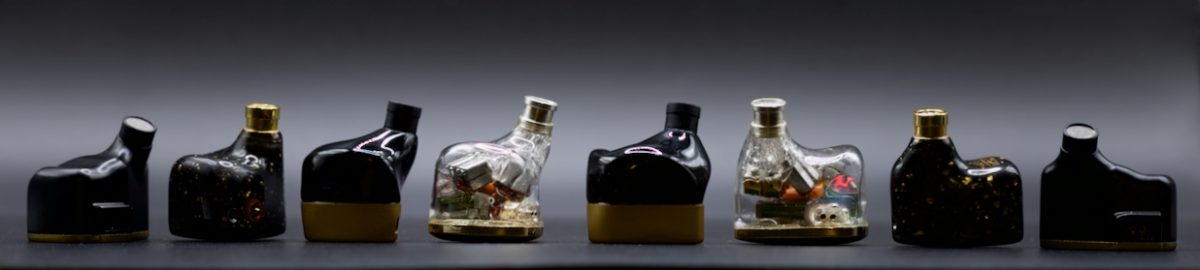
Aroma Jewel is a tribrid IEM, a flagship from Aroma Audio
Disclaimer: the unit reviewed here is a long-term loan from a good friend.
Technical Specifications (from Aroma)
- Acoustic Architecture: 13-Driver Hybrid Tribrid
- Ultra-Low / Sub-Bass: 1x 9.2mm Proprietary Dynamic Driver (DD)
- Mid-Low Frequencies: 4x Balanced Armature Drivers (BA)
- High Frequencies: 2x Balanced Armature Drivers (BA)
- Ultra-High Frequencies: 6x Electrostatic Drivers (EST)
- Crossover: 4-Way Passive Crossover System
- Impedance: 22Ω @ 1kHz
- Sensitivity: 103dB SPL / mW
- Frequency Response: 10Hz – 22kHz
- Isolation: 26dB (CM-style Universal Fit)
In the Box
- Aroma Audio Jewel Monitors
- Hard Leather Carrying Case
- Soft Protective Pouch
- Acoustune AET Series Eartips (S / M / L)
- Stock Cable: OCC Copper Litz Cable (1.2m)
- Connector: 0.78mm 2-Pin
- Termination: 3.5mm Stereo Plug (Standard)
The packaging is quite nice, with a blue cardboard box, inside of which there is a heavy metal (also blue) box. Once you slide open the metal lid, you are greetedwith a puck-style carrying box and, in another opening, the tips and cable.

In terms of building, there is not much to say, they are well built, with a semi-transparent shell, letting you peek inside. The shells are rather large, deep, with a short stubby nozzle.
The 2-pin ports are flush, and they aren’t the tightest I have encountered. Anecdotally, I have seen Aroma IEMs with very loose ports, so this is maybe somethingto bear in mind when buying used.
The provided cable might sound good, but it’s not much to say about it. It’s an 8-wire, very thin cable, relatively pliant, but also springy and with important microphonics.

Sound
Bass
Rich, ample, but fast and well controlled, the Jewel’s bass provides a solid foundation for a well tuned sound signature. The biggest quality is that even though bass presence can be impressive when called upon, most of the time is not there to impress you. It is not screaming look at me, it just minds its own business and is there if the situation calls for it. It’s got a reassuring but unintrusive quality. It’s an important advantage when listening to prog rock, like the Syndenes Magi (Arabs in aspic), which sounds bloated with traditional bassy sets.
For a DD, the speed is very good, double bass drums remain distinct, with just a shade of elasticity. They are a worthy companion for black metal. I would have liked faster attack, to bring a plus of dynamism to the drums, but in fairness, that is more the appanage of BAs, rather than DD.
Mids
With its relatively aggressive pinna gain, the Jewel places vocals front and center, but the presentation is a double-edged sword. While distorted guitars have enough grit, the energy is tilted heavily toward the upper-mids. This creates a perceived dip between the sub-bass and the vocal core, leaving me wanting more “grunt” and body in the lower-mids.
As a result, voices—while clear and forward—can lean toward the cold side, occasionally taking on a “raspy” or “dry” texture. On tracks like Dua Lipa’s Love again, this tilt becomes obvious. The higher register is occasionally so accentuated that the artist can sound as if they are struggling or pushing too hard, rather than gliding through the notes. This happened more with male artists. It’s an intimate, highly resolving midrange, but one that prioritizes “bite” over “bloom.”
The guitars have good bite, and a forward presence, making Jewel perfect for instrumental stuff, the likes of Animals as leaders or Long distance calling. The last time I heard a Strat sting like that, was the Elysian X.
Treble
While in general of sufficient amount, there is a bit of a veil hanging on the treble region, making the Jewel feel just a bit claustrophobic, with a ceiling too low for those cymbals to have enough space to unfold. The texture, on the other hand, is spot on. Never had the cymbals sounded thin with Jewel. The more I listened, the more my brain adapted to this less forward approach to treble and I think it has its merits. The high-hats have one of the most natural textures I’veencountered so far. For slow jazz, I generally like a longer decay, but I am really nitpicking now. With a change of cable, the treble sounded a bit more energetic and airy. It’s a thin line between natural sounding cymbals and too “perfect” ones. I find live music, such as Orianthi’s How do you sleep a good test to this effect. I like to hear a bit more rough cymbals in live recordings and Jewel delivers. The guitar has very good presence and the harmonics are there to lend it a nice shimmery quality. The immediate advantage of this tame(r) treble is that you can increase the volume seemingly without end. In fact, Jewel does sound better at slightly higher volume.

Stage and imaging
As already hinted, Jewel’s stage is not the largest. It is relatively narrow, but also tall and deep, making for a very engaging listening experience. Where it shines though, is the holographic imaging and separation, as revealed when listening to Akroma’s Thomas, or Maiden’s Empire of the clouds, combining a metal band with classical instruments/orchestra. Jewel juggles with many layers, maintaining each element in its own space, clearly separable from the rest, should you wish to focus the attention on it. For complex music, I find Jewel to be one of the best.
Sometimes I find the voice too intimate, but it is something record dependent.
Pairing
Jewel does not require your own SMR (Small Modular Reactor, for those not obsessed with energy generation) to power it, producing good quality sound even with my AK SP3000, which is not known for its brute power, but for technicalities.
Apart from SP3000, it sounded very good with the Nipo N2, Audma Brioso, but also some dongles, like LP W4, which provided just enough power, but still not getting close to N2.
My favourite pairing was Nipo N2, offering a good combination of stage width and control, while not adding even more sound density.
Jewel has good sound density, so I did not expect Audma’s Elisa adjustments to bring too much to the play, but I was, oh, so wrong. Once the stage adjustment was activated (which is basically a sort of cross-feeding), the sound density increased further, and Aroma started sounding just like a small venue live performance (with 45° and –6dB). Combined with Vesper 8W, Brioso created a large stage, with a forceful sound. A real wall of sound. Besides, the extra power had another advantage. On lower-powered sources, a slight veil hangs over the treble, but feed the Jewel more voltage and the ceiling lifts, allowing the 6 ESTs to finally shimmer. It’s a case of brilliant synergy, Brioso using Jewel’s strengths (holographic imaging and texture richness) to the max.
With MUB5, I initially thought the treble was muffled, but upon changing the cable to Vesper 8W, my perception changed, and I ended up listening to Nile’s Annihilation of the wicked album end to end, which helped me appreciate Jewel’s imaging even further.
In terms of cables, I’ve used the Eletech 5th Ode, which brings more grandness to the stage and an improved organic tone. Nightcraft Spectre 4w adds bite and air in the treble, while making the mid bass slightly more articulated. However, it also increases the bite in the upper mids, bringing Jewel too close to my danger zone. By changing tips from Baroque to Spinfit, the upper mids were brought back in check and, unsurprisingly, this was may preferred cable for everything metal.

Another cable that worth mentioning is the Nightcraft Vesper 8w. In a typical Copper fashion, it elevated treble, making the cymbals less shy, without affecting their texture. The subbass got a slight boost, but in an unusual way, it got stretched on all directions. Yes, the bass has further spatial reach and while the entire stage is larger, the bass and the extra air are the first effects noticed. For my taste, Vesper 8w turned a good IEM to an exceptional one. The only slight downside, the upper mids seem a tad thinner. Nothing the Spinfit tips could not solve.

A special noteworthy point here is how similar Aroma Jewel, NGaudio Erebus and NGaudio Khaos are. From the shape of the shell, the placement of the vent and the (seemingly) same cable used on Khaos and Jewel, to the similar approach to voices (both Aroma and Erebus are voice forward IEMs and stage (narrow, tall and deep) it seems there is a common thread uniting these two brands.

Khaos had virtually the same cable
Comparisons:
Erebus – sounds bassier, in particular in mid bass, more articulated and with better lower mids grit. The upper mids are less excited, but the treble is more energetic and quite a bit airier. The drums sound more impactful, more decisive, while the overall presentation is more balanced, due to the lower delta between the peaks and the dips in its spectrum. Erebus, sounds a bit darker, colder, an instrument of doom. Jewel is a lot more forward.
Traillii JP – the main differences are the stage, much larger on Traillii and a naturalness of voices that I don’t think has been reproduced by other manufacturers. Jewel sounds closed –in, by comparison with Traillii. It has a more visceral bass, with more satisfying rumble, but less articulated mid bass than Traillii. Of these two, I’d say Traillii sounds brighter and more airy, while not having the same impressive layering which puts Jewel up there with the best technical IEMs.
Steranko S40 v2 – mids forward done in a different way. The lower mids are pushed to the front, backed by a healthy bass shelf, going all the way into the lower mids. By all accounts, this should be too bassy for me, but the real magic is how it counterbalances that bass with a moderate pinna gain and then ramps up the mid-treble and air, creating the impression of a balanced bassy IEMs. The treble sounds more natural than Jewel’s, more airy and with heavier notes. The mid range is buttery smooth, S40 being my most preferred option for female vocals.
Songs
2Pac – All eyez on me
Jewel sounds percussive, grand and less excited in the treble than other IEMs. The sibilance is practically non-existent, the bass guitar is easy to follow, the voice is right in the centre and pretty forward, drawing attention from the overly excited cymbals presented by many IEMs. There is a slight delay effect, that I haven’tnoticed before, probably hidden by the sizzling treble, and some distant voice echoes, making a good song even better.
Traillii is no slouch either, doing a great job at controlling the sibilance here. A little trace is however, left. With a larger stage, Traillii seems to push the voice a bit further, and with its high placed cymbals, it’s easy to have your attention distracted by these. The bass on Aroma sounds a tad warmer, more organic, and more impactful, with a constant rumble, adding a special flavour to this song. Thanks to the warmer, deeper reaching bass, I prefer the Jewel to Traillii.
S40 the snare has a more impactful snap, the voice is warmer, and the stage is larger than Jewel’s with its stock cable, but the separation is not at the same level. For me, S40 is more organic, more analog and the extra oomph in the bass makes it my favourite for this genre. It’s also impressive how there is no trace of sibilance, despite having more sizzle than Jewel.

Joe Bonamassa – Life after dark
Jewel starts big, with ample bass and a low growl. Drums are fairly impactful, the bass guitar is articulated, with a nice interplay, sub/mid-bass, and a guitar that is borderline too loud. The S’s are a bit louder than the rest. Not sibilant, but on the harsh side. The cymbals are a bit pushed back/lower, which is not necessarily where I’d expect them. There is a slight warmth compared to Traillii.
Traillii has everything, the organic sound, the high placed cymbals, loads of air and no trace of harshness/loudness. Even the bass is sufficient, despite being a tad dryer than Jewel’s.
S40 is less sharp, less edgy, at least when compared to Traillii. The guitar tone is a little sweeter, rounder, while the bass guitar has a life of its own.
Einar Solberg – Remember me
A haunting piece, dissecting the separation between voice and the rest, bass control and treble air. All, while balancing on the edge to maintain Einar amazing vocal range.
Jewel starts with well controlled bass, and the voice is delicate and emotional in the beginning, his unmistakable falsettos nicely highlighted. The bass grows slowly, only to come to an abrupt end, leaving the voice almost alone for a few seconds. And what a voice that is. With Jewel, the voice floats comfortably over the top, and with the extra stage added by Vesper, there is hardly anything more I could ask for. It sounds quite theatrical towards the end of the song, due to the precise layering.
Traillii has the cleanest rendition. The bass is not that deep reaching, but the clarity and the way everything falls into place, the placement of the cymbals, the air, the distinct fss of the hi-hat closing, the force of the strings towards the end, push Traillii to the top of my preferences.
S40 shines here with a warm, relaxed, approach, with maybe just a touch too much bass in the beginning of the song, but with divine vocals. I also like the closed atmosphere it creates. Fitting with the tone of the song. The separation of the voice from the bass is top notch. At 01:10, when the bass stops for a couple of seconds, I feel almost naked, such a presence has been. From here on, the voice takes command of the song, while choruses sound psychedelic.
This song revealed something I’ve suspected from the first moment I put Jewel in my ears. Either of these three IEMs is more than enough to enjoy not just this song, but the entire album to the max. Formally, Traillii is my preferred. But, with the endless possibilities with tips, cables and sources, I can certainly see myself re-visiting this album with each of these IEM.

Paired with Audma Brioso
Ataraxie – Nausée
A blackened doom piece, not for the faint of heart. The song starts as a typical funeral doom piece, with lazy distorted guitar contrasting with crystalline cymbals. Jewel does a wonderful job, those 6 EST drivers giving each cymbal a nice, thick note (unlike jazz, the strokes are quite serious here). The voice is a lovely tuberculotic gargle, with Jewel having enough bass to give it an organic feel, without making it excessively warm. The decay of the cymbals is a bit too quick, but the attack is good.
Traillii paints a more organic image, with cymbals resonating a bit longer, but the most obvious effect is akin to a larger picture. Because no part of the spectrum is particularly elevated, Trailli gives a better overview of the whole. While the rumble is limited, the toms do sound impactful and overall more dynamic. The second observation is that Traillii has more air.
S40 is too bassy, too smooth for this raw performance. Its natural sweetness has no meaning in this dark place. It`s therefore, less transparent than Jewel or Traillii.
Akroma – Thomas
Very interesting piece, available in two options, orchestral and full band. Crowded production, where layering and holography are more important than anything, for the normal version contains also the orchestra.
Jewel does separate the orchestra from the band better than Traillii. It’s not really a surprise, as Traillii is not the best at layering, something I have noticed first with Maiden’s Empire of the clouds. I can hear there is an orchestra, but it is very difficult to distinguish exactly what is bringing to the table.
This test reveals something important, namely that Jewel is clearly technically superior to Traillii when it comes to layering.
S40 has the separation and layering, but the stage is no match for Traillii. It is a bit thicker than Jewel, so the question is whether one prefers a warmer, more bassy presentation or a lighter one (Jewel is not really brighter, just less heavy).
Altin Gün – Öldürme Beni
Surprising work, from a band I discovered recently. A mix of genres, glued together by oriental rhythms. Think ‘70s progressive with oriental influences. What I’mlooking for here is cohesion, as without it, prog rock sounds like…noise.
Jewel has the cohesiveness and pretty decent layering, without, however, being the widest I’ve heard. The bass is visceral and the separation makes this song psychedelic. Very good dialog bass – synth.
Traillii sounds massive, with very good stereo imaging, but once more the separation is not quite at the same level as Jewl.
S40 sounds a lot like a more bassy Traillii. It has the same key elements, muscular mid bass, good air, and good note thickness. The voice is less clear than with Jewel. The layering is somewhere between Traillii and Jewel.
Brandee Younger – New pinnacle
Balance is the key here, a triangle with harp, bass and percussions interweaved to perfection.
Jewel is executing a perfect ballet, with the harp maybe a little more accentuated than the rest, but not to the point of breaking the delicate balance. The textures present in all three instruments are something special. A certain thickness to the notes that is only possible with IEMs with a more intimate stage. The spatial arrangement is interesting, harp at the top and front, cymbals in the middle and the bass further back and low. As the cymbals gain in intensity, they do not do it at the expense of the rest of instruments. Towards the end they become the main element and they are pleasing, with good three-dimensionality.
Traillii is, as expected, big sounding, effortless, with the largest stage, and a very airy presentation. The balance between the three elements is good, and you can almost feel it’s an apartment performance. The shimmer of the cymbals is very satisfying and the harp sounds crisp and clear.
S40 has the bass just a bit too forward, too daring. Apart from that, the harp sounds natural and the overall balance of the song is not affected by S40’s inner warmth. As the song progresses, the percussion becomes louder and the bass is less prominent. I cannot choose a favourite here, all three are right up my alley.

NGaudio Erebus and Aroma Jewel
Trentemøller – Vamp
Bass bonanza. The Jewel hits really hard, the bass filling my head to the brim. Starting from 1:30 min, there are some stereospatial effects that sound clear and nicely separated from the rest. With this genre, the lack of air (compared to Traillii) is no longer an issue and I appreciate this fatigue free approach. I particularly like how the bass has a two-fold effect, a low rumble and residing above that, the articulation of the bass guitar.
Traillii is more open, with significantly less rumble, but with the same articulation of the bass guitar. The cymbals and the high frequency effects have more sparkle and the big splash at 2:40 resonates longer than with Jewel. Due to a bit more bite in the higher frequencies, it comes across as more lively than the Jewel. However, if bass is your poison, Jewel is definitely a step forward.
S40 sounds more closing in. The bass is massive and the treble has that ephemeral quality I expect from EST drivers. There is plenty of rumble and good L/R imaging. Depending on the source and cable, this title can go to either Jewel or S40. This doesn’t mean Traillii is not good, just that I am spoiled for choices.
Yosi Horikawa – Swashers
Jewel sound bassy, with good separation, but still quite confined (in the head). Nice placement of the waves, but overall the sensation is that of being in a club and not at the beach. The layering is well done vertically, but a larger stage would have been better.
This song benefits massively from the openness and spaciousness of Traillii. The waves sound very real and the percussions and voices create such a summery atmosphere that I can almost feel the sun on my skin and smell the sea. A total sense of realism, almost making me forget I am listening to IEMs and it’s winter outside.
S40…Do I picture myself on the beach?! Not quite, but almost. S40 has a bit of a refined, clean sound, so there’s no doubt it’s a transducer, but it does almost everything right. It makes the song sound more like a cinema hall, with its good layering effects, than real life. The stage is not as large as Traillii’s, but of decent width, nonetheless.

Conclusions
Is Jewel still a TOTL IEM? I believe it is. It has all the marks of a great IEM, with the only real let-down, for me, being the stage width. Newer IEMs have managed to raise the bar unexpectedly high in this regard, so if you are looking for a large sounding IEM, there are better options.
With regard to pure tuning, it is fairly neutral, which means it is also accurate. Even though the upper mids are quite elevated, most of the time what I heard was a balanced IEM, with all frequencies correctly represented, and a cohesive sound. Yes, the treble is not as energetic as I have expected, taking into account the 6 ESTs.

Aroma Jewel is an IEM that needed time to grow on me. It does nothing to impress, no cavernous bass, no sizzling treble, no creamy silky voices, but as you listen more and more, you realise that everything is correct; everything is where it should be. It’s one of those IEMs that get out of the way and lets you enjoy music. Take Traillii, for example, it has a huge stage, good sound density, but sometimes I get lost admiring the stage, no longer listening to the music. Jewel is the opposite. I find it very easy to switch from a sort of critical listening to just listening. Rather than the meandering of the fretless bass, I find myself focusing on the melody. In this regard, the tame(r) treble is helping. It’s a rare quality in IEMs nowadays.
Who is it for? Everybody, really. With the right combination of cables, sources and tips, to elevate the treble a bit, it is a good all-rounder, with high transparency and balanced tuning.
Who is it not for? Those looking for a very large stage, or a very bassy IEM. They also wouldn’t appeal to treble heads
