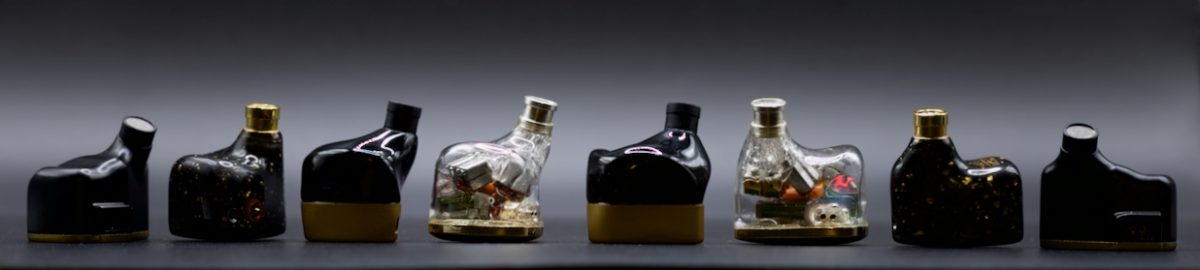
Embrace the darkness within
Mysticraft Tet is a quad-brid, with a 1DD+4BA+4EST+1BC configuration, tuned by Lee, the same guy that gave us Anni 23, Elysian X, Dio, Myth and Hex.
Tet costs a whooping 7700USD, and is limited to only 31 sets worldwide (numbering started with 00).
For the price, the package is spartan to say the least. In fact, the outer box and carrying case are identical to the much cheaper Myth. Not exactly what I’d expect from a 7K set, but I guess others have done it before (Oriolus Traillii, some recent Rhapsodio IEMs). Compared to the wonderful Hex package, I feel more should have been done. In terms of accessories, you get a box of what looks like Azla Xelastec 2 tips, a stock cable and the carrying case, which looks and feel a bit cheap.

Mysticraft Tet (L), Mysticraft Myth (R)
Turning to the IEMs themselves, the moment you pick them up, you understand where the bulk of the money went. While the faceplate is relatively simple and understated, the transparent shells are magnificent, with a high degree of clarity, letting you see the careful arrangement of drivers. The shells are large and relatively heavy, with a medium length large bore nozzle, foreseen with a filter. In use, the shells have proved amazingly comfortable, but some fatigue due to their sheer size was present after a couple of hours.
There are very few details available about the cable. Physically, it’s a relatively soft cable, with a bit of shape memory, but quite comfortable in use.

Sound
Bass. Tet is not bass shy. There is a healthy bass shelf on it, with no roll-off whatsoever. In theory this should be overwhelming, but in practice, the bass is very fast, which makes it perfectly suitable for every genre, no matter how fast. The sub bass is intense, with earthshaking rumble and sledgehammer impact. But play some Greek music and the bass will be perfectly dosaged, no problems enjoying a nice evening session. Play some techno though, and it brings down the house. The focus is mostly on sub bass, however, the level of details is astonishing, so many layers. The bass does not seem to come from anywhere, or go anywhere, it just exists, surrounding your head like a moving cloud. This is probably a masterful interaction between the 9,2mm DD and the BCD – making low frequencies feel holographic and non-localized. For electronic music is hard to find better, if you ask me. Mid bass is well textured and articulated, but not necessarily more than other sets. I like how these two work together, hand-in-hand. The drums don’t have the same dry, snappy short sound of Storm or Pentara, but the macro and micro- dynamics remain very high.
Mids are probably the best part. Heaps of details, but so well behaved, with such sense of realism. Listening to Yosi Horikawa’s Swashers, I can’t believe I am not on the beach. The waves recreate the atmosphere to perfection. Then come the voices, distant at first, but growing in intensity, just as if you’re approaching a group singing on the beach. I am not sure I can put into words how mesmerized I am by its sound.
While in terms of coloration the warmth is evident, they maintain a mostly natural sound. The notes are thick, trailing the borderline between natural and too thick. Because of Tet’s richness of textures, this weight is never burdensome. The notes are not just thick, they occupy more space than in other IEMs, made of layer after layer of details, each of them carrying a little piece of information. Acoustic instruments sound full and textured, with amazing details, as revealed, for example, in Giora Feidman’s Singing Clarinet. Violins have a full-bodied sound, with good convey of the pull exerted by the bow on the strings.
Treble. At first, you’d be hard pressed to tell this is a Lee IEM. There is none of that ether-real shimmery treble of Anni 23 or the aggressive nerve wrecking one of X. Tet is dark, if judged by those standards. However, normal standards should not apply to Tet, for Tet is not a normal IEM. Unlike many IEMs, the treble takes a step back in space, and much to my surprise, I find this “new location” well chosen for most genres.

Stage – While maybe not the same grandeur as Hex, the stage on Tet is huge, in all direction, not only is the music outside your head, but your head is in the music. Tet’s biggest accomplishment is the way the details are layered in the stage, and more particularly, the way these details layered in depth, height and width connect to each other to form a coherent and unitary sound.
Cables, tips, sources
FA Ultron reduces the bass, while also shaving off some note weight from mids and bass. The voices are more focused than with stock. The treble seems a bit more forward, if not also a bit more intense. If looking to reduce the bass, this could be a valid option, although I must admit, compared to the Apollo GT, it sounds limited, neutered. I would take it over the stock, as I find that a bit too heavy handed, but compared with Apollo is not in the same league.
Apollo GT brings improvements on all fronts, while maintaining the thick, syrupy mids and bass. The stage is larger and more refined, the bass is huge in amount, but closely controlled. The quiet background is another advantage,

Vesper shielded extends stage width slightly, while reducing the sub bass and adding a touch of bite to the treble. Mid bass is more expressed, bringing them closer to Hex. At high volume, upper mids have a touch of harshness, but only in some rare occasions.

Hex’s stock cable brings a slight emphasis on the mid bass and more energy in the treble. I was not looking for such changes, so I have quickly reverted back to Apollo GT or stock.

Tips – with fairly large and long nozzles, tips are essential for getting the best out of Tet. First, you need a good contact with the concha, for the BCD. I opted for short tips, that allowed me to achieve a comfortable seating with strong rumble. Longer tips tend to push them out a bit, not quite breaking the seal, but reducing the contact surface and thus, possibly, the efficiency of the BCD. There was no bass missing, but the stage was somehow less impressive. Nostalgia wide bore worked well, just like EletechBaroque Stage. Divinus Velvet seems to shade the treble a bit, so I steered clear of those. JVC Spiral dot ended up being my preferred option, reducing the bass but not the overall warmth.
Sources
Tet is relatively transparent, the differences between the DAPs being easily recognisable. My most preferred sources, at roughly the same level, were the Audma Brioso (no stage adjustments) and the AK SP3000 (with DAR).
Nipo N2 tends to emphasize sub bass, which worked well for some songs, but for others was too heavy (Take The Ocean – Cretaceous, there is so much rumble it becomes almost scary and unpleasant).
N6 III (R202) – added more sweetness and a bit thickness to the mids and bass, while calming down the treble. Is this necessary? Absolutely not. It helped other IEMs, but it did no favours to Tet. Even under these circumstances, Tet had an easy time coming on top.
Any dongle has enough power to drive Tet, which is, of course, very useful. The Questyle M15i and the LP W4 were particularly good, while the Rhapsodio Copper Fantasies was outstanding.
MUB5 was heavily dependent on the music. It provided a large stage (no wonders, since the huge stage is built into the Tet) that maintained coherence and a sound that I can only describe as controlled and forward.
AK SP3000 was by far my preferred source, with a good combination of softer sub bass, clear mids and smooth, detailed treble.
Unnecessary pairing: Adding Brise Tsuranagi OE to SP3000 made the experience almost transcendental. The stage depth would make Titan crumble (hope it’s not soon for this joke), mid bass gets an additional boost in texture and articulation, and the darkness is all but gone. Upper mids have a more abrupt attack, which might be too much for some, but I like it, as it remind me of another IEM that I love, Elysian X.

Comparisons
Hex is the most obvious choice for a comparison. Compared to Hex, Tet has a more sub bass centred approach with thicker and more forward mids , while the treble is definitely darker. Hex sounds more open and expansive compared to Tet.
Hex has more detailed, muscular and articulated mid bass, while the Tet, for me, holds the supremacy in sub bass. In addition, the bigger brother has more grit and texture in the lower mids, making it a more suitable option for metal (beware, though, you might need to tweak Hex’s bass with tips, sources, cables, etc.).
What I find interesting is Tet’s level of details in treble, which is not that different compared to Hex. It sounds to me like the difference between them is in spatial placement foremost, and less so in pure energy.
Both have a stage so large it makes me question if I really am listening to IEMs. Hex, sounds like open back…speakers, for the lack of a better word. Tet is already impressive, but Hex is from another planet.
In terms of details, Hex is the most impressive IEM I have heard to date, all said details are organized, categorized and tagged accordingly, with mathematical precision, almost like the virtual screens in Minority Report. Even more interesting is the fact that Hex doesn’t break a sweat while doing this. It doesn’t feel forced or artificial, but because I am not used to this level of details, there are moments when I find this approach a little bit digital, purely from the point of view of finding such level of details beyond the capability of an analog system.

Storm is a completely different beast, neutral, precise and more adrenaline infused. In terms of bass, Storm has a lot of grunt, but it focuses more onto articulation, speed, meandering and balance, with the end result being a bass sculpted with a fine chisel. Compared to it, Tet is a sledgehammer, the bass hitting with an impact that often leaves me wondering how come I’m still standing. That level of physicality cannot be achieved by Storm. In mids, Tet has more note weight, and it is very resistant to sibilance. Both have astonishing details, with Storm more actively pushing them towards you, while Tet seems to not do an extra effort. It hands everything to you up on a platter, you just have to reach for them. In treble, the situation is very different, with Storm being exuberant, lively and sizzly and Tet the opposite, restrained, polite even.
Between these two, you have all the bases covered: boomy, larger-than-life bass, lively and aggressive treble, warm, velvety mids, or, on the contrary, reference sound, they provide everything.

X is like a mix of the two, with rumbly physical sub bass and lively, acute treble. It adds some of the most exciting upper mids, in a delicate ballet close to the edge of my supportability. In some rare cases, X crosses the border and is a bit shrill, but for the 95% of the time when isn’t, it remains one of the most engaging IEMs I have heard.Compared to Tet, though, it seems to be missing quite a lot of stage and some bass. When quickly changing between them, the difference is shocking, X seems amputated. Five minutes later, the Tet spell begins to break and I can enjoy X again.
Erebus is the one that gets closest to Tet, in terms of general tuning, with a bassy sound, although, well below Tet in sub bass, but with mid bass being well represented, with a tad more articulation than Tet, and a treble that is at the same time detailed and airy, but also somehow darker tinted, with a slight back positioning. Since the upper midsare less elevated, the overall balance goes in the Tet’s direction. What’s interesting, in terms of stage, Erebus is the most narrow of the bunch, but because it layers the details in height and depth, it ends up sounding a bit like Tet.
More differences will become obvious when looking at particular songs.
Jennifer Warnes – Famous Blue Rain Coat (N6 III)
Tet (stock cable) takes a muscular approach; the voice is very close, the supporting bass is powerful, yet filling a larger stage, not getting in the way. A little bit of harshness is present in the voice, as she’s starting to go up. The sax, cuts through the mix and a bit through my ears. The same phenomenon happens with Pentara, only a bit later, at a higher frequency. The voice is quite thick, the notes hanging heavy, contrasting with the slight shrill of the upper vocal range.
Tet with CL Apollo GT is maybe a bit warmer, but the cable seems to have a calming effect on some of those rogue frequencies. There is more note weight than with its stock cable. This is, without a doubt, the best cable (I have) for Tet, at least for this song.
Pentara has a teeny bit of harshness in the upper vocal register. Overall, the atmosphere is colder, but not necessarily less emotional. The saxophone voice still cuts like a knife, but to my delight, it is less intense than with TET. It does have a glassier sound than TET. However, the note weight is a bit less.
Storm does away with any trace of warmth, leaving the track naked. Maybe less emotional than the other two, but Storm removes all the harshness from the sax, while maintaining Jennifer’s voice beautiful. Storm does not have quite the same note weight as Tet, but close enough.
Unsurprisingly, Traillii JP flies through this song, with the closest (most upfront) voice, natural, perfectly weighted, emotional and detailed. The sax has the best sound so far, no longer so intrusive, that 6K scoop working beautifully. Combine this with a more fluid sound, and a bass more focused on articulation and speed, rather than pure rumble, and you’ll understand why I consider it the best choice for this song.
Elysian X is the opposite of Traillii, with its early rising pinna gain, followed by a plateau and only the slightest dip afterwards, around 6K. This is exactly why I love X, for this raw, nerve-wracking sound. The sax is amazingly tame, with maybe a tad more metallic sound, while the voice is not missing any sparkle. The presentation is slightly warm, but in a different way from Traillii.
Erebus masters the saxophone to perfection, and the voice is warm and very human. I’d say that after Traillii, this is the best rendition of the voice. The fact that the voice is so close makes the song very emotional. The sax solo is much more pleasant than with other IEMs, with virtually no harshness. Erebus is significantly less intense in sub bass than Tet, so despite the weighty notes, the song flows seamlessly. In fact, despite less bass, Erebus is the one that gets closest to Tet in terms of tonality. The little pinna scoop makes a hell of a difference for this song. When it comes to pure stage size, though, there is no comparison; Erebus is one of my favourite IEMs, but its stage is nothing compared to Tet’s. Also, Tet has a whole extra layer of details, compared to Erebus.
Myth has clear vocals, neither cold, nor warm, spot on neutral. The overall sound is more open than Tet’s. Myth has the same early rising pinna gain as all the other Mysticraft/Elysian models, but it also has a peak at around 6,5K, so it does sound more shrill than Tet and X. What is a bit surprising is the bass. While lacking that wide spread of Tet, the quantity is more than satisfactory, it’s fast enough that it doesn’t become oppressive. While the sound is very good in itself, compared to all the others, there is a layer of details missing, along with a stage that is severely limited.
Hex may be the master of layering and bass, but for this song it is confined to use only a part of its immense skillset. It does play this piece wonderfully, with virtually no harshness, except for some very rare occasions and only at very high volume; probably more due to the recording itself than the IEM. Wonderfully balanced, the bass tucked away, waiting for the next time it will be needed. For this kind of music, both Hex and Tet are similar, with the former having a more open sound and the latter a thicker one.

Soen – Mercenary (MUB5 M1)
Relatively calm prog metal piece, very good for dynamics and bass speed.
First of all, Tet no longer seems dark. Thick notes, that seem light, flying around with ease. The bass is lightning fast, the precision of the double bass drum is like each note is drawn with a pen. Perfect if you’re inclined to count the beat. The voice is warm, crystal clear and the guitar solo has an equally warm, calm tone. The attack of the pick on the strings is quick, precise, much easier to understand what is going on than with other sets.
The bass guitar is less highlighted than I’d expected from such a bassy set. This shows the slight preference for sub bass, which, at times, can be a bit too much.
X is a bassy set in itself, but immediately after Tet, you feel naked. Like some part of your hearing has been amputated. The differences are clear, X is brighter, with less coloured mids, more impactful drums and a lot of treble energy. That extra energy is not sufficient to compensate for the perceived lack of details (I say perceived, because the details are there, but it is not easy to quickly find them without the musical map that is Tet). X is a more traditional set for this kind of music, with more grit in the mids, more splashy cymbals and more outwards sound.
Traillii abandons its suit and puts on the leather jacket. Large stage, incredibly balanced sound with a slight tendency towards shoutiness at high volume, good drums impact, short and decisive strokes, lively guitar solos and very forward voice. I have to admit, the much lighter bass is working well here, making the song feel lighter, bouncier. The lack of a sub bass shelf lifts the bass guitar a little bit, while the mids carry more grit. Despite Traillii’s emphasize on voices and more articulated bass, just like with X, I feel like something is amiss. Most probably, the bass.
Erebus is the only one comparable with Tet, again. Yes, there is less sub bass, and yes, the stage is significantly smaller, but the way it is built, reminds me of Tet. More focus on the bass guitar, which is the main reason I bought Erebus. Mids have just about less weight, but the treble is definitely more energetic. In terms of details, the 8ESTs in Erebus, coupled with some BAs, do manage to convey a similar sensation of thickness, body of each note. It’s like a scaled down Tet. Not an easy feat, if you think about it.
Pentara is somewhere in between the Erebus and Tet. It does have a larger stage than the God of darkness (Erebus), it has the same growling mid bass, but less note thickness in the mids and further emphasized treble. I guess some years of evolution do matter. While technically proficient in its own right, Pentara has less meat on its bones than Tet. It puts a tad more dynamism in drums, each stroke being felt almost physically. This is a first class IEM, with a cavernous bass and ecstatic treble. The only reproach is that the sound does not leave that long lasting impression, like Tet. It’s a bit like an espresso missing that crema, a bit runny. Just a bit too fast. This, in turn makes it perfect for everything metal and those split guitar tones are what is needed here.
The little brother, Myth, is putting up a fight against these monsters, each costing at least 4 times more than it. The defeat is inevitable against such odds, but fueled by a particularly good synergy with the MUB5, and the FA Ultron cable, Myth pulls a big one. The stage is large, sort of tall, but not very deep. The bass is more in line with my natural preference, lean, more mid bass focused. Of course, everything sounds a bit thinner. The guitars have almost o grit compared to the likes of Pentara and Storm. Upper mids go in the direction of X, with a bit more nerve than Tet. The velvet is gone, though, the vocals are a bit harsh and so are some of the cymbals. Treble is less detailed, but in terms of timbre, hats off to Mr. Lee. It hardly sounds like a planar. Despite these shortcomings, Mercenary is a fun listen with Myth.
Saved the best for the last. Storm is a completely different story. No colouration. Just music. First of all, the stage has re-opened. We are officially back in business. Funny enough, despite not having that blanket of bass, I don’t feel like anything is missing. Storm’s bass is the most fluid, what is missing in displacement being more than made up for in articulation. Maybe some textures, here and there are less profound (this is the SS2W cable, not the 4W), but no fun is lost. While at opposite poles, these two come full circle, completing each other to perfection. One unapologetically coloured, the other absolutely pure.
Charlotte Adigéry – Esperanto (Brioso)
Large, large stage with Tet with a bass coming from everywhere, in a never-ending assault. The treble is very distinct here, loud and clear, which makes me worry for the other IEMs. Endless vibrations of that huge bass, descending into the core of your being. I don’t think there’s ever been a more appropriate IEM for this genre. Very physical bass.
Straight after Tet, Storm feels almost strange; the stage remains large, although less than Tet’s, but with good height and depth, the bass continues to have good extension and nice filling power, but there is undoubtedly something missing. It’s colder, but not piercing as I was afraid it could be with some IEMs. The tiny effects L/R are more noticeable, but a whole layer of bass is missing. It’s like someone has peeled off the skin of an orange. The flavours are easily retrievable, but not the same weight and feel.
Elysian X offered me a big surprise. The bass is somehow similar to Tet’s, in the manner it feels almost like a touch. Of course, the amount is a lot less, but not missing. The same articulation, making me think that maybe Mr. Lee had this idea in mind from the beginning, but the technology wasn’t there yet. The treble is well dosaged, pleasant to listen to, despite X being the one with the most energetic treble in this bunch of IEMs. The bass is fast, the quicker decay helping make music feel faster and more streamlined. It’s somewhere between Storm’s neutrality and Tet’s warmth and sweetness. This one has the sweetness, but it’s cold and precise, like a scalpel.
Traillii loves the Brioso, so I have high expectations. Met. The bass is nimble, like Storm’s, but lighter. However, the articulation is astonishing, allowing me to register details that were a bit masked with the others. The difference in bass extension is pretty dramatic though. Probably the main reason why mid bass is so de-cluttered. The atmosphere is different from the heavy clubbing of Tet, to a more relaxed…clothing shop (in my country, they play this kind of music really loud in the shops, sometimes making it impossible to have a conversation).
Fei Wan – The Erebus’ sister IEM. Bass Bonanza, with extension reaching almost as far as X. The physicality is back, but the treble is like 4-5 levels more intense than Tet, which brings the overall bass feel of the song down a bit. It’s got a bit vibrations than X, going relatively close to Tet. Of course, the stage is “amputated” compared to Tet, but it is not necessarily a bad thing. My clubbing days may be long gone, but the Fei Wan is re-creating the atmosphere to a good extent, just giving the impression of a smaller venue than Tet. There is a bit of rogue splashiness during the last minute of the song, but nothing that would be disturbing.
Myth (this time with Apollo GT) has very good bass, and larger than usual stage. The bass is less strong than X and FW but comparable with Storm. The physicality is still missing, despite having a DD (not all DD are created equal, then), but the articulation and the mid bass details are actually amazing. Maybe it’s the cable, or this type of music, but the stage seems of good size, with some height but not much depth. This is a perfectly decent IEM, and its slight thinness in mids plays to its advantage here.
Hex does not have a lot more bass than Tet, which has an almost unreasonable amount thereof, but it remains a pretty bassy IEM. Is it all just one big rumble? Well, not quite. You see, the stage is huge, and there is plenty of room for that bass to dissipate. While it remains unapologetically bassy, mid bass is a lot more expressed than in Tet. What it means for this track is the very textured, fast mid bass of Traillii, combined with the sub bass shelf of Hex. It’s like Mr. Lee has concentrated and masterfully mixed the various flavours of well loved IEMs and poured everything into just one pot, Hex. In short, Hex shifts the bass focus towards mid bass and adds more treble sparkle. For this particular song/setup, I find Tet to have a less pronounced V, compared to Hex.

A quad-team of my own
Apart from these songs, I have extensively tested Tet across many genres, with some of them shining, while others turned out to not be the best match. Old- rock and up until end ‘80s sounded magnificent, with particular mentions of the drum fills in Dazed and Confused (Led Zeppelin), the bass guitar and voice in the Strange World (from Iron Maiden’s maiden album) with a punk infused atmosphere, 1978 Judas Priest’s Stained class, French rap/pop, like GIMS J’me tire, electronic, lots of jazz and lots of metal.
Conclusions
Given that I prefer brighter tunings, I am thoroughly impressed with Tet. While noticeably darker than my usual preference, it played everything I threw at it in a way that never left me wanting for more treble. Of course, some obscure black metal albums, with a “from the bottom of the barrel” sound are downright unlistenable, but those require a special tuning anyway. Tet is maybe less impressive than Hex, at a first listen, but once you start digging deeper, you realize it is at least as capable from a technical point of view. The way it manages to balance that much bass without totally drowning the rest, the calm, soothing mids, and the dark, but insidious treble, slowly making its way to your brain, is something no other IEM accomplished for me.
If I were to nitpick, the packaging is subpar; the cable is only decent (there seems to be various stock cables around), but all this is irrelevant once you have them in your ears.
With a smooth and velvety mid range, Tet may not seem like the ideal IEM for metal, but the heavy lower end adds a nice, meaty overtone to down-tuned guitars, which, combined with the precision of each pick attack on the strings, make them an absolute beast for the genre.
Slow, complex music takes better advantage of Tet’s technical chops, creating an entire universe for you to enjoy. There is a catch, though: For pure vocal songs, like Dominique Fils-Aimé’s Strange Fruit, the many talents of Tet are not used to the max, and while it has very good mids, I would still reach for Traillii for this kind of music. Press skip though, and on The Birds (referring to the next song and not the Traillii), you can take advantage of the stage, wonderful separation and the sensation of space is simply amazing.