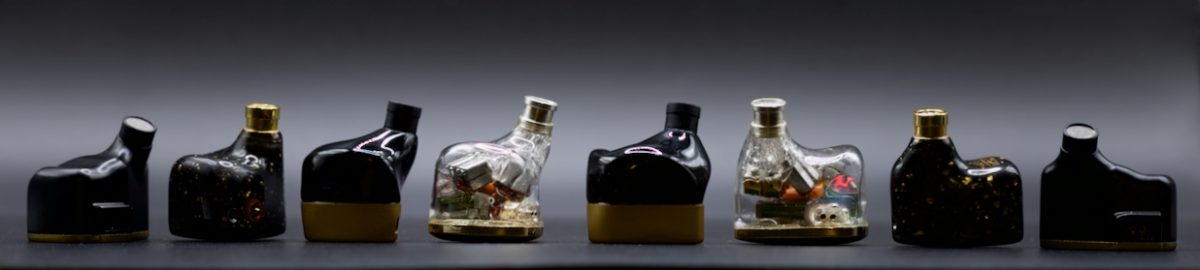
Even when you have a number of TOTL IEMs, there are times when a product can surprise you, bringing a breath of fresh air to what seemed like a stale 12 months in the world of top IEMs. One of those moments happened for me at Can Jam London, with the Melodic Artification Eternitum. After failing to secure a sample at the show, I insisted and eventually managed to get one.
The unboxing experience is as good as it gets, a huge wooden box, with a display for the conditions inside thereof. Upon lifting the lid, the IEMs rise to the top, in a jewelery like fashion. Underneath, a removable tray holds the dedicated amp, while a third layer, on the bottom of the box holds the two carrying boxes. Exquisite presentation.
Everywhere you look, the attention to details is astonishing. From the shells construction to the logo pattern on the carrying case. The packaging deserves a video review of its own.
The dedicated amp requires some clarification: Eternitum is not a system IEM. It can be listened to independently of the amp. However, the provided amp introduces a slight bass shelf, even in the lowest bass setting, so it comes highly recommended. The built is equally good.
Moving on to the sound, Eternitum is a clean, blazing fast IEM, with a particular spatial presentation. The level of details is unlike anything I have heard, from the tiny textures in voices, to the guitars attack, everything is presented with a precision I did not think it’s possible. What is even more impressing, it does that without sounding artificial. It manages to integrate all these details into a tightly knitted musical weave. It’s like a portal has been opened, exposing a new level of clarity.
However, Eternitum is not just a one party trick IEM, but a lot more than that. The stage is something akin to my highly praised Camerton Binom ER – a massive spherical space, with you in the center, the music not seemingly coming from a fixed point, but simply living in that space, all around you.
The bass is one of the strongest I have heard, rivalling Duality. It is, in general dormant, but when the music calls for it, it errupts with a force that could not have been foreseen. The little bass switch on the amp does not seem to change the crossover frequency, but the amplitude of said bass.
The level of details in the mid bass is elevated, without however having a clear mid bass focus, or being overtly present, like in the other resolution monster, the Hex.
The mids are highly upper mids centered, with great energy, that could be too much for some, but that brings a vital force making music feel so alive. Lower mids could have benefited from a touch of warmth, but if I need to choose details vs warmth, I already have some warm IEMs, so Eternitum comes as a last piece of the jigsaw puzzle that is my IEMs collection.
Without going too much into details, as a full review is coming, I find the Eternitum one of the best products of 2026, ticking more of my boxes than the highly acclaimed Ibuki.
Astell& Kern was the first company that made me desperately want a product. It was the beautiful, but somehow ill-fated SP2000T. Launched after the excellent SP2000, and affected by the shortage of AKM chips, dues to the fire of 2000, Oct 20th-23rd, when the Asahi Kasei Mycrosystems factory was severely damaged, the SP2000T did ot manage to achieve the same fame as its predecessor. It sported ESS ES9068AS in QUAD-DAC configuration and Korg Nutube 6P1 and to my ears it sounded really good. Once I’ve heard it, at the Munich HighEnd show, there was no going back.
Fast forward to 2026, Astell&Kern DAPs have been a constant presence in my sources line-up, maintaining a stable 2 pieces at any time (SP2000T, S3000T, SP3000, SR35, Activo P1, all were part of my line up at various points in time. The current line up is SR35 and SP3000. They share the stables with the amazing Nipo N2.
Recently, a good friend lent me his SP4000, which shakes my conviction that the SP3000 is the best DAP for me.
• Dual/Quad DAC Switching • 2-Step Gain Control • ReplayGain • AK File Drop
• TERATON ALPHA • DAR (upsampling up to 384kHz / DSD256) • 6 DAC Filters • Crossfeed • ReplayGain • AK File Drop
• Advanced DAR 2.0 with VSE (Virtual Sound Extender) • ESA (Enhanced Signal Alignment – Group Delay Reduction) • Ultra-Low Noise LDO Regulator (97% noise reduction) • 99.9% Pure Copper Shield Can • Any Layer HDI PCB • 6 DAC Filters • Crossfeed & ReplayGain
• Dual-Band Wi-Fi (2.4 / 5 GHz) • Bluetooth (aptX Adaptive, LDAC, BT Sink) • Full Google Play streaming apps • Roon Ready
Battery & Charging
• 3,150 mAh Li-Polymer • Up to ~20 hours playback (Dual DAC mode) • ~2.5 hrs charging (5V 2A)
• 5,050 mAh Li-Polymer • Up to ~10 hours playback • ~3.5 hrs charging (Qualcomm QC 3.0)
• 6,780 mAh Li-Polymer • Up to ~10 hours playback • ~5 hrs charging (Qualcomm QC 3.0)
Dimensions & Weight
Compact handheld form factor
• 82.4 × 139.4 × 18.3 mm • ~493 g (SS)
• 85.0 × 149.8 × 19.5 mm • 615g (SS)
The first ting one notices about the SP4000 is the imposing physical presence. While not as thick as some of the most famous DAPs (looking at you, N30LE), this is one hefty device. It’s also big, with a wonderful, bright screen. Just like other AK models, it has sharp corners, potentially turning its use without a case into a sort of BDSM experience. Be advised! Also, because the volume wheel doubles as the power button, it moves freely, to the point of feeling a bit flimsy, a feature carried over from the SP3000. While not my favourite volume wheel, it works well and my SP3000 is carrying its age with dignity so I have no reasons to believe the one on SP4000 would be any different.
The SP3000 has a neutral sound, with one of the leanest bass presentations, dead neutral mids and with a delicate and intricate treble delivery. One of the crispest, clear trebles I’ve encountered. The sound density is not very high, giving most IEMs ample space to breathe, and creating a large stage with or without DAR activated. The image and layering are very good. It works best with densely sounding IEMs, like the Mysticraft Tet, NGaudio Erebus, etc. but it sounds underpowered with monsters like Storm or Elysian X.
SP4000 follows the same path of neutrality, but it has a denser sound and the treble is less “grating”. While the presentation is more technical, it feels like there is less air in between instruments, making DAR a must for most IEMs. Without it, the amount of information is overwhelming, making it less pleasurable for me, compared to its predecessor. The bass and lower mids carry more grunt, without necessarily sounding elevated, being a clear departure from warm DAPs like N30LE, while clearly more muscular than SP3000. One caveat here is the High Driving Mode (HDM). With IEMs like Storm, Pentara, Elysian X, SP4000 in Normal Driving Mode felt lacking in dynamics. With one tap, though, things change dramatically, as HDM brings about improved macro and micro dynamics, pumping life into even the most demanding IEMs.
I find SP4000 to sound more detailed than SP3000 in the most part of the spectrum, with more texture and a tighter packing of the sound. With most IEMs, bass control is stricter, note weight is improved over SP3000, but there is a key area where SP3000 outshines the SP4000, and that is treble. With most of my library composed of varieties of rock, from mellow to extreme death metal, jazz and some older pop, I place a lot of value onto hearing the cymbals loud and proud. Occasional splashiness does not bother me. The way SP3000 presents the treble, with a good combination of body, shimmering and crispiness, remains unmatched to my ears. At least with some IEMs, like Oriolus Traillii JP, Erebus, UMxMusicteck Pentara.
For IEMs with slightly thinner notes, SP4000 is a gift from heaven, adding just enough meat on the bone, without altering the overall tuning.
One interesting find is the Mysticraft Tet, which is one of the thickest sounding IEMs, matched maybe only by the Epic Audio Intoxication. I would have expected it to sound unbalanced on the SP4000, but it is quite the contrary. Maybe through tighter control, maybe via dark magic, SP4000 makes is shave off some weight, elevating the sound, while maintaining the mid range lushness and bringing the treble more forward spatially. A highly recommended match.
In terms of functionality, the two A&Ultimate DAPs are now identical, since the SP3000 has also been updated to full Android. Funny enough, SP3000 boots up a bit faster than SP4000, but the difference is diminutive.
Upgrading from SP3000 to SP4000 makes sense if you have hard to drive IEMs and don’t want to use an external amp or if you favour a dense(r) sound. Personally, I am going to stick to SP3000 for a bit longer…but the edge is really tiny.
This one was in fashion when I got back into IEM. I have never bought one, on the account of them being too bassy and the fit being too finicky for me. Nowadays, Baroque or Baroque Stage tips make every IEM fit like a glove, so when my dear friend bought them, I was so happy I will finally have a chance to hear them proper.
The sound is a warm, polite one, with a clear bass boost, extending to both sub and mid bass, incredible impact, almost physical, like the bass drum beater is striking directly on your ear drum, lower mids well tucked behind the massive bass and a treble that is very polite, or even shy. With a very pleasant sound they cannot hide their age, being a couple of steps lower in terms of technicalities.
The obvious highlight is the bass, which is more detailed than some of the modern day IEMs. Apart from the physicality mentioned above, that feeling of a slight tap, the articulation is very good, the kind of set that makes you instantly want to offer your bass guitarist a hefty salary increase. The speed is reasonable, thus that even the fastest blast beats remain distinct. The bass does bleed into the mids, lending some warmth.
There is not enough roughness in the mids for the distorted guitars, Rn6’s sound being too lean, too closed in. This is compensated for with some aggressiveness in the upper mids, so it can be warm and shouty at the same time.
Long story short, this is not my preferred set for metal, but for everything dance, electronic and even jazz, it works very well.
Switching to Pentara, brings back the sound that I am chasing. This mild W has everything needed to keep me happy, while Rn6 simply caters for different tastes.
This unit has been lent to me by a fellow head-fi-er with no obligation whatsoever. It is the second time we temporarily swap gear.
The technical specs listed on the PMG’s website are the following:
12 drivers: 1x Rectangular Planar, 1x 10mm DD, 1x VCD, 8x BA, 1x Round Planar (all drivers are custom built to PMG Audio’s spec)
True 8-way passive crossover
Flat Impedance technology
SPL: 117dB @1kHz
Frequency response: 2Hz-22kHz
Titanium shell body
Custom 6N OCC pure Silver cable 4.4mm
Leather multi-function suitcase
Leather portable case
5 pairs of PMG-selected ear tips
Certificate of authenticity
3-year warranty
They are amazingly small and light, at 8,1g being lighter than some resin shells. Comfort, subjective as it is, was great for me. Any tips worked, with AET07 being my favourites, based on a combination of comfort and sound.
Sound
Let’s start with the most divisive point, treble. I have read some reports that they don’t have enough extension. What I hear is the opposite, there is more than enough extension, and enough air. Yes, it’s not the Annihilator ethereal, warm-ish, treble. What impressed me is the note weight in treble. Thick, meaty, Storm style. Cymbals are more contained than X, for example, where the attack is fast and the decay a bit longer. ME has the fast attack, but not quite that cutting edge, adrenaline infused of X. The decay is fast, shorter, for example, than X. An interesting effect is the cymbals seem to have their own resonance chamber, clearly delimited from the rest of instruments.
Upper mids are elevated, to the point of being very close to the top of my comfort edge. This is a set I cannot listen to at high volume for. along time. Luckily, there’s no need to, either, for ME sounds good and detailed even at low volume. Highly energetic upper mids means all guitar solos are highlighted in a quite obvious fashion, giving the impression the pedal board is cabled directly into your brain. I don’t mind taking a short break from time to time, for that lively sound. The only niggle I have with the mids is a slight upwards skewing of the sound. Some voices (particularly male) appear to be just a touch higher than on some other sets, or let’s say that I’m used to hearing them. This could be an effect of the forward voices, but it is something I did not hear with Epic Apocalypse, Storm, Tet or X. I’m sure it’s just the result of some rogue frequencies inducing this kind of response in my ears, but I thought it is worth mentioning, in the off chance someone else might have had similar issues. For the rest of the mid range, everything is how I like it. The lower mids carry a lot of weight, the distorted guitars sound relatively dirty, without affecting the neighbouring frequencies, the attack is lightning fast and the resolution is right up there with Tet and Hex. Male vocals, and in particular the death growling have a nice warm-ish weight added to them, making this set very good for such genres.
Bass is the highlight of APX ME, on that I agree with other reports. I could write pages of gushing about PMX’s bass, but frankly, it has to be experienced first hand. It’s not the amount, but the quality thereof that makes the difference. Perfectly textured, articulated, with a clear emphasis on sub bass and a mid bass that is probably the most detailed I have heard to date. The richness of texture and tone is unparalleled, to my ears. At the same time, the bass is so fast and accurate that is not overpowering the rest of the frequencies, despite some rare bleeding into the mids.
Stock cable was my favourite, first for comfort, secondly for sound. Details retrieval with cable is very high, separation natural, treble confined to its designated space and the balance sub to mid bass is perfect. However, it has the most elevated upper mids, to my ears.
Equiped with Vesper Shielded, the sub bass takes a small bump, but the stage is larger and taller, so it has more room to fill, the end effect being an overall improvement. Normally, adding more of one frequency, masks another, but Vesper has this great property of helping the IEMs distribute sound more evenly. The upper mids are less harsh to my ears, and the treble has that organic, edgy copper sound. A bit more shimmery, but a tad thinner. Comfort takes a small hit, but remains perfectly manageable.
With SS4W the stage is widened, but the height is not proportionally increased, so for me, it upsets the balance a bit. A matter of habit, I suppose. The sound density remains high, with each part of the stage full with sound, but maintaining ME’s natural separation. There is a touch more sub bass, but I haven’t noticed any improvement with regard to upper mids and/or treble. I wear spectacles and I have an unexpected problem with SS4W, it rubs against the spectacles arms and generates audible vibrations (ringing) in the shells.
Comparisons Storm. I’ll start by saying that straight after ME, Storm sounds muffled and lacking details. I know, of course, it’s not the case, but this is the sort of change ME induces in my brain. Obviously, Storm has a larger stage, the bass is more fluid, the upper mids less elevated and the treble more forward.
In terms of details, ME is more detailed than Storm on bass, slightly more detailed in mids, and less detailed in treble, with a presentation closer to the highly holographic Tet than the reference Storm. The attack on guitars is fast, each note is spectacularly detailed, something I first heard with Tet, then with Epic Audio Apocalypse. Triplets have a spectacular way of sounding, making listening to Raining Blood a real pleasure. Storm still takes extra points for treble (a perfect dosage of timbre, intensity and body, all at once). The biggest difference remains the overall presentation, with ME a bit darker, with its slightly coloured upper mids, while Storm is the very definition of neutrality.
Elysian X Sounds hollow after ME. Given enough adaptation time, the bass on X is less detailed but a touch more natural. Why do I say that? Because, in real life, it is rare to hear that level of details in bass. Except when listening in isolation. I’m not saying it’s a fault from ME’s part, simply that I am not used to that level of details and I am not (yet) sure if this is a direction I want to pursue further. While not having the dirty lower mids of APX SE (from memory), Pentara or Epic Intoxication, X still has some of the best sound for metal. The combination of roughness in the lower mids, buzzing in the upper ones, makes it an ultimate metal machine. The upper mids liveliness is reminding me of ME. Treble is more forward, with a more edgy presentation and more shimmer.
Listening to 2PAC’s “Can’t C Me” is a bit hot up top, but still perfectly listenable. Nicely textured bass, this album being one of the rap masterpieces, from the instrumentation point of view. Impressive control of sibilance from the part of ME. I know the song inside out, but the bass presentation is new.
Amon Amarth’s “Find a way or make one” is a very good test for grit and balance. The roughness in the lower mids, from where that granular sound stems, could have been upped a notch. The voice, on the other hand carries enough granularity, making it a compelling listen.
Despite finding the upper mids borderline uncomfortable in the beginning, I started missing them when listening with other IEMs, so I kept returning to ME. After a couple of days I got so used to ME, that the upper mids harshness completely disappeared.
After the stratospheric sets of the last weeks, it’s time for a reality check, with a set that retails for almost 600USD and comes with a portable amp, see here.
My version came with a dongle, the Venture Devastator Pro Max, which breaks through to over 3.1V RMS. Yes, it can drive Storm and not sound thin.
The ZhuanXu features 2 balanced armature drivers, an 11mm custom beryllium-coated dynamic driver and 2 planar magnetic drivers. The resin shells are on the large side, but comfortable, good looking and they have a metal nozzle protected with a metal mesh. Flawless execution from my point of view.
The tuning is a rather balanced one, with a slight bass boost, but tastefully done, not overpowering any other frequencies. Throughout genres, ZX offers a neutral presentation without any obvious coloration, with good notes weight and decent degree of instrument separation.
The bass is striking with its perfectly judged balance between mid and sub bass. I listen to a lot of metal, so mid bass is critical for my enjoyment. ZX provides enough mid bass to make the bass guitar clearly distinct, but it never steals the focus. Sub bass is somehow restrained, with modest rumble, but vast openness, this particular interplay of mid bass/sub bass delivering one of the most natural sounds I have heard in an IEM.
Mids are forward and transparent, getting out of the way of music, leaving me enjoy the sound without worrying about what’s inside, details, or any other distractions. The note weight is decent, but I would not call it stellar. In the lower mids, I would have liked a bit more roughness, to help distorted guitars sound more gritty. The voices, both male and female, continue on the naturalness line, devoid of any added warmth, any extra clarity sauce, just what you’d expect from Florence and the Machines or Boz Scaggs. I must admit, this is a ballsy approach as, I imagine, some people might be put off by this “naked” presentation. Upper mids have a bit of a boost, such that some guitar solos have plenty of bite, but they are not shouty.
Treble is maybe the most uneventful part of the spectrum, with roll-off starting well before 15KHz. The air is good, probably class leading in its price range, but not comparable with treble monsters like Anni 23, X, Pentara, etc. The treble is a bit closed in, tonally wise. Not a deal breaker, but it is clear this isn’t a treble-head set.
The stage, as expected for this price range, it has good width, decent height, but minimum depth. The instrument separation follows the same line, it is decent, but nothing I’d write home about.
The quick conclusion is that ZX is a set not meant to impress from the get-go. Rather than that, it tends to grow on me and wow me with its natural, uncoloured way of presenting music.
This here is the Mysticraft Tet, a behemoth with 1DD, 4BA, 4EST and 1BCD. Of course, not the first IEM with such a complex configuration, but it is one of the most impressive ones I have heard to date. There is something magical about the way it replays music, building it piece by piece and placing you in the middle to marvel at everything. Details are layered in depth, in height and in width. Not simply an onion-like presentation like, say Fatfreq GMA, but a more complex one, with the same elements interconnected via different planes. And everything done in a very coherent way, nothing sounding out of place.
The general tuning is warm and slightly dark. But it’s only an apparent darkness, upon listening, it becomes clear that details are abundant, textures have a life of their own and there is no harshness whatsoever.
Big, heavy handed bass, that gets out of the way when not needed, but gently reminds you it’s always there, always ready. Detailed, probably the first time i can say about a bass that it’s sparkling. Velvety mids, even buttery to some extent, with weighty notes, perfectly chosen decays and a lush timbre. Treble, while polite has one of the best textures.
So, what do you do when Unique Melody releases a new IEM?! You make sure you get one, that’s what you do.
The changes between the two successive Maven generations and the Pentara show that, de facto, Maven 3 has more in common with the latter.
Maven III
Pentara
Maven II
2DD
2DD (10 and 7mm)
2DD
4BA (mid highs, highs)
4BA (mids, highs)
4BA (mid highs, highs)
4EST
4EST
4EST
2BABCD
2BABCD
1Freqshift BCD
6 way crossover
7 way acoustic crossover
5 way crossover
Soundwise, the resemblance with Pentara continues, with more sub bass extension than Maven II, more mid treble and a lot more air. Unlike Pentara, though, the bass is less tight, while not being as loose as Maven II’s. It is less warm than Maven II, but it maintains some of its DNA, rather than the dry, Work, don’t play* Pentara. The mids remain as good as Maven II’s, with maybe a little more details. It may be that Maven II has more growling in the lower mids, this will be decided after more listening time.
Classical Unique Melody build quality, wonderful, shiny shells, and, much to my delight, a large enough carrying case. Thank you!
The easiest way to highlight the differences is to set Maven 2 as the reference line.
*Metabo, a power-tools company had this logo some years back
I’ve had Brise Tsuranagi V1 for over 2 years now and while I resisted the urge to upgrade to V2, I could not resist the famous Orochi Edition.
What’s new? The OE is basically a V2 with internal Orochi wiring. So by contrast with V1, the volume control is more linear, without the sudden jump in volume characteristic to V1, once the potentiometer reached about 2 o’clock. Also, from V1 to V2 there was an increase of the max input power, from 1,5 Vrms to 3,5 Vrms.
In terms of sound, I was lucky enough to compare the two and while V1 had a very controlled sound, it was more romantic, more lush, with the bass slightly more loose and the treble a bit softer.
OE appears slightly more holographic with the bass having tighter control and a tad more texture, being much better tuned for IEMs that are already warm. In terms of treble, the change is more significant over V1, with OE having a bit more sparkle, more air surrounding the highs. It sounds more…glossy, if you want, like an image that had the brilliance turned up. It’s not bright(er), it remains as neutral as before, but maybe a bit leaner and colder than the v1. Say goodbye to romanticism, the era of realism has arrived.
A particularly preferred pairing is the Oriolus Traillii JP, whose sound becomes bigger, larger, denser and with more enveloping bass, thanks to OE. Funny enough, it reaches a level of refinement that was not possible with V1.
*Technically this is not a new toy, but it just came back to me after a short pit stop.
I have seen a lot of crazy things in this hobby, but the Cross Lambda Apollo GT might be one of the most outlandish cables I came across.
From the choice of materials to the shielding, everything screams quality. The conductors inside contain Palladium plated Silver, Silver plated Copper, Copper hybrid, with a full braided OFC Copper shielding; the 4,4mm jack is made by Furutech and on the IEM side, Eletech’s Versa offer versatility.
This is not a cable that surprises you. It doesn’t bring a night vs day difference, what is does instead is to make the background really quiet, leaving more room for music. With V shape tuned IEMs, it brings more balance, allowing the voices to sound a bit closer. The bass and treble are prima facie unaffected, bar a subtle improvement of the articulation and note thickness. The biggest plus is an extra layer of coherence. I didn’t know a cable can help integrate the various parts of the spectrum into a more harmonious whole.
Ergonomically, it is one of the softest cables, especially when taking into account the shielding.
With 2DD+2passive MEMS, they create a large stage, with the sound extending well into all three dimensions. The layering is particularly impressive and the L/R imaging is one of the best I have heard.
Bassy by nature, they benefit from a fast driver, making them my second bassiest IEM that works for metal (Pentara has even more sub bass). They manage to hide the strong bass until is needed, the only give away being some floor toms that have a powerful hit and good resonance. It is one of the most natural reproduction of drums. Mid bass continues on this trend, being muscular and articulated, with decent texture, quite detailed and never feeling too much or smearing the mids.
Lower mids are markedly depressed, bringing a very interesting separation between the lows and highs. It may sound strange when you read about it, but in real life it sounds very interesting. The first effect is an amazing clarity. The second, a bit of thinness in the lower mids, leading to acts like Amon Amarth sounding a bit lighter than I am used to. Upper mids add some extra energy, so the voices are not remote. Also, the guitar tones are very lively, and they have good bite.
The treble is unapologetic, lively, energetic, with good sizzle and sparkling. With its large stage, there is plenty of air surrounding the cymbals, but the stage never feels empty or hollow. The sound is crystal clear, with a good sense of realism.
Overall, a very detailed set, maybe playing more on its excellent separation rather than adding details that were not present with other sets. Everything has more space to unfold, giving you time to register all the nuances.