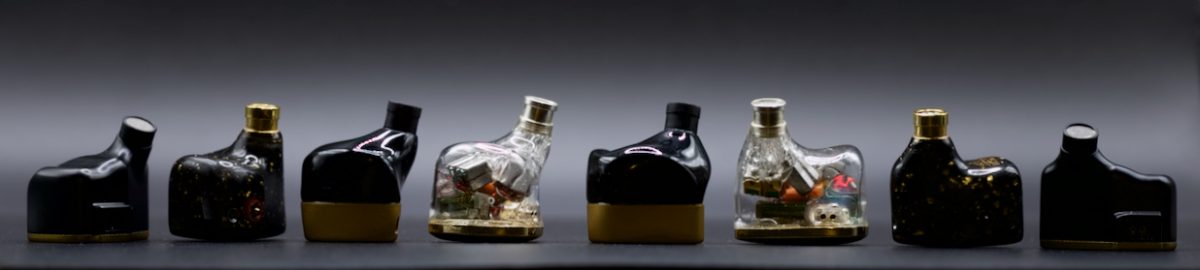

Mysticraft Hex is a behemoth of an IEM, featuring most types of drivers known to man:
- Driver configuration: 1 DD + 5 BA + 2 EST + 2 planar + 1 piezo + 2 BC (13 drivers per side)
- Crossover: 10-way
- Shell: clear resin
- Faceplate: handcrafted titanium with copper and silver inlay, with real diamonds set on one side
- Nozzle: one-piece titanium
- Connector: Pentaconn Ear
- Options: Stock cable, or Evenir Ascension cable upgrade
Design and build
Hex is the most expensive single IEM I know, meaning it does not come as a system with its integrated amp/DAC, although in this competitive market, by the time I finish typing, there might be another option challenging the price. The unboxing experience fits the bill, with a wonderful wooden box that exudes quality.
Starting with the box, its simple finish displays the beauty of the natural wood and it has that “old money” nonchalance that is lacking with piano-gloss boxes other manufacturers offer. I am not saying one is more beautiful than the other, simply that there are many ways to express elegance. I like the simplicity of it and the lack of apparent hinges. Small detail, I know, but it is these details that turn a simple object into a piece of art.

Open the box and you are greeted with the IEMs, in all their splendour and the nicest carrying case to date. Just take a moment to let the beauty of the inner hinge sink it. It is a work of art.

The left unit faceplate sports a pattern interlayed with diamonds, while the right shell features a puzzle with golden pieces and black carved spaces (where the golden pieces would fit). In addition, the Mysticraft logo is carved into the titanium faceplate, with a patterned infill.

The clear, transparent shells themselves are a sight to behold. The neat arrangement of the drivers inside is something I could look at for hours.


Sound
One immediate advantage of Hex is the ease to drive. This has an immediate impact on sound, for Hex sounds good from any source, no matter how much power it has on tap. The reverse is that Hex can easily be overpowered and thrown off balance, so there is absolutely no need to exaggerate.
The bass is certainly one of the highlights, it is large, punchy, fast, but deep, giving me the impression I am about to be blown away by a gust of strong air coming from them. The bass is akin to an impressive pair of floorstanders, it has a cavernous depth to it, but unlike Tet, it is more mid bass focused, which is a great plus in my books. Strong as it is, the bass can stop in a split second, there is no rogue lingering of notes, no mushy double bass drums falling on the recovery of the membrane, just instant control. However, Hex does have elevated mid-bass amplitude/decay weight (which creates warmth and in some cases, some masking). The large stage allows for the massive amount of bass to sort of dissipate rather than accumulate and become overwhelming. While not as liquid and fast flowing like Storm’s bass, it is surprisingly nimble. Another point worth mentioning is the layering within the bass. Not only in height and width, but in depth, making each listening session like a visit to the iMax. Of course, other IEMs have wonderfully layered bass, like the APX Me, but for my taste Hex maintains a better balance between show and naturalness.
The performance is very source dependent and album dependent. It is just so easy to push the bass over the edge and fall into warm shifting sands.

When it comes to mids, Hex has some aces up its sleeve, with plenty of details, natural timbre and impressive positioning. Lower mids are sufficiently thick, but just like the bass, nimble. The balancing on the ledge, this living on a razor’s edge is done so tastefully that it is keeping me hooked and immersed in the music at all times. The notes carry less weight than say, Tet or Epic Intoxication, but that’s not to say they are thin. Texture is top class, but not quite at Tet’s level. Vocals are perfectly placed and adequately lively, without crossing into shoutiness, with sibilance very well controlled, including the famous offenders, like Joe Bonamassa’s Life After Dark or Iron Maiden’s Seventh Son of the Seventh Son. Only the faintest trace of sibilance is present, as if the rest is sucked out of the track. Impressive performance.
With regard to the voices, if they may seem a bit ethereal with a regular source…with LP6Ti199 the situation changes in a way I did not think was possible. More on that when we get there. My only comment is that in some cases the mids get masked by the prominent mid bass and tend to be overlooked.
Treble is like Anni 23, but more detailed and less coloured. Nice, thick notes, textured cymbals and close to perfect timbre. I may not be a great expert on classical music, but from what I can tell, there is just a bit of romanticism in the sound, just like the Traillii adds a bit of sweetness in the voices. Fast transients, giving a steep attack to string instruments, while the lower frequencies provide good woodiness. Hex is not a bright IEM, gone is the razor sharp treble of Elysian X, replaced with a more mature version, smoother and easier to listen to.

Stage and imaging
So much has been written about Hex’s stage that it feels redundant for me to insist on this aspect. It has been said before, the stage is large, tall and deep. Deeper than most IEMs I have heard. What impresses particularly is the imaging, taking full advantage of all the space this huge stage has to offer. Elements are interwoven on all 3 axes, creating a puzzle with very tight tolerances. And, if you look carefully, just like the sound is “carved” into depth, the black pieces on the faceplate are hand carved, evoking missing pieces. I often wondered if the resemblance of this design with the way Hex’s sound is perceived is just an accident or intentional.
Pairing
I will keep this short. Warm, fuzzy sources are obviously not my first choice. Those excluded, I am left with just two options:
- LP6 Ti199 – this deserves its own review, as it is such a departure from anything else I have heard before. If most DAPs extend the stage horizontally and vertically, this little wonder adds a whole new dimension to the sound, namely depth. Whatever I thought I knew about stage depth is eclipsed by the LP6Ti199. The sense of tri-dimensionality is unlike anything else I’ve heard. A side effect of this depth is that width and height become irrelevant, the music comes alive and it feels more real than ever. Another direct consequence is the note weight. Each note having extra depth, they come across as heavy, textured, rich. The voices are brought closer (please take a minute to read Szabi’s excellent depiction of the two DAC working modes)
- The rest: Whether it is Evo Aria, the SP3000 (still my preferred DAP for treble), Nipo N2 (my first choice for everything Lee) or the Audma Brioso, immediately after LP6Ti199 I have the feeling I am listening to the musical equivalent of a piece of wallpaper. The third dimension is simply non-existent by comparison. It takes me at least a couple of hours to re-code my brain to this presentation. I am afraid the LP6Ti199 broke me for good.

Tips
Obviously a very personal choice, but since it is quintessential for obtaining a balanced sound, I want to share my findings.
First of all, Hex has BCDs and this usually means a deep insertion is required to take full advantage of them. This eliminates the fatty metal bore tips, which seat the IEM too far away and makes the stage artificially large, while reducing the sound density a bit. This in itself wouldn’t be an issue, Hex is normally operating with a huge margin. But some physicality is lost.
I also had to rule out Baroque and Baroque Stage. If Baroque Stage added some bass, but also made the sound a touch harsh (not the first time for me), the regular ones made the bass simply too much. Even going down one size wasn’t enough.
Very good results I had with the Epro Horn, very skinny, very open tips, with the Oriolus Traillii stock tips and Tangzu Sancai (which are also the tips I use for measuring graphs). Clarion Tri also reduces the bass a little, but pushes the voices away. CP115 had the opposite effect, bringing the voices closer. This is something that can be useful when listening to slow, acoustic pieces, but for complex music I would stick to one of the others.
Cables
Hex is provided with a stock cable that has good sound, but is not the most ergonomical cable ever. I have seen it in two different version, with normal braiding, similar to Mysticraft Tet’s cable and in the twisted braiding.


This is a tough topic, as cable rolling can lead to results ranging from dramatic to almost non-existent. In my view, Hex is not the most responsive IEM to cable rolling, its character being so strong that it is not easily swayed one way or another. I have heard Hex before, with it’s stock cable and I definitely like it more with the Evenir Ascension, the Mysticraft’s own upgrade cable. The changes can be summarized as less mid bass bloom, more stage depth and a slightly clarified treble. Also, the vocals are slightly more focused with the Evenir compared to stock.

In order to keep this section short, I have simplified my findings to a synthetic ranking, taking the stock cable as a reference.
Synthetic comparison of cables tried with Hex
| Attribute | Stock | Evenir | LL Venom | Tet stock | Cross Lambda Apollo GT | Nighcraft Vesper 8w shielded | Sloflo Pentacon | Sovereign 2w |
|---|---|---|---|---|---|---|---|---|
| Mid bass overwhelm | +++ | +++ | ++ | ++ | +++ | ++ | ++ | +++ |
| Subbass extension | +++ | +++ | ++ | ++ | +++ | +++ | +++ | +++ |
| Sub bass/mid bass Balance | 30/70 | 35/65 | 50/50 | 40/60 | 30/70 | 50/50 | 45/55 | 45/55 |
| Mids unmasking | + | + | + | ++ | + | + | + | ++ |
| Treble intensity | + | + | ++ | +++ | ++ | +++ | ++ | +++ |
| Stage width (W) | ++ | +++ | ++ | ++ | +++ | +++ | ++ | +++ |
| Stage height (H) | ++ | +++ | ++ | +++ | +++ | +++ | +++ | +++ |
| Stage depth (D) | + | ++ | + | + | +++ | ++ | +++ | +++ |
| Voice distance | ++ | +++ | + | ++ | ++ | ++ | ++ | ++ |
Notes from the page:
- Scale: +++ = strong/large; ++= less strong/large; 0 reference
- CL: More focus in the mids, but same mid bass bloom
- Tet, Vesper: More textured mids (unmasking)
- Sovereign 2w was used with adapters that may change the native sound – ↑ upper mids & treble; no changes in mid bass overwhelm, but stage is larger, more impressive
Comparisons
| Hex | 1DD + 5BA + 2EST + 2planar + 1piezo + 2 BC |
| Tet | 1DD + 4BA + 4EST + 1BC |
| Elysian X | 1 DD + 4BA + 2EST |
| Subtonic Storm | 2 SLAM BA + 5BA + 2EST |
Tet
Tet is the most obvious comparison, sharing much of Hex’s tuning, but with some significant differences (a full review is available here). The bass balance is tilted towards the back (of the spectrum), Tet putting more emphasis on sub bass, rather than mid bass. It has the same deep extension as Hex, but the viscerality of that mid bass is toned down one notch. The bass seems a bit colder and less “all-conquering” like Hex. This makes it more adept for metal and other genres with fast bass. The mids sound more detailed to me, in the sense that there is a sharper edge to the sound, like a photo with more sharpness. The voices are clearer, cutting with more ease to the top of the mix. While Hex is very smooth, Tet is a bit more grainy in the mids and to some extent in the highs too. We can draw a parallel to another great pair: Anni 23 and X. If you want, Hex is Anni 23 – coloured, fun, detailed, with bold mid-bass, while Tet is X, more sub bass, more excited in the upper mids with less resolution in treble, but more texture.
Depending on cable and source pairing, Tet commands roughly the same stage size, making it difficult to draw a clear line between them. There is a fundamental difference in the imaging, though. While Hex is unbelievably precise and almost draws lines between the elements, Tet is more like a conventional IEM, with the separation less intrusive. Trying to identify and follow a single instrument is very easy, but they don’t pop out on their own will. I need to actively focus. WIth Hex, there are constantly elements flourishing like fireworks. Not with Tet.
Storm
Completely different presentation, more aggressive, less coloured, but equally large. While the stage is somehow narrower than Hex’s, the height is about the same. Funny enough, Storm creates better impression of depth with the congested tracks, while I perceive Hex deeper with slower pieces of music. Hex’s depth seems to come from sub-bass/mid-bass reverberation and decay, which can get congested on dense metal tracks, whereas Storm’s depth comes from clean transient separation and a leaner low-end, keeping front-to-back layering intact during busy passages.
Storm’s bass is very nimble, more agile than Hex’s, but what it gains in speed and agility is partly traded away when it comes to decay. One could argue it is too fast.

Elysian X
Am I crazy to include X in this comparison? Not at all. Although slightly older, this little marvel keeps up with Hex and Tet in a big way. It is bassy, with nice decay in the sub bass, but quick articulation in the mid bass, and great impact and slam. It falls exactly in between Hex and Tet when it comes to bass. In a way, it is superior to both of them, even though it is lacking that crazy floor standers presentation Hex has. The upper mids have a slight elevation making X potentially bright for some music. The overall presentation is more grainy than Hex, the treble is more cutting, and, similar to Tet, very textured. This is usually the area where Storm excels, but X gives it a run for the money. It has outstanding holographic imaging, getting close to Hex.
Songs
Tuonela – Therion
Any song from the Leviathan album would do, as they all have the same operatic/theatrical production, but I chose this one for the presence of Marko Hietala. His voice is criminally underrated. Such a mixture of emotion and textures. Hex shines like a star, with extremely well articulated bass guitar, from the very first note a guiding beacon throughout the song, with both the female and male voices being majestically layered, not getting crowded by any of the surrounding elements. The chorus overlays everything, adding yet another layer of complexity. This track helps Hex show off its utterly musical tuning.
Tet, immediately after Hex, feels like something is missing. Given a couple of minutes for accommodation, it becomes obvious there is a lot less mid bass. It is almost as if Tet is more V shaped, compared to Hex, even though the graph has less variation than the L/R of units of some of my sets. I would say that Tet has more clarity, provided the music does not rely heavily on sub bass, which tends to be quite expansive. Just like in other songs, the bass guitar is less articulated, but the rhythm and harmonies are more clear, more grainy. Upper mids are brought forward, almost driving the song, unlike mid bass driven Hex.
Storm has outstanding clarity for this kind of music, with the cymbals placed high up, more energetic and with faster attack than Hex (and Tet), and fast bass, characterized by mid bass less imposing than Hex’s, but more articulated than Tet’s. The upper mids are brought forward, similar to Tet, but in a more accented manner. Storm feels more agile than Hex and partially Tet.
Wonder – Anneke van Giersbergen
There is a thin line connecting this song to the previous one, the collaboration between Anneke and Marko Hietala (six strings and a voice).
Very simple song, playing mostly on Anneke’s voice, with Hex being very close to the best, which remains, for me, Traillii. If in terms of details and texture I have no complaints, there are two IEMs that bring a little extra: Tet adds more texture to the voice, while the upper parts can be just a touch hot (Hex is safer). Traillii adds a drop of honey, while maintaining a very natural tone.
Storm is also a strong contender, but with the margins here being very thin, the decision was always going to be more emotional than rational. I particularly like the crystal clear voice, slightly more intimate. A very slight hint of sibilance is present, which wasn’t the case of Hex. For this kind of slow, acoustic track, Hex might be a better choice.
X is perfect, marrying Hex’s bass, Tet’s grit and Storm’s upper mids and treble. It is also the one that gets closest to Hex’s way of building the stage, while not as large. For this kind of slow, acoustic track, X is downright perfect.
Lingua Ignota – Persefone
A tough cookie for Hex (and Tet). Plenty of booming bass, overlayed with a variety of instruments. More metalcore than anything else. Hex handles it with aplomb, the bass is huge, the distorted guitars are always very close to the breaking point, yet somehow an invisible force pulls the sound back from the brink and it stays within reason. Let me just say I haven’t heard this piece sound so bassy and so large, without falling into gratty distortions.
Storm has everything laid up for excellence here: It’s more energetic treble and the less excursion bass, electric upper mids are more up my alley. With less mid bass, the lower mids are more alert and there is more grit, but also feels like there is more margin left. The lower mids are slightly more upfront, which sits well with me. The treble is more cutting, which, again is more in line with my preferences.
Tet is pushed to the limit, the sub bass kicks like a mule, the floor toms giving me the impression the house is coming down, but freed from the heavy mid bass, the guitars sound more gritty, colder, more menacing and more distinct. Something I’ve always appreciated with Tet is how it exposes every down-pick, up-pick, triplet, everything, while not making it pop out of the music.
With the charge clearly cymbals-lead, and the upper mids forming the second line, Storm can sound slightly shouty on this track, especially at high volume and I always play this track at high volume. Storm has a kind of ruggedness that works wonders for me here. Also, the layering is just as impressive as Hex’s, but, just like Tet, the separation is done more “on-the-fly”, more fluid, less distinct than on Hex. Stage depth is enhanced compared to the other two.

Within – Daft Punk
I know what you’re thinking, not the best track for dynamics, but I love it and it shows how Hex is a bass beast, but also has some delicacy that it can display at the exact same time it’s rattling your teeth. And the fairy dust moving from R to L, the cymbals, they all work together to portray this album in a way I have not heard before.
Tet sounds lighter, thinner, in a way, which makes the impact of the sub bass even more dramatic, while the treble is delicate and weighty, but lacking that extra air that Hex has.
First snow on Brooklyn – Jethro Tull
Since the winter holidays are approaching, I have resurrected my favourite album for this time. Hex has a larger than life presentation, the vibrancy of the flute, centrally placed, surrounded by the strings, a track simple in its complexity. Hex enhances the cinematic image, making the song seem like a movie. Voice upfront, heavy bass, and those strings free flowing around, ethereal, yet almost tangible. Particularly noteworthy is the flute solo, starting at 2:10 mark, during which the strings have tremendous impact.
Tet is slightly brighter, with the voice very close, carrying a bit of colouration, but less than Hex. More textures in the voice and partially in treble. Less impact than Hex during the solo, but more lively flute. While I find this presentation more correct, I can’t stop myself from wishing it had the same bass. There is slow-ish low frequency DD decay, that makes the whole experience very enjoyable.
Storm has a brighter presentation, less cinematic than Hex, and with less note weight. Those strings are a lot less imposing, the bass does not have the same impact, and to be honest, nothing thumps quite like Hex. Storm’s separation is on par with Hex, but the holographic imaging falls behind. Ian Anderson’s voice is a touch thinner and further away, but more detailed: with each of these two, different details amaze me. Storm is closer to Tet than Hex.
X is…how shall I put it..? Shocking. The imaging is just a hair below Hex, the voice is as good as Tet, but placed less intimately. There is none of that mid bass domination, but the articulation is there. Think Hex mid bass with less elevation, Tet’s stage and Storm’s treble.
Wars – Hurt
Is that a bass guitar or a steam roller? Such viscerality is hard to explain in words. It starts heavy, but then it seems to just spiral down, after each chorus dropping lower, to frequencies I wasn’t even sure are still in the audible spectrum. All this while another layer of bass is handling the articulation.
Tet is quite similar to Hex, but darker, more textured. The bass is almost overwhelming, but it manages to tread the thin line.
Storm is more closed in, which is not quite usual. Usually its presentation is more expansive, outward going. The bass guitar may not have the same impact, but it still sounds impressive. The balance is perfect.
X shows signs of slight shoutiness here, showing that Hex’s tuning does have some advantages. If I try to get the same amount of bass as with Hex, I have to increase the volume quite a lot (X blooms at high volume), which makes the chorus just a touch shouty.
Lucidity – Soen
Hex has almost too much bass. But, it is so well done, in a way, like Anni 23’s treble. Coloured, but in a tasteful way, enhancing, rather than detracting from the music. Martin’s (the drummer) ghost notes are clearly audible throughout the song, even over this thick layer of bass. The voice is warm, but harrowing, extraordinarily clear, but organic, there is nothing digital sounding about it.
Tet has less mid bass, and this enhances the mids, for me. The overall sound is darker, but also colder and less heavy. It’s funny, I used to consider Tet the coloured one, but it is actually not necessarily so. Not here. Bass guitar is less dominant, the voices are just as close and with more texture up-top. In fact, with more texture everywhere. Tet has more transient density / leading-edge weight (fundamental harmonic focus with less mid-bass bloom. Because the imaging is less spectacular, Tet is more music centered.
Storm is perfect for enjoying Joel’s voice, having both the right placement, but also a good amount of texture and details. The bass guitar is easier to “ignore”, to blend into the background and focus on the voice. Unsurprisingly, the ghost notes on the snare drum are very clear.
X is like a mixture of Hex and Tet, with the calm, relaxing sub bass like Tet, Hex’s mid bass articulation, back to Tet for upper mids and ending with a treble that is half Tet, half Hex. It has, for me, the best bass of the bunch, working equally good for slow blues and satanic metal. It is also exceedingly clear.

Conclusions
The conclusion is very simple, Hex is the best IEM in the world.
Now for the long version. Hex impresses in many ways. First, with its omnipresent bass, the speaker-like presentation and the pinpoint accuracy of its imaging. The holographic imaging is without a doubt the best I have heard, with clear separation between various elements, that does not feel artificial. Yes, there are some rare occasions when said instrument separation feels supra-natural, but these moments are so seldom, I consider them exceptions. With its large stage, extending in all directions, Hex resolves like nothing else complex, congested music, placing everything at good distance from the surrounding elements and maintaining good “legibility” of even the most complex music.
It is not perfect, and I am glad it isn’t, for it means progress can still be made. Out-of-the-box, the mid bass is, to my ears, overwhelming. Not immediately, but after a couple of hours the constant pummelling becomes tiring. Trying to mitigate this with cables can quickly ramp up the bill, but luckily, tips and sources are a faster, more reliable way to achieve this. However, the more effort one invests into reducing the mid bass, the more Hex will start sounding like something else. I have learned to embrace the bass and live with it and if this means changing my listening habits, so be it. More frequent pauses will be highly appreciated by my family and there is so much music I like but have been neglecting in favour of some familiar albums.
Hex can play any kind of music, but is more restrictive with the production method. Dark, muddy productions will sound …sub-optimal, but anything well produced will be elevated by Hex.

