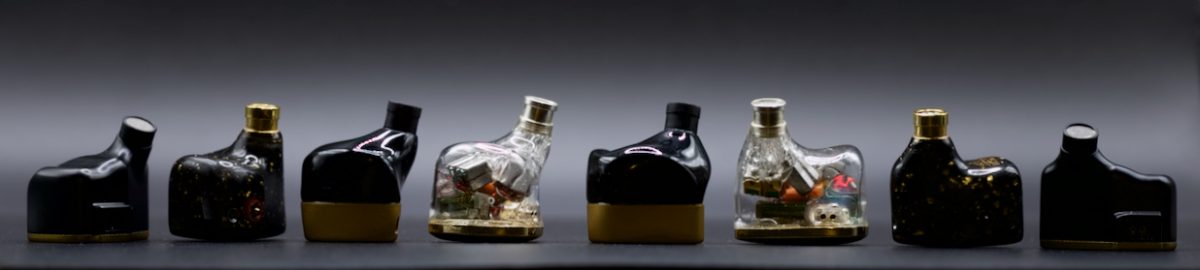

Packing 13 drivers across six distinct driver topologies per side (1 DD + 5 BA + 2 EST + 2 planar + 1 piezo + 2 BC) through a 10-way crossover, the Mysticraft Hex is an engineering behemoth. Even before you press play, it makes a statement—arriving in a natural, hinge-less wooden box with “old money” restraint, housing clear resin shells that showcase the immaculate internal driver layout, capped with handcrafted titanium faceplates featuring copper, silver, and real diamonds.

Sound Signature: Controlled Viscerality
Despite its complex architecture, the Hex is remarkably easy to drive—meaning it scales effortlessly, though it can just as easily be overpowered by warm or overly colored sources.
- Bass: Large, cavernous, and deeply physical, mimicking a pair of high-end floorstanders. Unlike sub-bass-focused rivals, the Hex leans into mid-bass authority—delivering punchy, weighted slam that stops on a dime without blurring double-bass drums. Its elevated mid-bass decay adds warmth (and occasional masking on dense tracks),but the sheer scale of the stage lets that energy dissipate rather than overwhelm.
- Midrange: Nimble, detailed, and natural. Lower mids carry enough body to stay engaging without turning thick, while vocals sit cleanly in the mix with virtually zero sibilance—even on notorious test tracks like Iron Maiden’s Seventh Son of the Seventh Son.
- Treble: Think Elysian Annihilator 2023, but with higher resolution and less coloration. Cymbals have realistic weight and texture, strings snap with fast transients, and the razor-sharp bite of the Elysian X is replaced by a mature, slightly romantic smoothness.
- Stage & Imaging: This is the Hex’s crown jewel. Tall, wide, and extraordinarily deep, it places instruments on all three axes with razor-sharp, firework-like separation.
Synergy: Tips & Sources
- Sources: Warm sources will tip the mid-bass over the edge. Neutral, clean chains are a must—and pairing the Hex with the Luxury & Precision LP6 Ti199 unlocks a tri-dimensional depth and note weight that makes other flagship DAPs feel two-dimensional by comparison.
- Ear Tips: Because of the dual bone-conduction (BC) drivers, deep insertion is critical. Skip wide, shallow metal-bore tips or bass-boosting tips like the Velvet Baroque; slim, open options like Epro Horn, Oriolus Traillii stock tips, or Tangzu Sancai preserve both physicality and balance.
Quick Flagship Comparisons
- vs. Tet: Tet shifts focus from mid-bass to sub-bass, offering a colder, slightly grainier, sharper-edged presentation that excels at fast metal, whereas Hex is smoother, more mid-bass driven, and far more holographic in its separation.
- vs. Subtonic Storm: Storm is leaner, faster, and more aggressive—keeping dense metal tracks cleaner through transient agility—while Hex trades a touch of speed for grander note weight, richer decay, and a more cinematic presentation.
- vs. Elysian X: X sits right between Hex and Tet in bass balance and comes surprisingly close in holographic imaging, though it lacks Hex’s speaker-like scale and may turn slightly shouty at high volumes.
Verdict
Is the Mysticraft Hex the best IEM in the world? For sheer holographic imaging, speaker-like scale, and musical immersion, nothing else comes close. Out of the box, its relentless mid-bass pummelling can grow fatiguing over multi-hour sessions—and muddy, poorly mastered recordings won’t get a free pass—but feed it well-produced music through a clean source and the right tips, and the Hex turns every listening session into an IMAX event.
Interested to know more, proceed to the Full review.