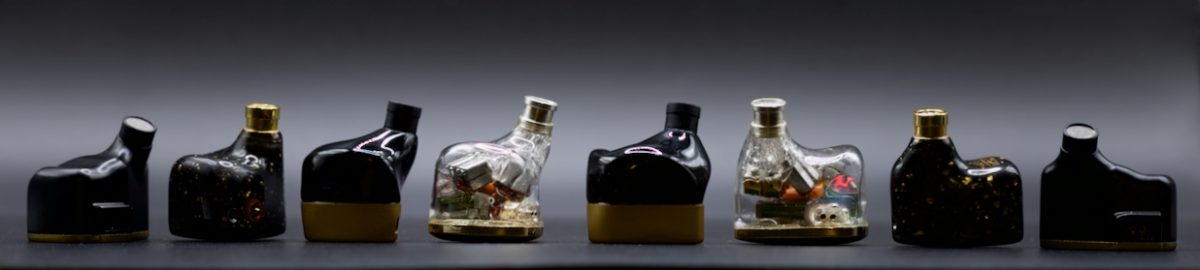
Fei Wan is a hybrid IEM from the well known brand Aroma. According to the manufacturer:
• Driver Count: 12 Drivers (10 BA + 2 Coaxial DD)
• Configuration: 4-Way Crossover (2 Low DD, 4 Mid BA, 4 Mid-High BA, 2 High BA)
• Impedance: 18Ω @ 1KHz (Highly sensitive, easy to drive)
• Sensitivity: 103dB SPL @ 100mV RMS
Disclaimer: This is a set I have purchased with my own money, from the pre-loved market, midway into the evaluation process. A slight bias towards them is thus possible.

The unpacking is quite a simple experience, with a pop-up box, similar to NGaudio’s Erebus. Maybe a step down from the nice, heavy, metal box of Jewel, but you get a nice puck-style carrying case, large enough to hold the IEMs and the cable.
The shells are comfortable, following the same general design of its brethren, the Aroma Jewel and the NGaudio Khaos and Erebus. I am not a big fan of the standard design of Fei Wan’s faceplates, but I did love these ones from the first minute. The shells are semitransparent, displaying the branded drivers inside.
The included cable is quite thin and supple, with zero microphonics. The hardware is the same as that on the NGaudio Erebus, with Fei Wan’s cable covered in paracord, while the Erebus one has a PVC coating.


Fei Wan’s cable is a clear step up from the Aroma Jewel, where the cable had its own will.
There is a little bit of driver flex upon inserting them into the ears, but once properly seated, there were no more occurences.

Sound
In terms of sub-bass, Fei Wan is my current favorite. It has good, satisfying rumble, while the mid bass is slightly tucked behind the large sub bass. The bass is well controlled and fast, with no smearing into the mids. Mid bass is well articulated, maybe not at the same level as Erebus or Pentara, but certainly belonging to the top tier. The details are present, but not jumping out, rather melting into that sub bass. Speaking of which, the sub bass is powerful, yet controlled, and has just the right amount of elasticity, giving music a bouncy character, a subtle liveliness. Scores like the The book of Boba Fett or Shark Chevelle have a cinematic presence, making everything come to life. Between the ample bouncy bass and the unapologetic treble, there is a great sense of dynamism.
Mids are mostly uncolored, with the lower mids, where the force is needed to provide grittiness, feeling slightly breathless by comparison with other TOTL (see below), and voices centrally placed, but somehow deep into the stage, enriching the sensation of space. The voices have good body, but maybe not as much as Traillii or Erebus. This could be a good thing, as I have heard complaints about Traillii’s rendition of voices being too full-bodied. If the mid bass is relatively elevated, starting with the lower mids, Fei Wan’s energy takes a bit of a dive, giving it a perceived V character. This dip persists throughout the mids, only to recover in the upper mids, with the effect that the voices seem to sometimes struggle to come on top of the production, during the congested passages. The problem is a lot less evident with jazz and non-existent with instrumental music, which makes them my favourite set for OSTs. Guitar solos are nicely highlighted with Fei Wan. What stands out in the mids section is the clarity, with very few IEMs managing to reach this perfectly clear sound.
Treble is energetic, full-bodied and slightly compressed in the upper register. For the most part, though, it has natural timbre. it’s just that is lacking that final touch of shimmer, a sustained overtone usually added by the EST drivers. Take Traillii JP, for example, there is a more natural tone to the cymbals, the higher overtones appear to linger for a bit longer. In return, Fei Wan has a more biting (faster attack) sound and a little more air. And this creates a bit of an issue for me, the fast attack, the high initial energy are not followed-through, breaking the harmony a bit and leaving that mid treble exposed and sometimes harsh sounding. Luckily, this only happens with a handful of albums and it can be brought down with cables/tips/sources. A touch of harshness remains though, as it becomes evident when listening to Dream Theater’s cover of Perfect Strangers. On the long run this could translate into fatigue, for some people. Luckily, I can tolerate it quite well.

The stage is wide and deep, but not very tall. All-in-all, it is a nicely built stage with top-notch layering and instrument separation. No matter how congested the music, Fei Wan has plenty of room. It passes the “Empire of the Clouds” test with flying colors.
Cables
The stock cable does not look like much, but sonically it performs well and it is relatively comfortable. The hardware is a reminder of the NGaudio Erebus, which is a nice thing, since I liked that cable.
Eletech 5th Ode brings an air of lushness to the mids and treble, making Fei Wan sound more rounded. My impression is that the bass is slightly heavier than the stock cable, with an overall enhanced note thickness.
Nighcraft Spectre (4w) brings the sub bass down slightly, lifting, or rather maintaining the mid bass, with the end effect of the latter being a bit more in focus. The mids are less lush than with 5th Ode, but the harshness is all but gone. The treble is even livelier, a change that speaks to me.
NGaudio Erebus cable is one of my favourite for Fei Wan. It controls the sub bass to a higher extent, making mid bass pop out more, and reduces whatever harshness was audible with the stock cable.
For the most part of this review, I have used the stock cable.

Sources
No particular problems with finding a source, since Fei Wan is easy-to-drive. I did prefer less analytical sources, like Nipo N2, Quloos MUB5 and Audma Brioso. No need for an external amp, but when adding the Apos Gremlin, to add some colouration, I was awarded with an analog sound, wherein the bass was accentuated (but still well within reasonable limits), but the overall roundness was to die for.
Combining the MUB5 R2R DAC with the Apos Gremlin tubey goodness, created a very powerful combo, being difficult to get them out of my ears.
For ultra-portability, the Hidizs AP80 Pro Max did a good job powering them, with a balanced sound that did not excel on details or stage, but the musicality was there.

Comparisons
Oriolus Traillii JP (8BA, 4EST)
Traillii cannot match Fei Wan’s clarity and while it sounds less ample in bass, the note thickness keeps this old warrior in top 5 of my preferred IEMs, helped by its wide stage and tasteful vocal range.
Switching from Fei Wan to Traillii JP, immediately exposes the lack of DD. Some soul is missing from the bass, despite mid bass details being more easily discernible. I would have liked more instrument separation, but no IEM is ever perfect, right? The voices are vibrant and come easily on top of the mix, making the Traillii (still) the reigning king of vocals.
Another notable difference is that, somehow, with Traillii you feel more immersed in the music, no doubt partly thanks to the more forward voices, partly thanks to its panoramic stage.
In terms of macro dynamics, I would say Fei Wan is more dynamic, with its big bass and energetic treble offering a nice contrast. In terms of micro dynamics, things are more complicated, with both IEMs trading blows, but thanks to its improved layering, Fei Wan makes it easier to register all the tiny details.
C12 (1DD, 11BA)
Turning to another 12 drivers hybrid, the Cadenza 12, the treble is more cohesive, so the slight issues I had with Fei Wan’s treble are not inherent to this combination of drivers. However, listening to C12 after Fei Wan, despite a less V, and more balanced presentation, with uplifted voices, the sparkle of life is missing, the treble is a lot less energetic, lacking air and the bass is lacking elasticity. More correct, yes, but not necessarily as enjoyable.
After some adjustment time, C12 starts sounding better, but the extreme clarity of Fei Wan is never matched. I can certainly understand why most people write down this IEM: it needs time to show what it can do, in stark contrast with Fei Wan, dressed to impress.
Fei Wan has better imaging, more powerful and tactile bass, and more lively treble. The only point where C12 recovers some ground is the vocals. C12 banks on a reference sound with the voices pushed forward, not unlike Traillii. The resemblance stops here, though. I wish the C12 had more mid treble energy, and a bit more forward cymbals.

NGaudio Erebus (1DD, 6BA, 8EST)
With a similar tuning to Fei Wan, NGaudio is slightly more rounded, more lush, with a bit more bloom in the mids, noticeable both in instruments and voices and with a less energetic presentation. Fei Wan has a more cavernous bass, a bit faster, but in terms of details I tend to prefer Erebus, partly because it has more mid bass than Fei Wan, partly because it is easier to discern certain details.
Fei Wan, by comparison with Erebus, has cleaner, more airy voices, with astounding clarity, but sounding a tad thinner than Erebus, which, in turn, has more grunt and gritt in the lower mids, constantly pummeling you with weighty notes. Overall, Erebus is more mids-forward, more metal oriented, while Fei Wan has laser precision, that serves better lighter genres.
The treble is more polished on Erebus, but equally detailed, and the passage between frequencies is more harmonious, assuring a smoother flow. You can say the treble is smoother, like a finely matured velvety Bordeaux wine, while the Fei Wan, by comparison, is a young Beaujolais (known for their relatively high acidity).
Despite these small differences, they are more similar than different. Would it make sense to keep both? Hard to say and mostly library dependent.
Erebus seems to need a bit more power, rated 104db SPL@1mW and having an impedance of 17Ω@1kHz.
Pentara (2DD, 4BA, 4EST, 2BABCD, 1 UM FreqShift BCD)
The first thing that strikes you is the stage and how the music is presented. It is as if there’s more space for all the elements to be upfront at the same time. The bass seems less intense, but somehow more tactile, while being more rich in textures. Mid bass is more articulated and is helped by the sensation that the whole bass is penetrating deeper into your skull. Pentara remains the most immersive IEM in my collection. The voices pop out a bit more and there is more grit in the mids. Also, I find the vocals to have more body on Pentara.
Fei Wan remains the more excited of the two, with its bouncy bass and acute treble. Despite Pentara’s bass being of better technicality, I find the Fei Wan to have a more satisfying thump and slam and a warmer musicality. Like a pair of old slippers, perfectly formed to your feet. If the music is not hyper-fast, I tend to prefer Fei Wan.
With female singers, the uppermost part of their vocal range seems a shallow and shrill by comparison with Pentara. This becomes obvious listening to Tarja’s Beauty & The Beat album, in particular the 2nd Disc.
In terms of music, I have used a metal centric playlist, with a good part of jazz and some pop, film, ambient and even some classical.

Conclusions
I must confess, I liked Fei Wan much more than I expected. In the past, I have always preferred Jewel to Fei Wan. However, after spending a couple of weeks with Jewel, I had no problems letting it go. Fei Wan was another story, causing a small rearrangement in my IEMs collection
As mentioned above, for OSTs, only Pentara can overtake Fei Wan, and this is only due to the stage, which is larger.
For jazz, the crystal-clear cymbals provide a good anchor, with the older recordings (Peggy Lee, for example) sounding better than some of the modern ones. Also, lower, less congested music allows Fei Wan to better highlight the voices.
They work very well for all subgenres of rock, courtesy of the fast bass and the cutting treble. There is not much lower mids grit, clean heavy metal being more appropriate than melo-death.
Who is it for, then? Well, everybody. Whether rap or rock, classical or ambient, Fei Wan plays everything with good transparency and with uncanny clarity. That this clarity is not perceived as an overly analytical sound is a big bonus. The only genre where I am not, yet, convinced is opera. I find the slight boost in upper mids a bit too much for most female singers.
An interesting find is Fei Wan’s ability to serve both critical and relaxed listening in equal measure. Fresh after reviewing the Luxear Valor, a great IEM, focused more on relaxed listening, I can certainly appreciate the path Aroma took with Fei Wan.
Those sensitive to upper mids might want to give it a listen first, it can be quite intense.

