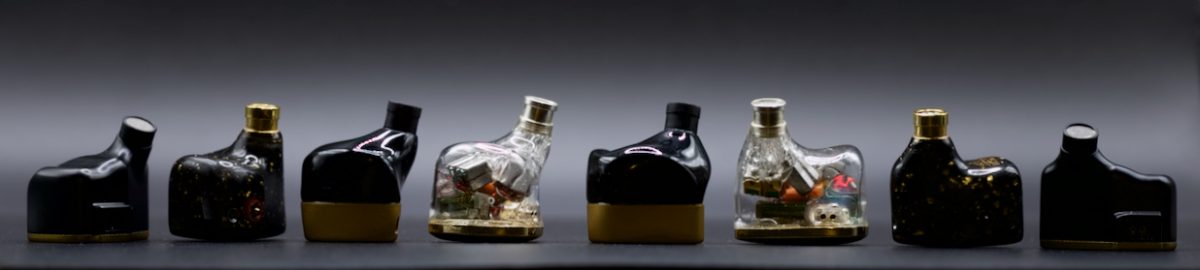

When my friend Szabi bought the Karma, I couldn’t wait to lay my hands on it for a review. It’s not everyday that I have the occasion to try a 900USD IEM that sounds like a 3000USD one. Or, does it?! Time to put the bold claims to the test.
The review is based on a loaned unit with no obligations whatsoever. In fact, the unit was sold long before I finished my review.
About Quill Acoustics


Packaging
A well-considered unboxing presentation complete with a rugged leather case and a custom “shuriken” tip holder, though the included stock cable presents notable ergonomic compromises.
The Karma arrives in a substantial, cube-like cardboard box featuring an embossed 3D model motif on the top lid. Removing the lid reveals the earphones seated securely in protective foam alongside a warranty card finished in a matching geometric pattern. Beneath the first tray sits the documentation paperwork, followed by another divider that reveals a rugged, genuine leather carrying case. Inside the case, you find the stock cable and two varieties of ear tips—wide-bore (Eletech Baroque Stage) and narrow-bore (Symbio Orange Peel)—in small, medium, and large sizes. The tips are held in place by a 3D-printed organizer shaped like a ninja throwing star or shuriken—a standout, creative design element.


Build & Specifications
Tightly assembled, lightweight anti-static resin shells housing a 6-driver quadbrid setup with a generous pressure vent, though the long, straight nozzle can cause acoustic fatigue during extended listening sessions.
Under the hood, the Karma is a 6-driver quadbrid built around Quill Acoustics’ “Depthwave” architecture using a 5-way passive crossover and a 4-duct acoustic system:
- Driver Topology: 1x 10mm Graphene Composite Dynamic Driver (sub-bass & bass), 1x Quill Custom Balanced Armature (lower & upper midrange), 2x Sonion Balanced Armatures (treble), 1x Micro-Planar Driver (ultra-highs), and 1x Full-Range PZT Bone Conduction Driver.
- Impedance: 14 Ω
- Sensitivity: 110 ±3 dB/mW
- Frequency Response: 20 Hz – 40 kHz
The anti-static resin housings feel somewhat plasticky to the touch, but they are exceptionally lightweight and put together with precision. There is no rattling, internal flex, or seam play when handling the monitors. The aluminum-magnesium alloy faceplates sport a clean geometric model, that seems to be a stylised yé chinese character, while mechanically reinforcing the bone conduction driver’s vibrations. A large acoustic vent hole is integrated into the side of the shell to relieve internal cavity pressure and mitigate acoustic ear-canal occlusion. The nozzle is relatively long and projects at a straight angle. While this geometry ensures a deep, consistent seal (necessary for proper bone conduction contact), it can induce noticeable physical ear canal soreness after prolonged, uninterrupted sessions beyond the three- to four-hour mark.
The cable is physically stiff and retains heavy coil memory. Because the full-range PZT Bone Conduction Driver and the aluminum-magnesium faceplate actively couple with shell vibrations, cable movement generates audible microphonics that get mechanically transmitted and amplified through the housings, making a cable swap highly recommended. The hardware on the cable is highly reminiscent of the EA cables of the Code series.

Sound Analysis
Bass (20 Hz – 250 Hz)
An elastic, sub-bass-biased low end with brisk transient recovery, capable of resolving rapid-fire kick drums while preserving an underlying warm hum.
The Karma leans warm and bass-tilted, though its tuning avoids the bloat of an outright basshead monitor. Overall quantity is moderate and well judged, with the acoustic balance favoring sub-bass extension (20–60 Hz) over mid-bass bloat (60–250 Hz). This foundation feels springy and elastic, maintaining fast transient decay. When tested with high-BPM double-bass drum passages—such as George Kollias’s blistering blast beats in Nile—the 10mm graphene dynamic driver preserves distinct note-to-note separation. Consecutive strikes retain their machine-gun-like percussive leading edge without slurring together. Interestingly, there is a persistent, low-key sub-frequency hum (~30–45 Hz) running continuously beneath the music that only becomes obvious when it drops away during silent pauses between tracks. Rather than an acoustic defect, this fundamental floor—reinforced by the tactile physical resonance of the bone conduction driver—adds a pleasant analog-like warmth and rich texture to electronic music, providing clear vertical layering across synth basslines.
Midrange (250 Hz – 4 kHz)
Neutral and transparent, but a steep drop from the sub-bass shelf into the lower midrange (250–500 Hz) leaves lower fundamentals and rhythm guitars slightly thin.
Precision and neutrality dictate the midrange tuning. The low end rolls off cleanly before reaching the core midrange, preventing any perceptible mid-bass bleed or masking over core fundamentals. However, because sound pressure drops off sharply from the sub-bass shelf into the lower midrange (250–500 Hz), lower-register instruments can sound slightly lean and exposed. Down-tuned rhythm guitars lack full cabinet resonance, softening the physical weight of heavy palm-muted chugs. Male vocals show average chest resonance, though deep guttural death metal growls retain an aggressive edge due to sub-frequency reinforcement. Female vocals and upper-mid instruments cut through cleanly via an assertive pinna gain rise from 1.5 kHz to 3 kHz, followed by an even, gradual downward slope without the deep upper-mid scoops found on monitors like the Oriolus Traillii JP or Unique Melody Maven II. Tip selection shifts this presentation considerably: wide-bore tips push vocals further back onto the stage, while narrow-bore tips bring vocals forward for an intimate, centered vocal delivery.
Treble (4 kHz – 20 kHz)
An energetic, resolving top end powered by planar speed, exhibiting a characteristic planar sheen and wash across upper harmonics (8–12 kHz).
The treble is a primary highlight of the Karma, delivering transient speed and resolution that punch well above its price bracket. Driven by its dual Sonion BAs and ultra-high micro-planar driver configuration, lower-treble presence (4–6 kHz) has ample attack, while the mid-to-upper treble (8–12 kHz) displays an unmistakable planar timbre. While far more controlled than the overt metallic glare on sets like the Forté Ears Mefisto, crash cymbals still exhibit a distinct planar wash on trailing decays. Brass instruments cut through with a gritty, textured timbre and plenty of bite. It yields an abundance of micro-detail, though listeners who are exceptionally sensitive to treble peaks may find it riding close to their threshold.

Soundstage & Imaging
Expansive horizontal width (XX axis) and vertical height (Y axis) with precise placement, contrasted by a flat center-stage depth (Z axis) that can cause front-to-back congestion.
Karma produces a wide and tall out-of-head listening field that gives instruments ample breathing room across the lateral (X) and vertical (Y) axes. Imaging is stable, placing cues accurately across the stereo field without drift during dynamic shifts. The acoustic drawback lies in the center stage depth: the Z-axis depth through the middle is relatively flat. Without sufficient front-to-back distance, centrally positioned lead vocals and crashing cymbals can occupy the same physical depth plane, introducing a hint of congestion during complex musical peaks.
The way the stage is built and the density of sound throughout said stage can easily be marked down as the third highlight of Karma. It’s a full sound, both airy and dense at the same time, which is a bit of a departure from some other vibrating BCD IEMs (some IEMs contain BCDs that don’t directly transmit the vibration to the shell and from there to concha, hence the distinction).
Cables and Sources
Stock Cable & Aftermarket Matching
- Stock Cable: Finished in a thin paracord sheath with sleek hardware reminiscent of Effect Audio’s Code 23, Code 24, and Code 24C series, complete with a Damascus-style splitter insert. Sonically a good choice, but ergonomically not so much.
- Eletech The Fifth Ode: The top match overall. It balances the low frequencies, tightens sub-bass extension, improves mid-bass punch and vocal articulation, and smooths out the planar treble sheen.
- Silver-Plated Copper (SPC) Upgrades (Marco Custom Cables, PlusSound): Sharpen top-end transients and bring a cutting edge to the treble while keeping bass quantity lean and disciplined.
Source Pairings & Load Behavior
- Impedance, Damping & BCD Drive Requirements: Despite an approachable nominal rating of 14 Ω and 110 dB/mW sensitivity, the Karma’s 5-way passive crossover, reactive PZT bone conduction transducer, and current-hungry micro-planar driver make it highly sensitive to source output impedance and current delivery. Amplifiers with high current swing and low output impedance (high damping factor) exercise strict electromagnetic control over the 10mm graphene dynamic driver’s back-EMF, reining in excess elasticity while properly energizing the BCD and planar drivers.
- Luxury & Precision P6 Pro Ti 199: The ultimate benchmark pairing. Its discrete R2R presentation injects natural center-stage depth and analog note weight, addressing Karma’s flatter central layering. Perfectly balanced note weight.
- AUDMA Brioso PHPA1: The standout pairing. Engaging the crossfeed circuit (Elisa) introduces subtle interaural time and amplitude delays that pull in excess lateral width, build genuine front-to-back center depth, and fill out note density—bringing the Karma directly in line with my target sonic preferences.
- Quloos MUB5: Delivers massive output power and iron-fisted dynamic grip. Its high current reserves and damping control the dynamic driver’s elasticity with precision, transforming the Karma into a versatile, controlled all-rounder.
- NiPO N2: Supplies strong low-end damping to limit excess driver bounciness while preserving crisp, high-energy treble sparkle.
- Portable Dongles (Luxury & Precision W4, Muse HiFi U3, Muse Hifi M3 Ultra): W4 provided clean, portable sound, with less control of the bounciness than MUB5 or N2, but still more than FiiO JM21. Applying a slight low-shelf EQ via U3’s built in PEQ, tamed down the bass and allowed the warmth and body of the lower midrange some space to breath. M3 Ultra provided some tube grittiness to the lower mids, but lowered the treble details in a notable way.
- Nipo N2 + Apos Gremlin: This wonderful combination for the Karma, enhancing all aspects related to sound. Gremlin has supreme control over the bass, the rumble being diminished to the necessary and the articulation greatly enhanced. A second big advantage is the added texture in the lower mids, a sort of tuby grittiness that suddenly uplifted the set to a level above Maven 2 in this regard. The treble gets a bit more decisiveness and the planar glare is reduced to the point of being almost non-existent.

Technical Summary
| Acoustic Parameter | Specification / Band | Engineering & Perceptual Character |
| Driver Architecture | 6-Driver Quadbrid (5-Way) | 1x 10mm Graphene DD, 1x Custom Mid BA, 2x Sonion Treble BA, 1x Micro-Planar, 1x PZT BCD. |
| Electrical Load | 14 ΩΩ / 110 ±± 3 dB/mW | Easy to bring to volume, but scales significantly with high-current, high-damping amplification. |
| Sub-Bass | 20 Hz – 60 Hz | Elevated, elastic, and textured; features an ongoing BCD-assisted low-frequency hum (~30–45 Hz). |
| Mid-Bass | 60 Hz – 250 Hz | Fast graphene DD transient recovery; keeps pace with extreme death metal double-kick drums. |
| Lower Midrange | 250 Hz – 500 Hz | Clean and bleed-free, but a rapid drop from the bass shelf leaves down-tuned rhythm guitars slightly lean. |
| Upper Midrange | 1 kHz – 4 kHz | Direct pinna rise (1.5–3 kHz); un-scooped, clear female vocals with tip-dependent intimacy. |
| Presence & Treble | 4 kHz – 10 kHz | Highly resolved; displays planar speed, crisp brass bite, and a characteristic cymbal wash. |
| Upper Air | 10 kHz – 40 kHz | Open and extended via the micro-planar driver, highlighting fine micro-details in percussion overtones. |
| Staging (X/Y/ZX/Y/Z) | Spatial Imaging | Broad width (XX) and tall height (YY), but shallow front-to-back center depth (ZZ). |
| Stock Cable | Mechanical/Acoustic | Paracord sleeve with Damascus-pattern splitter; stiff, high memory, and microphonic via the BCD shell. |
Comparisons
vs. Unique Melody Maven II Crescent (2DD+4BA+4EST) (1700USD): Karma is the more visceral, forward, and energetic monitor. It packs significantly more sub-bass rumble than Maven 2, which is quite tame by comparison. Maven 2 has a more relaxed decay, its bass being neither bouncy, nor dry. A pleasant combination of fast attack and slow relaxation. The marked sub bass roll-off puts the mid bass in the spotlight, with Maven 2 providing one of the best articulations, clear and unintrusive. The key difference between the two is the texture (grittiness) in the lower mids. This adds to the downtuned guitars that heavy distorted sound and it lands a hand with growling vocals too. Mids carry a touch more warmth and texture, overall sounding a bit more natural. Maven 2 creates a void surrounding the voice, thus helping it pop from the background. In reverse, Karma has a more immediate presentation, with the voices placed close to the listener. If Karma leans heavily on clarity and detail, Maven 2 has a conservative approach when it comes to voices, with lushness being the keyword.
Maven 2 has an energetic treble, with layers upon layers of details, but with rather conservative air. That particular EST shimmer is beautifully done. The resolution may be the same, but thanks to the superior layering, the details are easier to separate with Maven 2. At the same time, Maven 2 is quite aggressive in lower treble, where Karma is perfectly smooth. Maven 2 runs into shoutiness long before Karma, when pumping up the volume.
Maven 2 provides a more cavernous sound, thanks to its deeper imaging, while Karma draws a clear win on stage width.
vs. Virtus Audio Apex (2DD coaxial) (1300USD): Looking at the graph, one might think these two follow a remarkably close tuning philosophy from 20 Hz to 3 kHz, but an audition immediately contradicts this. Apex has a drier bass, warm but with little elasticity. Unmistakably DD, it’s warm, natural, decisive and euphonic. A subtle V shape is clearly audible, tastefully done, though, with the inflexion point close to 1kHz, followed by a soft pinna rise, thus lifting the voices, without making them strident. Apex offers more cohesive dynamic timbre and deeper vocal placement, albeit with a fine veil, like a slight air of mystery, whereas Karma pushes upper-mid vocals closer, imbues them with more clarity and a sort of glossiness that contrasts with the marked graininess of Apex.
Karma has more airy treble, while Apex scores extra points in treble timbre and cymbals note weight. Karma has a wider stage, while Apex provides more depth. Guitar solos have more sparkle on the Karma, but Apex carries more texture (better for rhythm guitars).
Both these IEMs have a number of unfair advantages. Both come with upgrade cables and both are high on my list of preferred IEMs. Maven 2 is one of my oldest serving IEMs, and has seen many models come and go. Virtus Apex is a new addition, but one I thoroughly fell in love with, thanks to, what else, its gritty sound and high cohesion.

vs. AME Igris (1DD+4BA+2Planar magnetic) (1788USD) My deeply rooted distrust in vibrational type BCDs has become a thing of the past with Karma, so I was really curious how it compares with a similar, BCD-less IEM. Igris has a bass that covers as much ground as Karma’s, but with significantly less elasticity. Its DD driven bass can start and stop instantly, which is not to say it doesn’t provide a lingering note when needed. Apart from the lack of elasticity, I’d be hard pressed to tell the difference between the two, at least as far as bass goes (which is a big testament to Karma’s technical prowess). Igris has a more conventional stage, with decent width and height, similar to Karma, but with more depth than Karma, but I’d not qualify it as a deeply holographic stage. WIth more articulation in the mid bass and more texture in the lower mids, Igris is a better companion for metal. Just like Karma, however, it is restricted to thinner productions, things like Obscura being simply too bassy. Mids are better weighted than Karma, but when switching directly from one to another, they seem to lack the sparkle. Gone is that outstanding clarity of Karma, replaced by a presentation closer to Apex, but even more veiled at times. Turning to vocals, there’s no way around this, the timbre is off to my ears. Male voices are more acute than I know them. Plus, the way to control sibilance leaves them with a slightly strange sound, as if something is artificially removed. It is hard to recognize Joel Ekelöf (Soen). The placement is further back, enhancing the impression of stage depth.

Treble is where the fight reaches its apex (pun intended) with Karma having a bit more air and definition, while Igris strikes hard with a very natural timbre. Both IEMs use planar drivers in the treble, but Igris sounds more natural.
(Because Igris arrived too late, it is not featured in the songs comparisons.)

Selected songs
Giorgio by Moroder – Daft Punk
Karma paints a vivid image, with an abundance of details and layers in the bass, in particular after the 5 min mark. This song is probably the best fit for Karma’s abilities. Large stage, accurate sounding cymbals and space-age sound effects. The sound of the future…This is the kind of track where I am grateful Karma is so smooth, I can just increase the volume and pretend I am in a club. Almost psychedelic.
Apex has a much smaller stage, but it is equally capable of reproducing the many details in the bass, albeit with a less holographic imaging. Not the same club feeling, more like being at home in front of some large speakers. The cymbals sound more natural, the bass is clearly more mid bass centered.
Maven 2 has a larger stage than Apex, although narrower than Karma’s. The bass seems too civil compared to the other two, with plenty of details in the bass solo around 7 min mark, but not necessarily more than the others. Just like Apex, the closing hi-hat has a very satisfying sound. Karma takes home an easy win, thanks to its large stage and big, bouncy bass.
From the start – Laufey
A song with upfront vocals and the rest of the music tucked behind. Will this be too much for Karma? Not at all. Karma has a spacious presentation, with the voice placed intimately, but not claustrophobically. Very nice separation from the rest of music. The voice itself sounds magnificent, with high clarity and completely unveiled. A drop of honey would have made it perfect, but it is very good as it is.
Maven 2 has a great balance of immediacy and lushness, Laufey’s voice being perfectly weighted, emotional and detailed, without feeling like an X-ray. Perfect balance between the instruments and voice.
Apex provides a bit more warmth than Karma and with a less sparklingly clear voice, it gives it a more natural presentation. In contrast to Karma, the voice is not glossy, it carries some texture.
At this point, in an attempt to decide which is the best presentation, I turned to Traillii JP. Yes, the texture is there. Starting from Traillii JP, I would give the point to Maven 2, but frankly, any of the three deserve it.
Coming back to life – David Gilmour Live at Pompeii
Karma builds a stage that immediately makes me feel transported to the venue. David’s voice carries a little less texture than Maven 2. The forceful presence of drums and bass guitar enrich the feeling of being present at the concert. The guitar solos are uplifted, rising atop the mix with ease. All the while, cymbals maintain a constant presence, with the faintest of planar sheens.
Wonderfully textured voice with Maven 2, with a combination of warmth and coarseness, so typical for Mr Gilmour’s latest albums. A beautifully ageing voice. The solos are not as forward and electric as with Karma, but they remain well detached from the background.
Eight legs of thunder – Amon Amarth
It’s all about textures and keeping up with the drumming. Karma handles the speed without issues, but the texture are a bit lacklustre. The cymbals gallop during the chorus is loud and proud, but the voice lacks a bit of engagement, doubled by the elastic bass.
Maven 2 is the king of textures in this formula, each guitar strum coming through clear, the gallops being clearly distinguishable, and the cymbals cutting like a razor. A noteworthy is the cymbalwork underlying the first guitar solo, where Maven 2 has a far more natural sound than Karma’s planar.
Apex is darker, with roughly the same amount of bass as Maven 2 and below Karma. The rhythm guitar lacks that ultra edge of Maven 2, but it still carries a bit more texture than Karma. This V shaped sound is more in line with what I expect to hear when listening to this kind of music. During the solo, the cymbals sound a bit muffled, but during the chorus they have enough force. Maven 2 is the clear winner, leaving Apex and Karma to trade blows, both coming on second place for me.
All eyez on me – 2Pac
Karma does a great job, placing the voice up central, directly in the spotlight. Bass impact and definition are world class and the large stage takes advantage of Karma’s string dynamics, with the tiny L/R panning effects remaining a clear presence, in particular in the R side (both sides, but the L is occupied by cymbals, so the R is more visible). The cymbals are sometimes too present, which is a feature of this album.
Due to the particular production of this album, rather sibilant, and the use of a great session musician on bass guitar, Apex is best suited to make it shine, as it is darker than the other two and virtually sibilance free. Impactful and articulated bass creates a movement akin to a well oiled engine, firing on all cylinders.
Maven 2 suffers from sibilance while its relaxed bass is no match for Apex’s forceful hammering or for Karma’s snappy rubber band-type of BCD driven bass.

Conclusions
Karma works very well with jazz (the air and the intimate, clear voices), electronica (the bass, layers, wide and tall stage, smooth treble), rap (bass, voices), rock and some metal (mid bass, treble) and of course OST (stage, bass, cinematic presentation). Less recommended genres are NUmetal, modern congested metal (too much sub bass rumble) and classical (textures are too polished for my taste).
Despite not being the most texture-rich IEM ever, Karma works quite well for metal, as long as the production style is rather dry (Thy Darkened Shade, Death – Symbolic), but not for ready to bounce ones like Lugubrious Garment or Obscura’s Sermon of the seven suns).
During the writing of this review, I went through various stages of disbelief, whenever I took the time to think back of their price. They fight head-to-head with sets 2 times more expensive and I know there are 3K+ sets that can hardly hold a candle to Quill Karma. While I would not call it a giant killer, it is clearly the best at this price (a place held previously by Myth). Karma is a great IEM, one that I am very grateful I had a chance to review.
