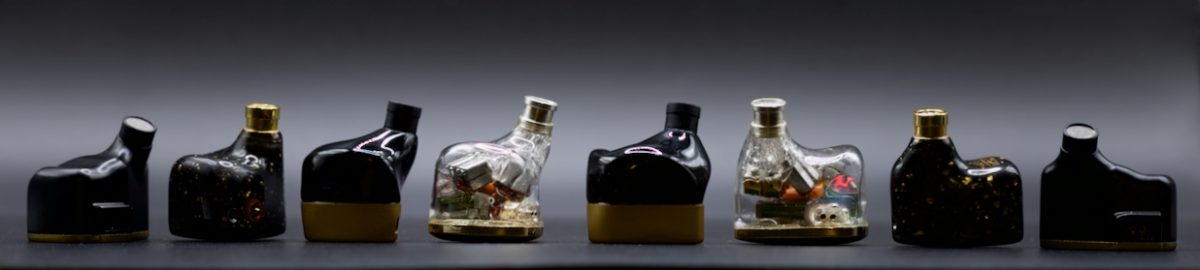
This unit was provided by HifiGo for a review.

I have heard of Juzear, but this is a first for me…
Juzear says Nebula is the most refined and best-value flagship IEM JUZEAR has ever created. They based Nebula on the earlier Defiant architecture. Rather than settling for a conventional hybrid arrangement, Juzear and Japanese reviewer KOTO implemented a five-driver tribrid topology, with one dynamic driver, three customized balanced armatures, and a micro-planar unit. The mechanical foundation of this monitor rests on a sophisticated four-way crossover network paired with four independent physical acoustic sound bores. By channeling the acoustic output of each driver class through isolated pathways directly into the nozzle, the design minimizes intermodulation distortion and turbulent acoustic cross-talk, preserving phase coherence and signal purity before the wave reaches the ear canal.
Packaged within ergonomic 6.1-gram resin shells adorned with multi-layered cosmic-refraction faceplates, the Nebula presents an impedance of thirty-two ohms and a sensitivity of one hundred and ten decibels, paired with a four-hundred-core, silver-plated copper modular cable. The resulting synergy yields a warm, deeply grounded foundation crowned by an articulate, forward vocal delivery and smooth, expansive extension.
Technical Information
>Impedance: 32Ω.
>Sensitivity: 110±1dB.
>Frequency Response Range: 20Hz~20kHz.
>Isolation: 26dB.
>Connector Type: 2-pin 0.78mm.
>Termination Plugs: 3.5mm+4.4mm.
The dynamic driver is tasked with delivering quality lower-end with good reach and punchy slam, the BA drivers are tuned to deliver an exceptional clarity in the mid-high frequency band, and the micro-planar is tuned for an excellent reach and definition in the high-frequency band. Together these five-drivers deliver a crisp, high-resolution clarity that presents each genre with exquisite performance.
Packaging and accessories
Nebula is neatly packed in a mostly cardboard box, with a nice presentation upon opening the lid. Inside teh box, there is the IEMs with the cable already attached, which is a good thing, as the 2-pin ports are very, very tight).
Rather than a carrying case, Juzear provided a pouch, which is a solution also adopted by Hidizs, amongst others. Convenient and practical, unless you like to stack the boxes with IEMs, in which case, you cannot.
The cable is of good quality, and it has swappable terminations. Very little microphonics, I use them everyday, in buses, trains, walking, with no problems whatsoever. Bear in mind it is summer, so I am not wearing many layers the cable could rub against.


Juzear calls this a Flagship-Level Cable Configuration
6N single-crystal silver-plated copper
400-core structure (100 cores per strand × 4 strands)
Reinforced with ballistic fibers
Double-layer PVC insulation
Interchangeable 3.5mm / 4.4mm connectors
In this price range, it is indeed a very good cable. It is reasonably thick, but pliant, with no microphonics.


The selection of tips is quite good, with my favourite being the translucent silicone ones. They are very similar to Eletech Baroque, which is a big plus. However, just like them, a size in between is needed. M is too small and L is too large for me, not uncomfortable, but enhancing the bass.
The shells are well built, with a vent located in the vicinity of the 2-pin port. There is no suction upon inserting them, no pressure buildup and no driver flex. The shells are rather light, at 5,5 g. The nozzle is reasonable long, with a lip to keep the tips in place, preventing them from sliding too far up or remaining stuck in your ear. The nozzle measures 6,3mm, a rather common diameter. The faceplate looks nice, with an iridescent effect, displaying different nebula-like reflections at varying angles. Each faceplate is visually unique.


Sound
Bass
On paper and under measurement against a tilted diffuse-field reference, this driver produces an imposing sub-bass shelf climbing to roughly ten decibels above the baseline. In casual assessments, such an amplitude profile might suggest an unyielding, bass-heavy presentation. In practice, however, what I hear is that the acoustic damping and steady downward slope toward 250 Hz prevent low-end resonance from bleeding into the fundamental vocal range. Instead of an overwhelming wall of mid-bass mud, the low end behaves like a decoupled subwoofer, maintaining authority while leaving the core vocal registers entirely unencumbered.
The bass guitar has good articulation, without taking the frontstage, it remains in the background, which is very nice. The keyword here is control. The bass is punchy, but fast, without muddying in the mids.
Mids
The handling of the midrange and presence bands is where the Nebula’s sonic identity reveals itself. Tasked with vocal reproduction and lower-treble harmonics, three custom balanced armatures drive an early, decisive rise into the pinna region, peaking boldly around 2.8 kHz. Because this prominent ear-gain shelf is contrasted against a lean transition through the lower mids and followed immediately by a steep suppression across the five-to-seven-kilohertz presence corridor, human perception naturally rebalances the entire stage. With percussive splash, sibilant friction, and cymbal bite held in check, vocal fundamentals and primary instrument overtones step forward into clear focus. What appears on the graph as an aggressively bass-shelved monitor thus translates in listening sessions to a dense, relatively intimate, and vocal-centric soundscape, completely devoid of glare. Voices are forward, without feeling too intimate, just very central. There is a nice separation of the voices from the instruments, giving a good sense of depth. Outstanding vocal clarity, making them very good for K-pop/J-Pop, vocal centric tracks and many more.
Highs
Standard balanced armatures often face challenges with parasitic resonances or early roll-off past ten kilohertz, whereas planar diaphragms excel at linear, low-distortion transient speed. Following the pronounced dip in the lower treble, the planar unit introduces controlled recovery and air beyond ten kilohertz, ensuring that trailing cymbal decay and spatial cues remain perceptible without introducing piercing fatigue.
The microplanar driver employed in the treble is the size of a BA.

The structure of a micro planar driver, according to Juzear
In practice, the treble is clear, crystalline, with fast attack (the period between the note start and maximum intensity) and well controlled decay (the opposite).
The timbre is very accurate, the cymbals sound crisp, metallic, but not overly so, just precise and clean. The cymbals are placed slightly back in the stage, creating the impression of a small venue performance, with the singer front and forward and bass and drums further back. The planar implementation is so good that most of the time it is impossible to tell it is a planar. Only fast repeating splashes can give a little bit of glare, but these are very rare moments.
Stage and imaging
Nebula has a larger stage, much larger than most of the IEMs in this price range, but more importantly, it has good sound density throughout the stage. While having good air between instruments, it never feels hollow. With the singer closer and the instruments arranged behind, it creates good depth. The height is not neglected, with Nebula being capable of offering a cathedral-like sound, provided the recording is up to the task. The arrangement is a bit particular, the bass happens somewhere behind, it stays localised, rather than lining up the edges of the sound stage. The treble extends further away, thus appearing outside the bass envelope. This enhances the sensation of horizontal air between the cymbals and the rest of instrument and makes the bass feel controlled rather than expansive.
The imaging is also unexpectedly good, probably helped by the four-way acoustic tubes.

Comparisons
Compared to Binary Acoustics 1900
Binary Acoustics, another HiFiGo offer, has a much more conventional tuning with big bass, slight V shaped, with the mids losing a bit of energy, only to rise again, just in time to elevate the voices and bring them ahead of the mix. Treble has good energy, smooth and with good air. Of this crop of budget friendly IEMs, this is my favourite one and I think it is the tuning to beat.
The only niggle, slight thinness in the low treble, which, combined with a touch of splashiness sometimes pushes certain sounds forward. Luckily, it’s all so quick that it doesn’t become shouty, but the first attack remains a bit sharp.
Compared to Binary Acoustics EP321
A totally different presentation, much leaner and with the treble moved forward, while the bass is much more mellow than Nebula’s. This tuning allows for more details to be easily perceived, since the attention is not distracted by the bass, things like the tuning of the drum kit, every nuance in the synthesizer of the subtleties of the cymbals. To me, this is an IEM better suited for critical listening, while Nebula is more for relaxing, enjoyment.
Compared to Ruviest Viola
A different kind of bassy goodness, with a totally different approach. The bass is more enveloping, reaching wider, deeper, lining up the edges of the stage, like a thick insulation layer. There is some space between the bass layer and the rest of the instruments, leaving the stage sounding just a bit hollow.
Compared to Tri i3 Mk3
A more expensive option (219 USD at the time of writing), Tri also sports a planar, albeit a 10 mm one, not a microplanar. It is the one that sounds most similar to Nebula. It can be considered a Nebula with a good –3dB below 300 Hz. Like Nebula, Tri has outstanding clarity, but the generational leap can be felt in the more precise imaging of Nebula. Tri has more note weight in mids, and an idea more air in teh treble, but the difference are minimal.

Juzear Nebula, Binary Acoustics EP321, Tri I3 Mk3
Some songs
Dio – Holy Diver
Nebula is engaging and large sounding, clear and well balanced with an obvious mids first approach. The voice is clear and the bass is very well kept in check.
EP321 sounds clear, dry and everything is line up behind the cymbals. The voice is further than Nebula, but still dead in the center and loud enough to rise above the mix. Subtle and detailed articulation in the bass, With the lower mids very lean, most of the focus on the guitar happens in the upper mids. The guitar sounds thus bodyless. For this iconic riff, more weight was needed.
Viola has more ample bass, coating the limits of the soundstage, like an elastic band. The voice is smaller and less forward. What really annoys me is the lower mids, or the lack thereof. It sounds like an artificial V, like someone has removed something.
Jennifer Warnes – Famous Blue Raincoat
Nebula plays this very maturely, well balanced, with the voice close and emotional, even though it sounds just a bit nasal.
EP321 has a less rich vocal texture than Nebula, but the timbre is more accurate. Very detailed voice, every breath can be hear. Very fast transients make the sudden stops of sounds like “t”, “n” pop-up like colorful ballons. The saxophone has more bite.
Viola The voice puts more focus on the head, loosing a bit the chestiness, due to the lower mids getting a bit diluted in the large stage. Not such an intimate presentation, with some engagement lost.
Aphex Twin – produk 29 [101]
Nebula unleashed a massive bass, making me wonder how it is possible to have this subwoofer effect in an IEM. I like the balance between the mids and the bass, with the upper mids coming forward
Viola has the largest stage, with very strong, tactile bass, that can be even overwhelming, depending on your preferences. A slight thinness in the mids can be sensed. The BCD creates a more cavernous space, the space effects create the impression of movements and the highs are more intense.
EP321 is made for different kind of music, its bass here being simply too shy.
Sting – Be still my beating heart
Nebula has a very nice presentation, voice forward, bass bebind and cymbals at the periphery. Very 80’s Hi-Fi sound. The voice is clear, words are easy to understand, and the tonality is good, since Sting had a more acute voice at the time. The natural coarseness in his voice is easy to hear. It’s like the singer is placed in the spotlight.
EP321 is even more clear, with more details in the treble, but the voice is further away and coming from above. The treble can induce a little bit of fatigue for those sensitive, but for treble lovers, it sounds just right. The microdetails in Sting’s voice need more effeort to be perceived, so overall, Nebula is more detailed in this regard. For my taste, while both are good, I prefer the Nebula for this song.
Viola has a more enveloping bass, the voice sounds natural and the treble thicker, with more note weight. The bass guitar has the nicest texture, while still not overcoming the whole. A very pleasant listen, with the difference between Viola and Nebula being mostly in the intimacy and the placement of cymbals. Sting’s voice sounds more natural on the Nebula, to my ears.
Conclusions
Ultimately, what Juzear has achieved with the Nebula is a highly refined and mature monitor that easily lives up to its flagship status. The five-driver tribrid architecture isn’t just an exercise in cramming drivers into a resin shell; it translates into a cohesive, vocal-centric soundscape that balances a decoupled, subwoofer-like bass with crystalline, fatigue-free highs.
While the EP321 might cater more to the hyper-analytical crowd, and the Viola offers a thicker, more cavernous bass envelope, the Nebula strikes a beautiful middle ground. It remains engaging and deeply musical, making it an IEM built for relaxing enjoyment rather than sterile critical listening. Whether it is the intimate, forward vocal delivery in a Sting track or the massive low-end reach required by Aphex Twin, the Nebula maintains outstanding control, depth, and precise imaging throughout the stage.
For my first foray into the world of Juzear, the Nebula made my job incredibly easy. Packaged with a genuinely excellent cable and ergonomic shells, it offers a tuning that simply gets out of the way of the music. For anyone looking for outstanding vocal clarity paired with a controlled, punchy low-end and fatigue-free air, the Nebula is a very easy recommendation.