
When a shadow is pushed into the light*
In the Greek mythology, Erebus (/ˈɛrəbəs/;[1] Ancient Greek: Ἔρεβος, romanized: Érebos, lit. ’darkness, gloom’),[2] or Erebos, is the personification of darkness.
The name “Erebus” is also used to refer either to the darkness of the Underworld, the Underworld itself, or the region through which souls pass to reach Hades, and can sometimes be used as a synonym for Tartarus or Hades (https://en.wikipedia.org/wiki/Erebus).
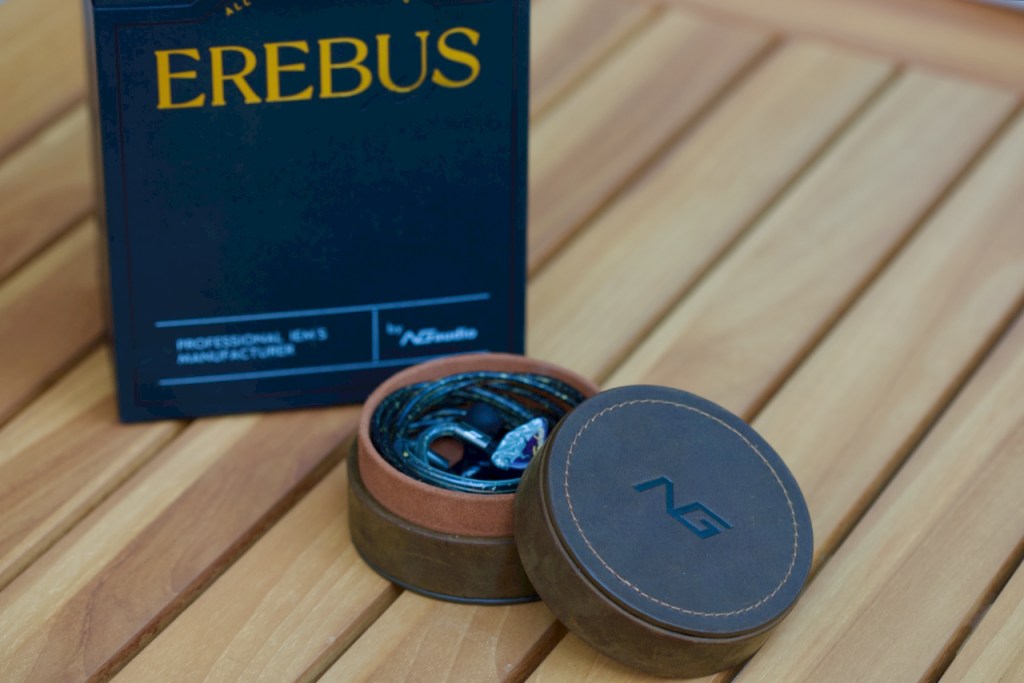
According to NG Audio, during the development of Erebus, the designers accidentally discovered that the electrostatic driver’s transformer would cause significant fluctuations in sound pressure when exposed to different magnetic fields. Consequently, NGaudio, using advanced craftsmanship, revolutionary added a special masking layer to the Erebus’s internal transformer and driver surface, ensuring more stable and ideal driver operation. Ultimately, this thorough implementation of the “masking” concept creates an exceptionally deep background when reproducing music. This results in a more stable overall sound quality, significantly enhancing the information content and density. With Erebus, the vision of NGaudio’s acoustic engineers has been significantly realized. Dedicated to the ultimate in “black” and “purity,” NGaudio’s designers, like fine musical artists, constantly plan and implement their own bursts of inspiration. (https://www.ngaudio.hk.cn/ng-erebus)
Configuration
15-unit 4-way, 4-way crossover design
1 low frequency (DD),
4 mid frequency (BA),
2 mid-high frequency (BA),
8 high frequency (EST)
impedance 17Ohm @1kHz
Sensitivity 104db SPL@1mW
Sound insulation effect 26db(CM)
Frequency response 5-70kHz
They arrive in a large cardboard box with the top splitting in two halves, along the longitudinal axis, the content of the box popping up as the two halves are pulled to the sides. A neat trick.
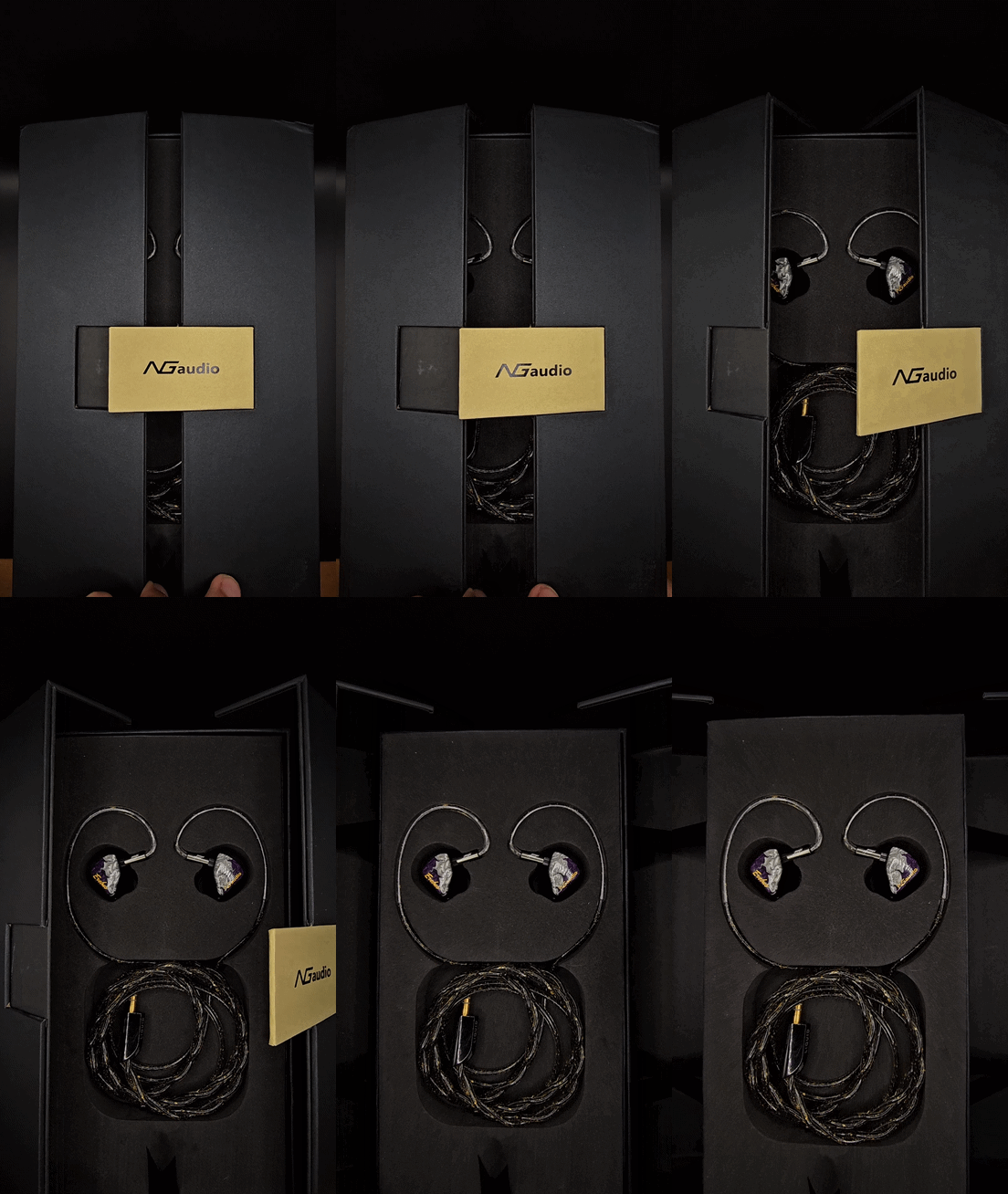
Inside the box there is a puck suede-like box, the IEMs and cable.
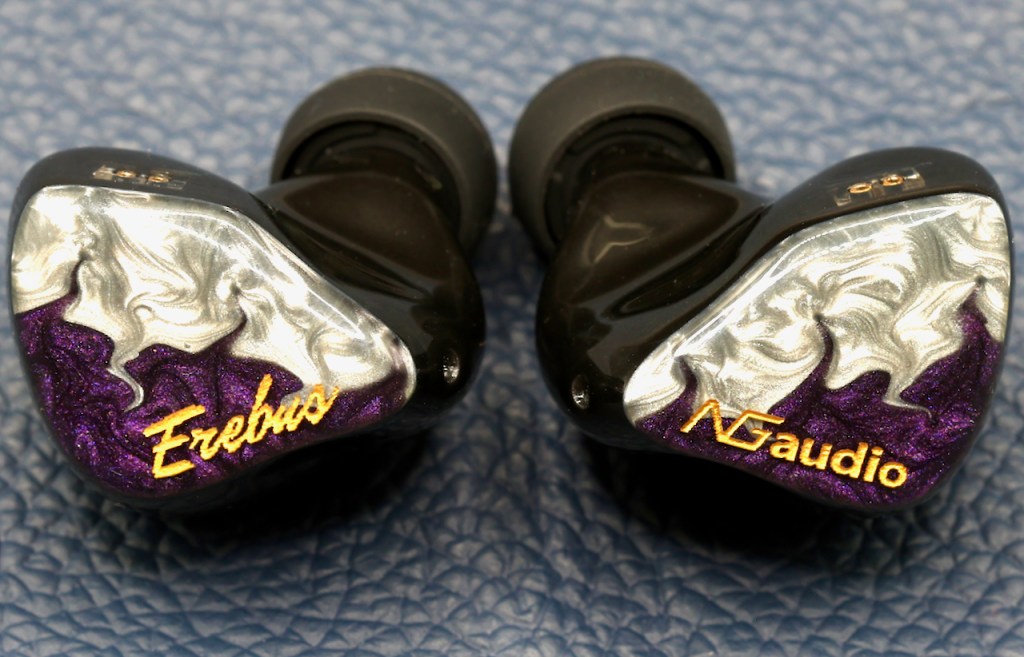
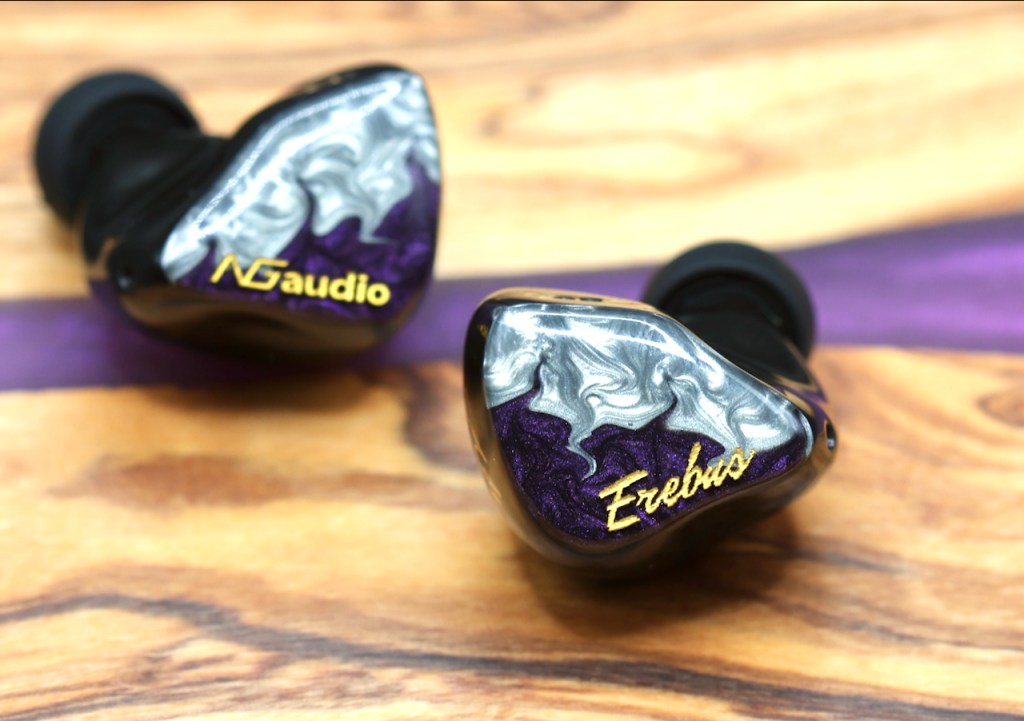
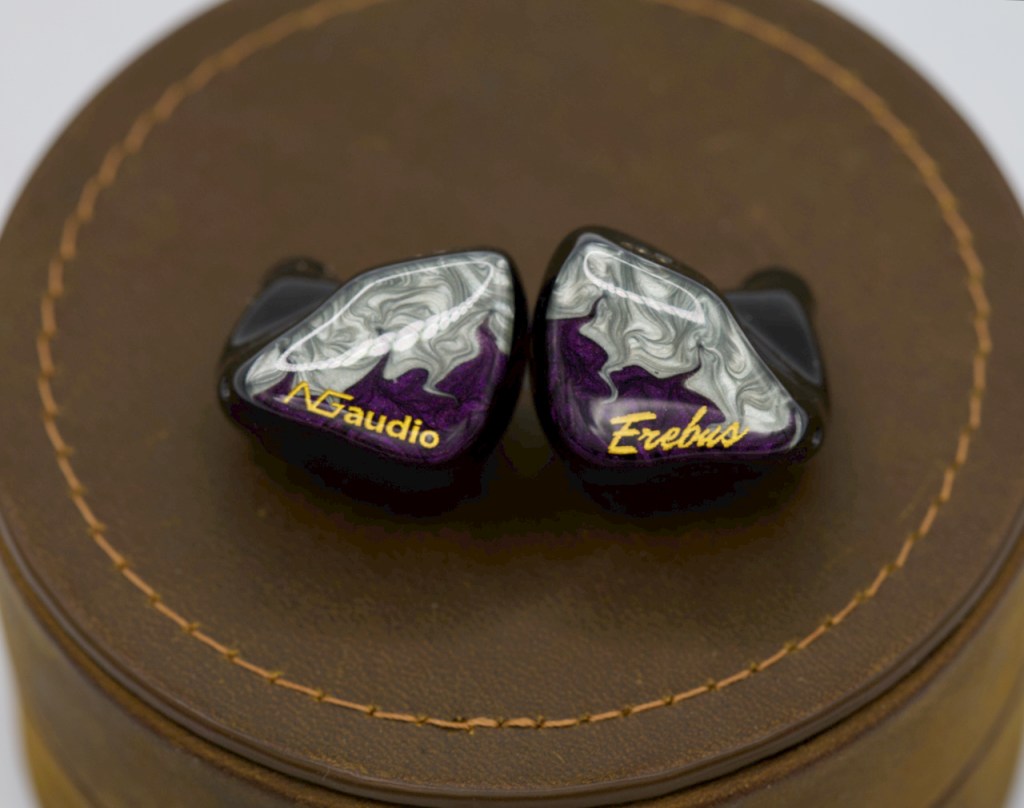
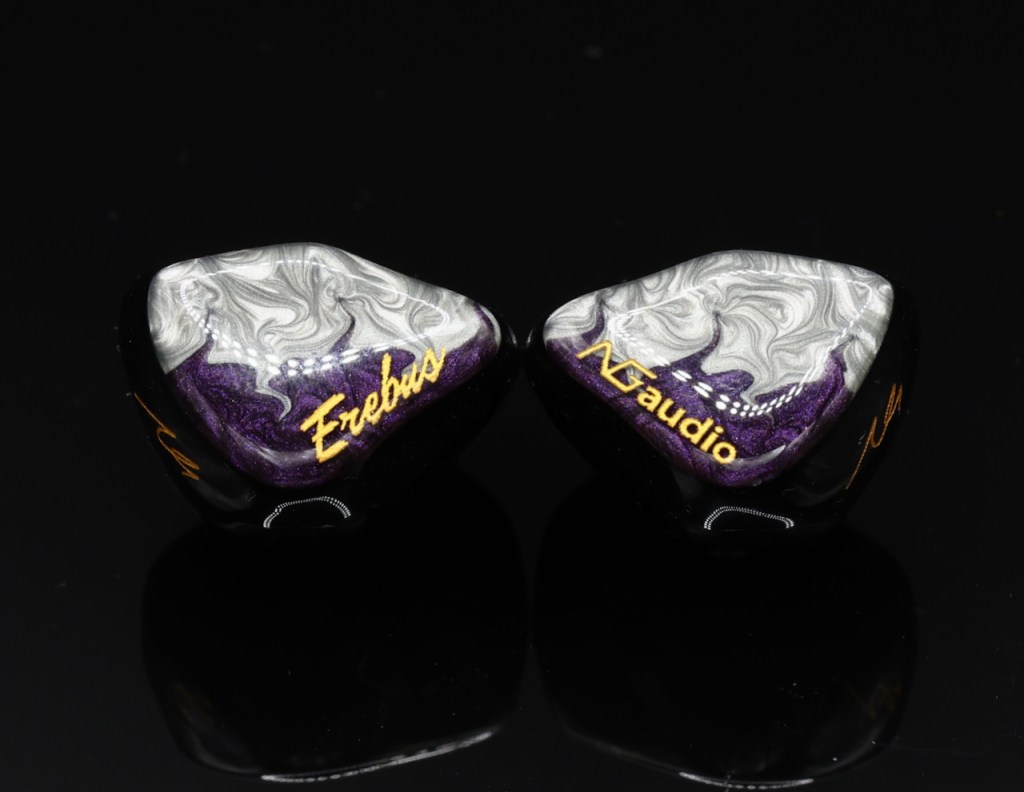
The shells are beautifully crafted, with a body made of resin with a faceplate representing maybe the Tartarus, where Hades resides and with which Erebus is synonymous. It could also be the darkness-light antithesis. Or it could be just a random model. The shells are relatively large, but comfortable. The nozzle is fairly large, with a protruding lip that makes attaching tips rather adventurous. There is no stop position for the tip, it can slide all the way up until the nozzle is actually exposed, so I’ve used Divinus Velvet or Symbio W in order to prevent this from happening. Sliding a couple of O rings onto the stems allows for safe use of tips like Eletech Baroque.
The attention to details is astonishing, the same signature you find on the IEMs is embossed on the sleeve holding the box closed…
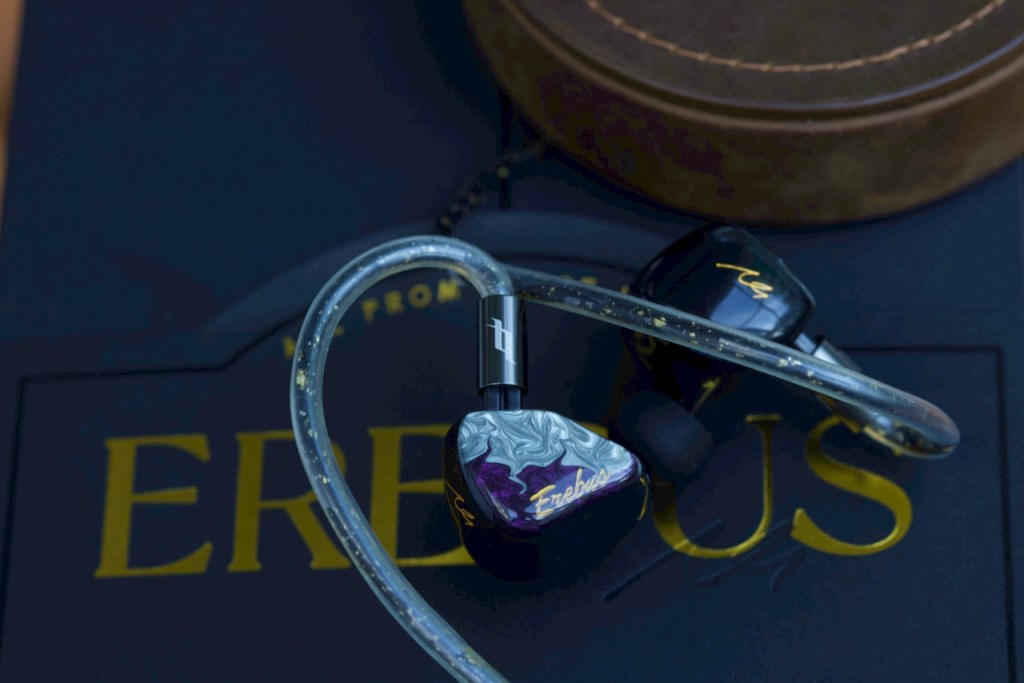
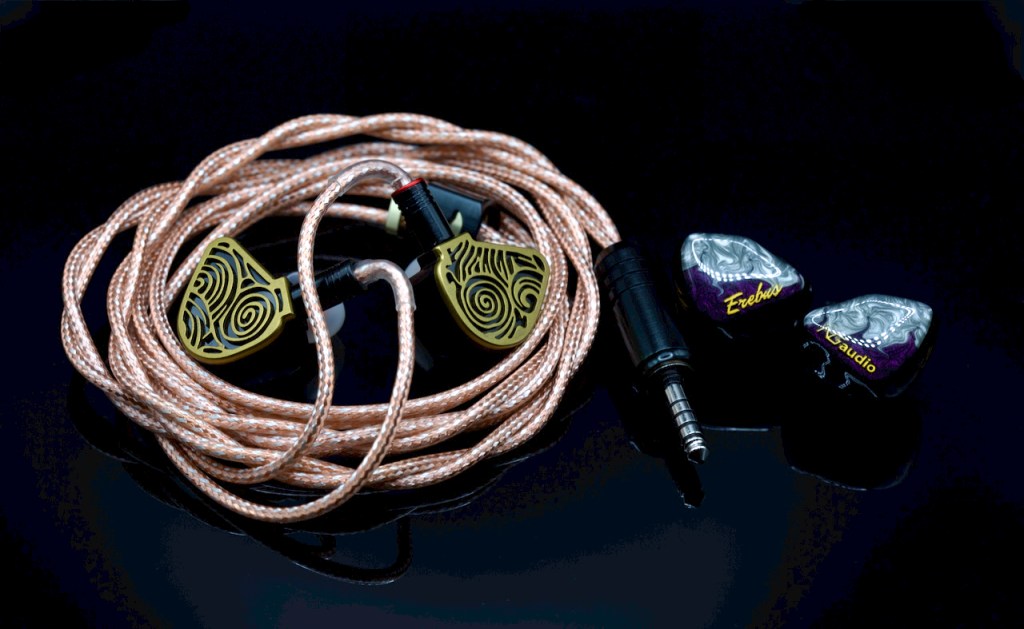
The cable is a simple black one composed of 4 braided wires. It is very ergonomic and free of microphonics, but sonically I found it to be surpassed by LL Venom, Nightcraft Spectre, and some other cables.
What do they sound like
The following impressions are based mostly on LL Venom and Nipo N2 with Eletech Baroque, Divinus Velvet or Symbio W1 tips.
There are two main features that draw attention immediately. First is the mid bass. It is the most beautifully textured, addictive midbass I have encountered in an IEM. The second is the particular stage, tall and narrow, with the lateral edges clearly defined. Think of a giant capacitor and your head is right in the middle of it. And there is actually a third feature competing for attention, the treble, which is as close to perfection as it gets, in terms of presence, airiness and extension.
Bass
As already stated, the midbass is wonderful. There is a level of technicality akin to modern days state of the art BAs, with all textures being clearly discernible, and the bass guitar line being the skeleton onto which the rest of the elements are attached. It is not overpowering the drums, they are rather equal in intensity, but the bass being warmer, more constant, it is the one that captures the listener’s attention.
In terms of subbass, there is good rumble, but the extension is not infinite. If you’re looking for a teeth rattling bass cannon, this ain’t it. The fast decay makes it feel alive, the breathing soul of the rhythmic section. And while it won’t make you feel like in the middle of an earthquake, it won’t leave you wanting for more. When the music requires it, it delivers deep rumbling notes, but all is contained. Interesting to note is the layering of the bass. With the stage being narrow and tall, the bass forms a blanket at the bottom of the stage. It does not wrap too much around the sides, it rather tends to stay contained to the bottom.
Particular mention to cellos and fretless bass guitars. They sound very real and detailed.
Mids
They are not as forward as the midbass or the treble
One thing I like is that they are not overly smooth, they can convey some grittiness when needed. I’ve praised UM’s Maven 2 Crescent somewhere else for this quality of having a bit of grittiness in the mids. It’s something I look for in my IEMs and it is the feature that can make the difference between a good IEM and an “I absolutely love it” one. The voices are quite forward. I guess this particular sound stage has its advantages. Female voices are layered above the cymbals, lending the Erebus a sort of small bar performance sound. This adds to its addictive character, making it difficult to stop after a couple of songs, as you feel a real connection with the music. The same holds true for male voices, clear, emotional, perfectly placed. The tiny inflexions in Stromae’s voice are saying so much, sometimes more than the words themselves. Sting and Elton John sound equally impressive. Enough warmth, very detailed, just keep on listening.
Guitars have good textures, intricate layering with the voices, pianos sound natural as far as I can tell.
There is relatively high energy in the upper mids, making them maybe a tad bright for some pop music.
Treble
To me it sounds at least on par with Anni 23. There is ample extension, airiness and the feeling of vast headroom. The cymbals sound detailed, textured, being a particular joy for jazz, where all the soft playing does not go unnoticed. Through judicious tuning, the volume of the treble is such that it does not distract from the rest of the music, while still being the second main attraction of the Erebus. Despite having ESTs, the treble is not too ethereal, on the contrary, there is a rather thick body, with brilliant textures and very good note weight. I guess having 8 of them does pay off. From my point of view, they have succeeded in their quest to increase the density of information.
Blowing instruments as well as violins sound full and dynamic. I’m not an expert when it comes to their textures, but it does seem rather complex to me.
Soundstage
As already mentioned, I affectionately call them “the capacitor” (in most latin languages, called a condensator/condensateur/condensador. This, interestingly enough, also means (in spanish) a device for condensing a gas and turning it into a liquid (in French, we use condenseur, which is also very close). What’s the meaning of all this? In a chemistry lab, such a condenser is used quite often in the process of purifying a substance, or for concentrating it. And this is exactly what Erebus does, it concentrates the music, doubling the fun and making sure nothing is lost.
The holographic layering is precise, well delimited, mostly on the Y and Z axis. Tall and deep.
Pairing
Unlike Storm, Erebus does not require your own SMR. It paired nicely with the ifi GoBar Kensei, in high gain, it amazed me with the Nipo N2, but the best it sounded with AK SP3000. The smoothness of Astell’s treble and the crystal clear mids really brought the best out of the Erebus. LP P6P was also a good pairing, as well as the Nipo A100.
In terms of cables, based on a gut feeling, I switched from stock to LL Venom and it was impossible to go back after that. I guess part of what makes the bass so impactful is the Venom. Besides that, Venom augments the forceful presentation of the bass, with even tighter control and adds more vocal clarity and note weight. I’m sure there are other combos that work well, but this one ticked all my boxes. I wouldn’t use cables that enlarge the stage, in order to preserve Erebus’s natural soundstage.
With Kensei, there is, naturally, some hissing, which can be resolved with the impedance matching sliders, or better ignored, as it goes away as soon as the music starts.
Where do they shine? Classic rock, with its no-nonsense production. You’ll never look at Geezer Butler the same after listening to Black Sabbath on Erebus. For some prog records there may be too much clarity, though.
Rap, the high vocal clarity makes the words more intelligible than other sets. There is more than enough rumble and slam. A particular note here, Erebus highlights the albums where the bass is interplaying nicely with the voice, all the microbreaks are preserved, making the music more impactful than ever. Example: 2PAC’s All Eyez On Me.
Metal of all sorts. Obviously, with such a good midbass, acts like Amon Amarth and Death benefit greatly. Doom is particularly pleasant, with the Erebus amplifying the depressing atmosphere, while the treble gives it that shimmer of hope to keep you hooked.
For classical music, the narrow stage could be detrimental, at least in theory. But in reality, I find them very technical, there is so much going on, that personally I completely forget the stage and I get transported by the music. In fact, I have the impression that the soundstage is blooming and expands compared to other genres. I particularly liked them with Baroque music, but not only. Thibaut Garcia’s interpretation of the Concierto de Aranjuez abunds in emotions, the delicate equilibrium between the less macho guitar and the orchestra being perfectly preserved. Impressive dynamics, equaled only by a handful of IEMs, as far as I’m concerned.
Less preferred: some pop, the extra clarity is too much for me. The treble is more detailed than necessary.
Comparisons with Storm, Steranko S40
The following comparisons are meant to give you an idea on how various songs sound with Erebus vs some other highly regarded sets, not to establish a hierarchy between them. The price of these sets varies greatly, but the S40 has a similar driver configuration (2DD, 10BA, 8EST) to Erebus, even though it costs ⅔ of the price. Storm obviously has no DD, but I’ve included it because it is considered by many one of the best IEMs ever made.
Metallica – Master of Puppets – this represents to me the best metal song. All three IEMs are highly enjoyable, with Storm being more raw, more accurate, and maybe a tad less…exciting. The level of details with both is astonishing. Erebus puts Cliff’s bass and Lars’s cymbals upfront with James’s voice being also emphasized. The guitars sound rough enough in the first part of the song, but the solo James does is very mellow. The cymbals sound polished as opposed to Storm’s more rough, aggressive, sound. Everything sounds cohesive.
With Storm there is usually no mercy for the quality of the recording (no issues here). The heavy hitting drumming style is more obvious, the voice sounds more raspy. With Storm it is like everything is always in focus. While both are engaging, Storm gives me more of a trip down the memory lane, back to my neighbours parties with tens of people shouting Master! Master! (Disclaimer: I was too young to join them, but I liked the music).
Erebus almost enhances the production, making it sound more modern, more polished.
Can S40 keep up? After all, price-wise is in a different league than the other two. Well, I believe it does. It falls right between Erebus and Storm in terms of tonality. It’s not as bassy as Erebus, and not as aggressive in the upper frequencies as Storm. The bass line is easy to follow, even though not as in plain sight as with Erebus. The mids bump is obvious at James’s solo, it is my preferred rendition of these three IEMs. Treble is similar to Erebus presentation, smooth, detailed and airy. The bass drum is a bit too forward, not really the best anchor for this song, but still a good listen. S40 feels a bit more analytical than engaging compared to the other two, which is unexpected.
Muse – Supermassive black hole
This exact song was my trigger for acquiring Storm. It sounds massive, the bass, although not having the impact of a DD is present in good amount and quality. It seems to come from all around, you’re in front of the stage at a big venue. Erebus, once again, has the same level of details, presented in a different way, with a warmish coloration. With Erebus, it sounds less large, but the bass impact is more pronounced. Both have a very lively presentation.
S40 also shines here with a spherical soundstage between Storm’s supermassive one and Erebus’s narrower one. The music seems slower paced, unlike the other two. The balance is evident, S40 is not less than a Traillii with DD bass. Being more relaxed, it does not have the same dramatic bass impact. For Muse, though, this works very well.
Break in Lizzy Hale and Amy Lee
Simple song, all three sets are equally good. Storm keeps Amy’s voice more ethereal, more in line with her usual singing style. Both voices are more forward and somehow highlighted compared to Storm. A bit more closed in. An easier listen, but in most cases I prefer Storm’s reference approach. S40 once more sounds more relaxed, with the voices not as forward and “heavy” as Erebus, but also not microscopically detailed as Storm. Storm remains my preference here.
Stratovarius Alpha & Omega
Apart from the bass tilt, Erebus does not have that large, symphonic like presentation, in particular during the chorus. The voice is less disperse, it sounds more like converging inwards rather than going outwards in the case of Storm. S40 sounds massive, not quite like Storm, with a base that is just slightly less impactful, and the voice forward in the mix. This is a very crowded track, and while the separation on the S40 is not as clear as the other, I don’t feel like any details have been masked. I don’t have a clear preference here, all three are equally good, with Erebus being the most coloured presentation and Storm the most reference one.
Depeche Mode – Policy of truth
The pattern continues: the Storm presents a grander scale with a more even-keeled bass, while the Erebus brings vocals and treble details forward for a more intimate and polite listen. The layering and spatial effects are more spectacular on Storm. S40 feels at home here, everything just falls into place nicely. The voice is warm and detailed, the bass is just perfect, the stereo effects very tasteful, drawing the attention less than with Storm. The song creates an open atmosphere, airy and spacious, very appropriate for this kind of music.
Kandace Springs – Piece of me
A lot more intimate on the Erebus, with the voice really forward, dominating the mix. With the usual Divinus Velvet, the bass was too prominent, so a change of tips to Symbio W reduced the bass to a level similar to Storm. However, this reduced the treble too, so a slight trade-off here.
Storm sounds bigger, the voice has just a tad less body. Both are very pleasant, with Erebus more relaxed and Storm more in the direction of critical listening. S40 has a voice centric presentation, with perfect balance between detailed and analytical. The mastery of Storm is highlighted here, as S40, like Erebus, needs some tips rolling to achieve the perfect state when switching from metal to jazz, while Storm seems impervious.
Slayer – Seasons in the abyss
Storm is the best at conveying that raw energy, the rage, the descent into madness. The drums and cymbals sound ferocious, the guitar tone is as rough as I remember it. While the drum fills at the end of the introductory part sound more bombastic on Erebus, overall Storm takes the prize, with its balanced, energetic presentation.
Erebus focuses on bass guitar and drums plus cymbals. For this particular song, it works wonders, the way the ride drives the while thing during the verse is mind boggling.
S40 is more similar to Storm than Erebus. The bass is controlled, but there is an underlining rumble that is always present. It just isn’t as loud as on Erebus. There is no midbass emphasis here, if you want to follow the bass guitar line, you have to work. The bass drum is very forward in the mix, almost to the detriment of the rest. It’s the one driving the whole thing in this case. Mids are not overly smooth, Slayer’s dissonant guitar tones coming through without an issue. Funny enough, for such a smooth set, S40 sounds very analytical.
As a bonus, while it makes no sense to compare them directly, an unsung hero emerges here, the UM Maven 2. With a similar configuration, 2DD, 4BA, 4EST, Maven 2 sounds relatively close to Erebus. There is tad more subbass and less midbass with Maven 2. The treble is a bit smoother on Erebus, although it brings details more forward, it does it in a pleasant, non-intrusive way.
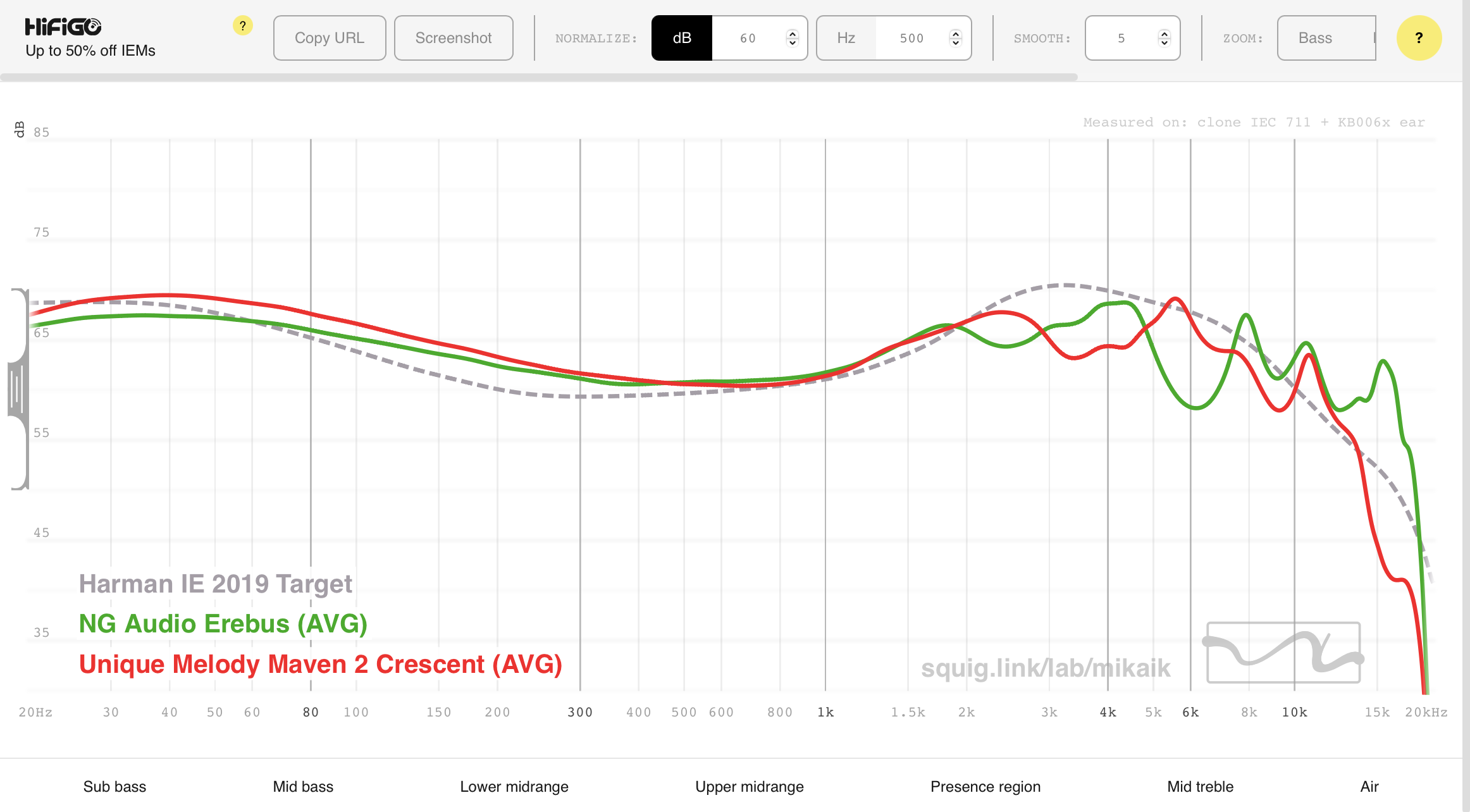
Erebus has more vocal clarity, but make no mistake, the mids on Maven 2 are class leading, so either of these feels at home playing just about anything. The stage has a more classical ovoidal shape on Maven 2. The midbass on Erebus makes for a more compelling listen, but Maven 2 is not far beyond and source pairing may even elevate it above Erebus (it is the case of Nipo A100 for me).
The comparison could go on forever, with these three sets being clearly at the top in this crowded market. Unless you are an extreme basshead, I cannot imagine that you wouldn’t find a good match in one of these three. Erebus is a very detailed set, with a warmish tilt. It is very engaging, due to, at least partly, its very interesting staging. It is very good with technical, complex music, like prog rock, metal, jazz, but it does not shy away from other genres either. The big shells might not be a good fit for everybody, but rest assured, they are not the biggest or the least comfortable ones you’ll ever see.
LE: The Erebus appears to be available from MT, for 4800USD (Aug 2025).
*This is the title of one of my favourite albums of the Finnish band Swallow the Sun. Erebus rendered this album in such an emotional way, the contrast between the soft and the brutal parts reminding me of the image on its faceplates.
**This text was originally published on Head-fi.org and is now re-published here in an effort to bring all reviews under one roof.
 Mikaik-audio