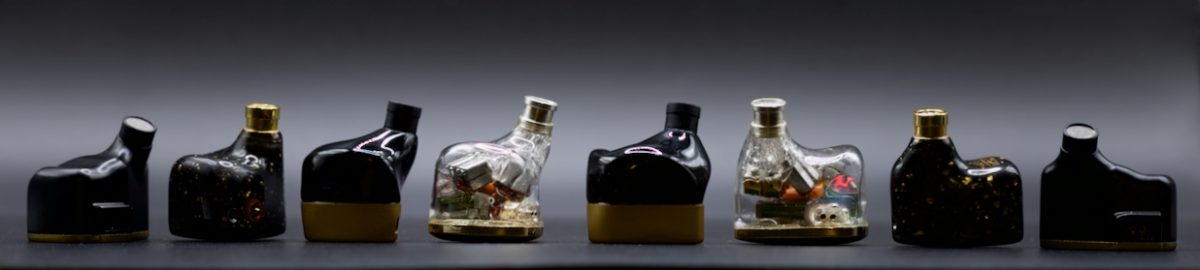
Review Asteria – Blue Lava
Asteria is the new flagship from 7th Acoustics, limited to 77 pieces.
Technical and Driver Configuration (from the manufacturer’s website)
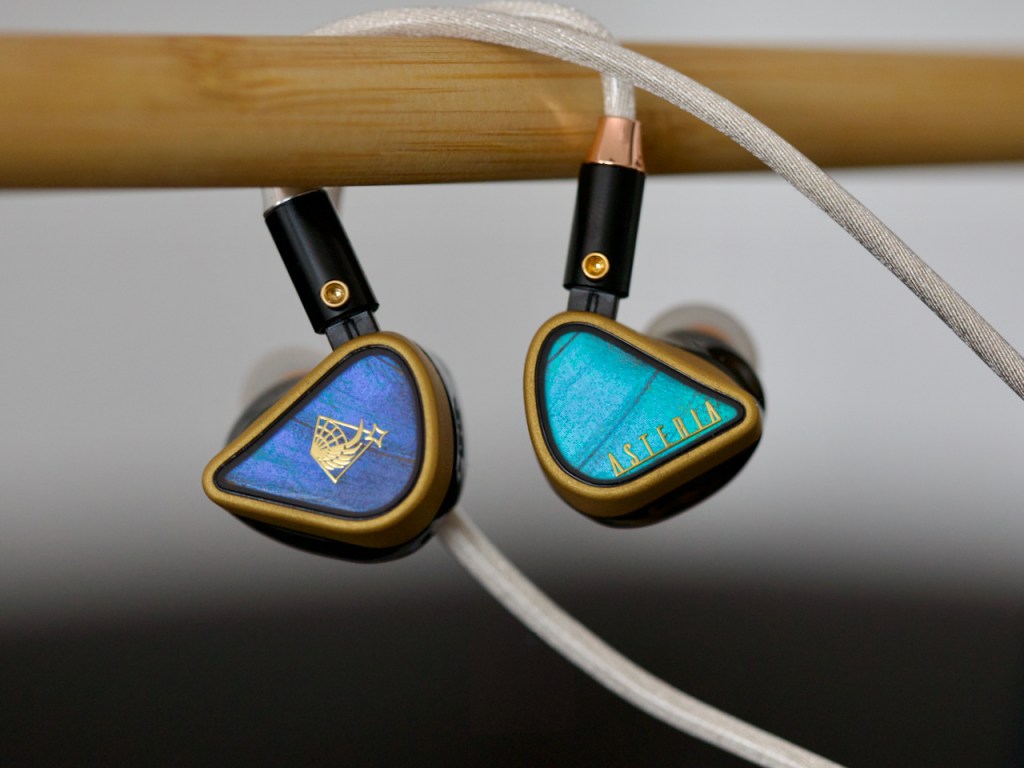
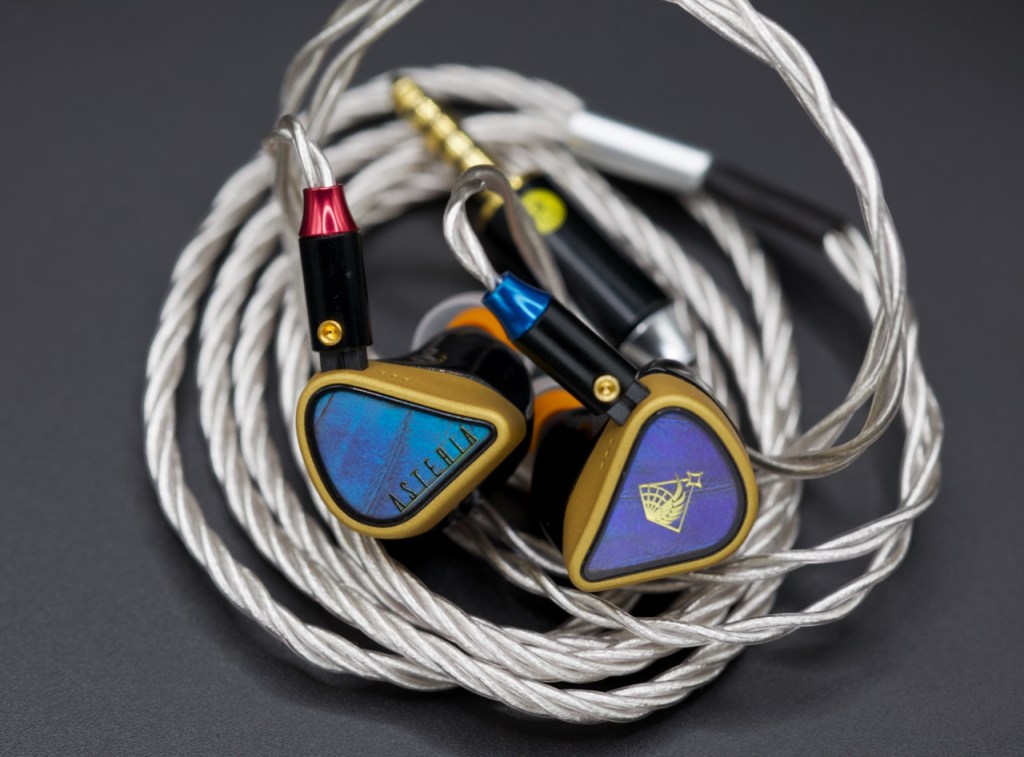
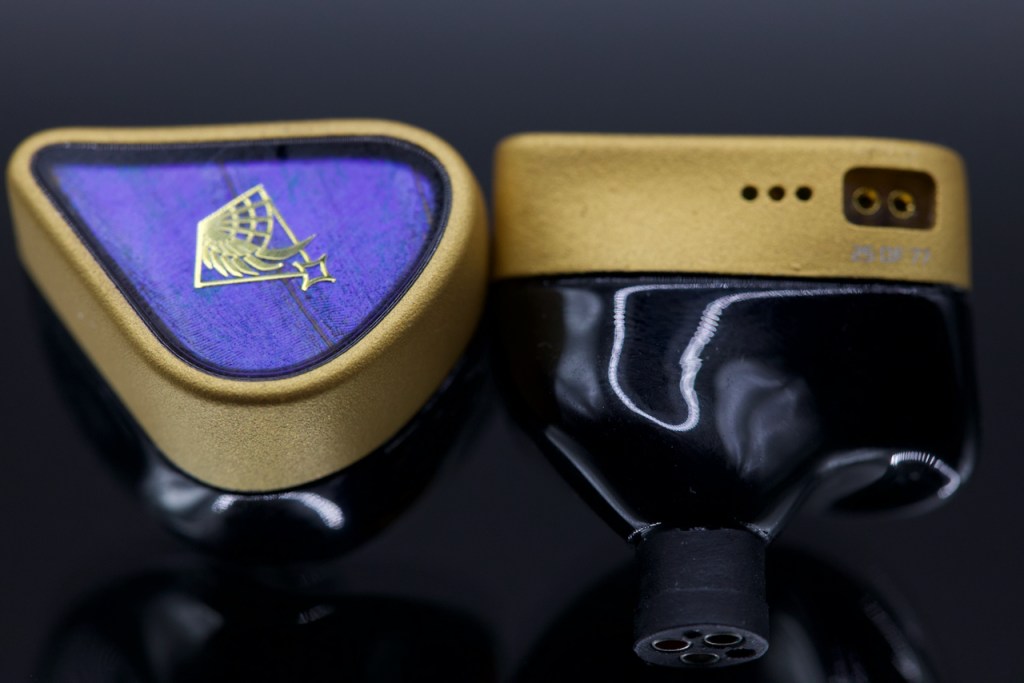
With a no-holds-barred approach in aesthetics and engineering design, the Asteria features a custom 1 dynamic driver with BalanceFlow vent and 12 ultra-low distortion, next generation Knowles balanced armatures. The housing features a medical-grade resin inner shell and a CNC aeronautics-grade 7075 aluminium outer shell with ceramic coating finish. Each unit’s faceplate comes with an iridescent blue morpho wing inlay, making each piece truly unique.
The Asteria utilizes specialized drivers and technology specifically dedicated to handling the highest frequencies:
Driver Configuration:
- Bespoke 10mm Double Vented, High Magnetic Flux Dynamic Driver with BalanceFlow Vent Technology , 10 mm Dynamic Driver for Bass
- 6 Balanced Armatures for Midrange
- 2 Balanced Armatures for Upper Midrange
- 2 Balanced Armatures as Tweeter
- 2 Balanced Armatures as Supertweeter
- Impedance: 23Ω @1kHz
- Sensitivity: 111 dB/Vrms
- Frequency Response: 5-24.000 Hz
- Channel Matching: ±1dB
They feature the following innovations/proprietary solutions
EXPP (Extreme Xover Performance): 5-way Crossover (Utilising the highest quality capacitors and resistors, EXP ensures a very low distortion and high driving efficiency without compromise)
ECHO (Enhanced Clarity Horn Outlet): Supertweeter Tube (ECHO is 7th Acoustics treble acoustic technology to control and push the supertweeter capabilities to its absolute limit. Unlike a conventional acoustic tube, ECHO mimics horn loudspeakers to enhance the efficiency of the driver, especially in the higher frequency ranges. This allows the treble region to be more crisp and well-extended without sounding unnatural or shrill)
BalanceFlow: 7th Acoustics’ proprietary approach to regulate the pressure waves generated by the dynamic driver to maximise dynamics while keeping extremely low distortion levels. The dual ports deliver superb technical performance while avoiding common pitfalls such as driver flex and pressure build-up while worn. BalanceFlow adapts dynamically to the demands of the music track, giving a detailed texture, powerful punch, and yet maintaining a tight control over the driver.
Fully 3D-printed Individual Acoustic Tube
Internal Vent for Pressure Relief
Radial Bass Port
Internal Construction
6N OCC Gold Plated Copper & Estron Silver-Plated Litz For The Internal Wiring
Top-of-The-Line Resistor & Inductor Component
Oyaide Tin Solder
Spring-Loaded Gold Plated 0.78mm 2pins
Lyra Cable
4N OCC Pure Silver
4-core 23.5AWG
Type 6 Concentric Litz
Ultrasoft PVC Jacket
Full Ceramic-Coated Brass Hardware
Proprietary Insulation Material
Custom Blend Tin Solder
Oyaide 2-pin Connector
Furutech 4.4mm Plug
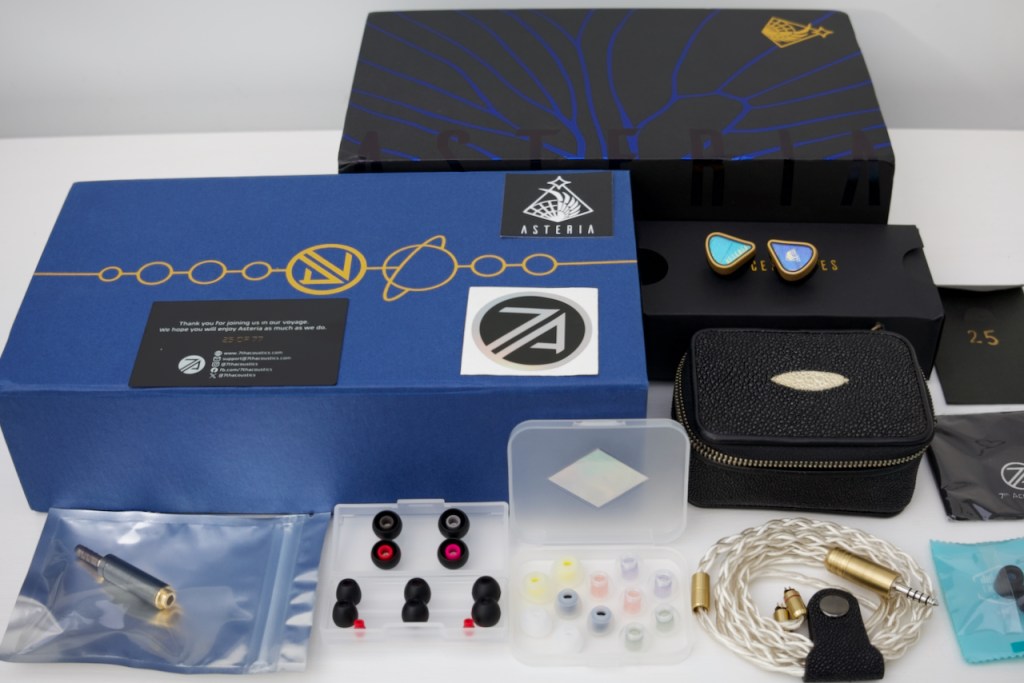
The full content of the package is as follows
Asteria In-Ear Monitoring Earphones
LYRA Cable
Serial Number Card
Genuine Stingray Leather IEM Carrying Case
Genuine Stingray Leather Cable Clip
7th Acoustics Standart Eartips (S/M/L)
Spinfit W1 Eartips (S/M/L)
Final Audio Type E Eartips (SS/S/M/L/LL)
Dekoni Mercury Foam Eartips (M)
Microfiber Cloth
IEM Cleaning Brush
4.4mm to 3.5mm Adapter
Stickers
Limited 1.5 Years Warranty
What was the tuning philosophy of the makers: With our uncompromising approach to tuning, Asteria aims to deliver meticulous tonal balance from one end of the frequency spectrum to the other. Aiming for an U-shaped and balanced tonality, we build up from a deep, rumbling, controlled, and textured bass with a visceral punch and zero bleed into the mids. Imagine having two subwoofers in front of you, that is what we hope to emulate with the Asteria.
With the midrange, the Asteria delivers a clean and sweet tonality without sacrificing details. Vocals are timbrally natural and well-centered with clear positioning, regardless whether it is male or female vocals. Macro- and micro-details in the mids are finely reproduced without being overwhelming.
Asteria’s treble is very well-extended, lively, textured, and airy; we aim to replicate the experience of listening to a speaker setup with tweeters. We designed Asteria to sustain as much energy and details in upper frequencies without harshness nor sibilance.
The set retails for 3800USD at Bloom.
Construction
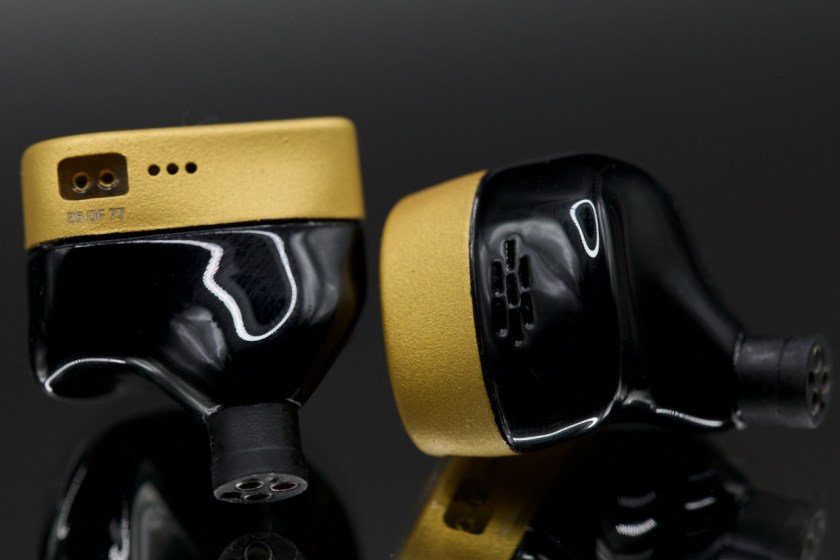
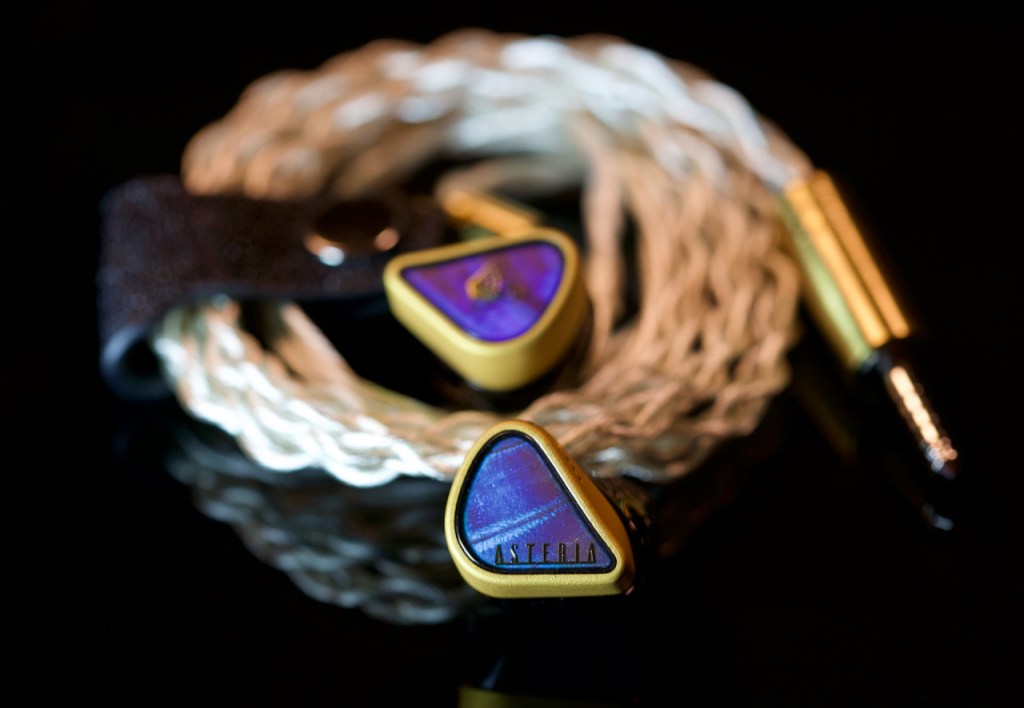
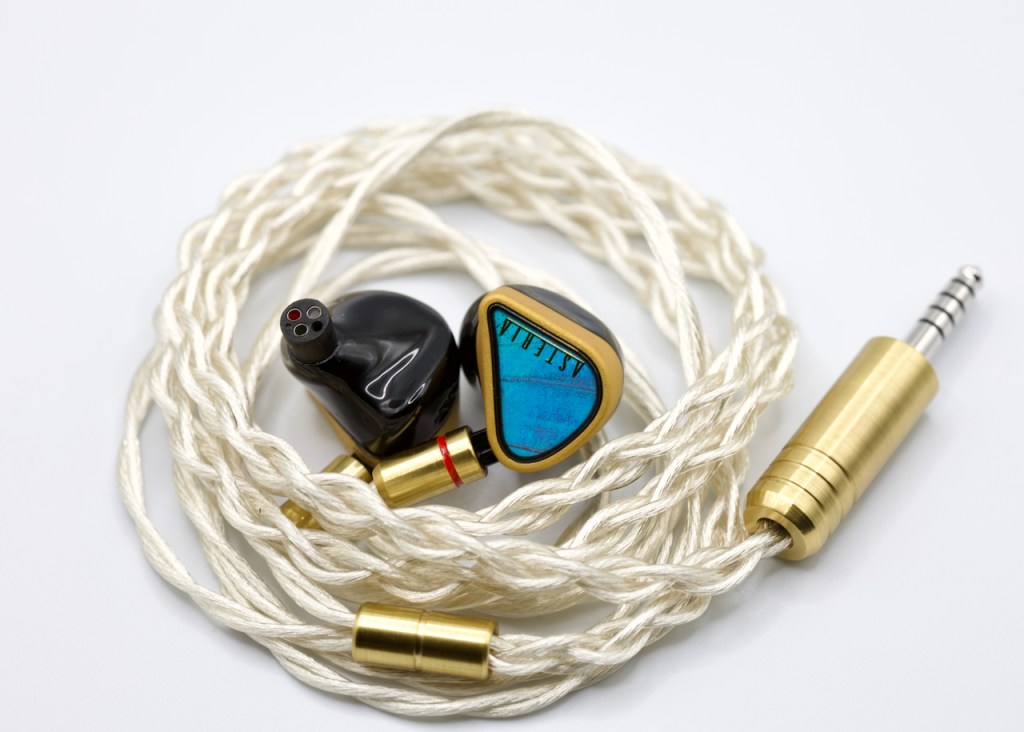
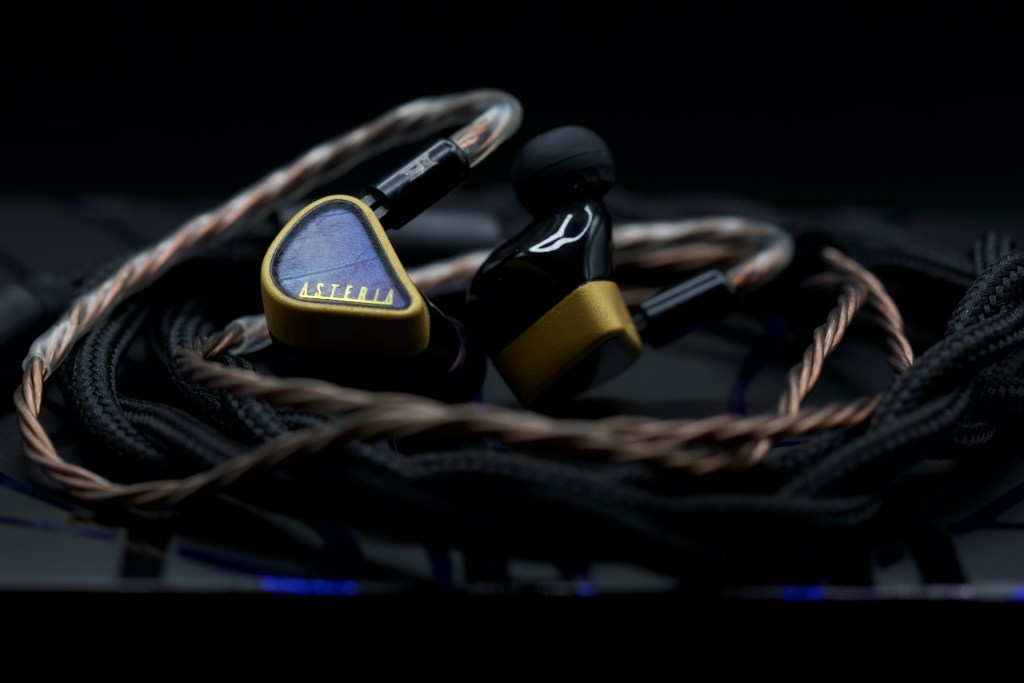
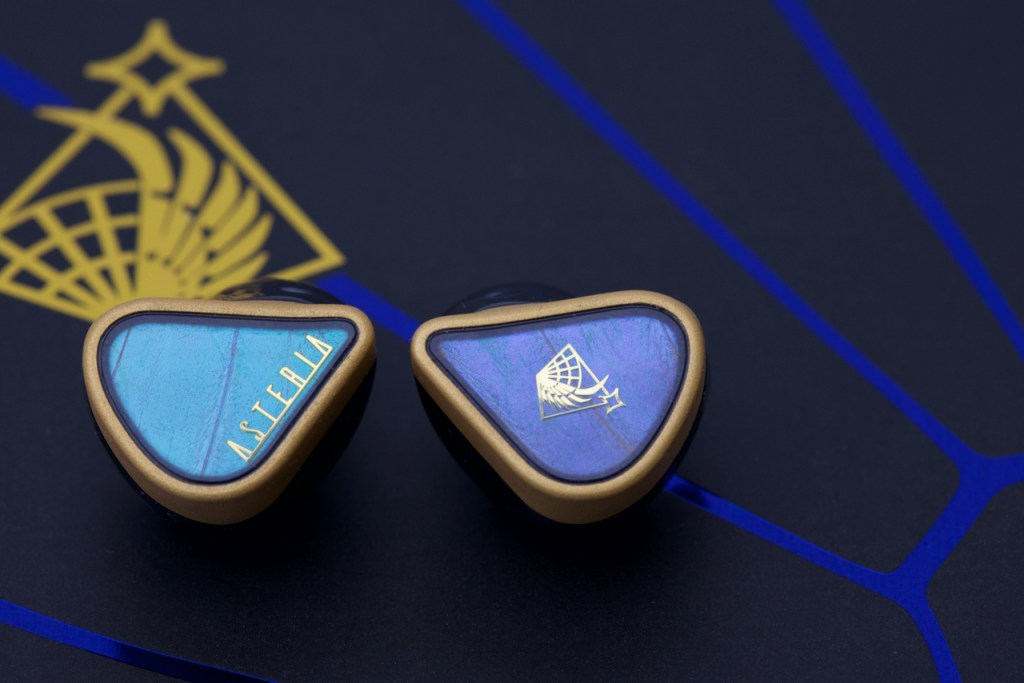
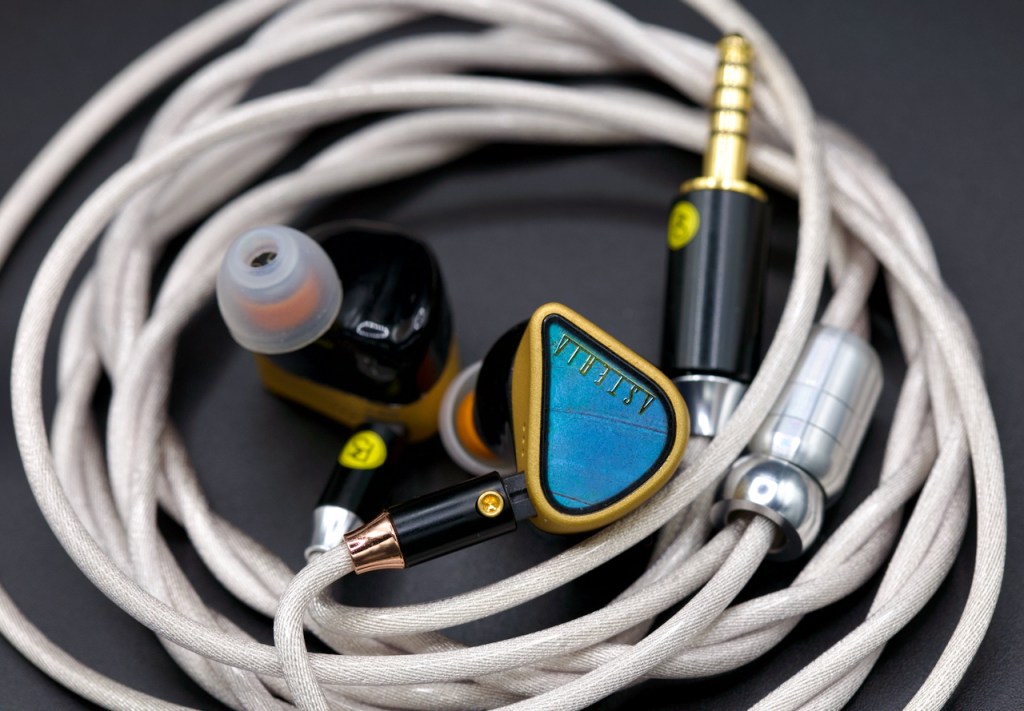
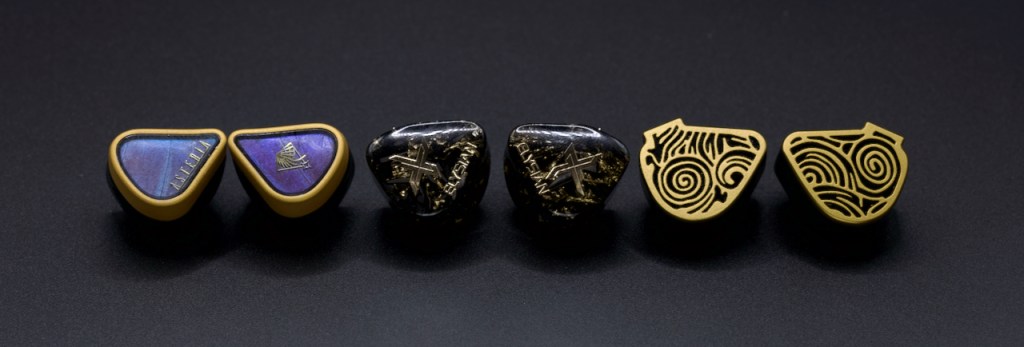
The shells are wonderfully built, with a black resin shell, and a blue iridescent faceplate, protected by tempered glass. They have a thick golden rim surrounding the faceplate (which is, according to 7th acoustics made of Aluminium coated with a ceramic material). The design of the faceplates, as well as that on the outer sleeve, make me think of Blue Lava. The nozzle has a matte finish, which is brilliant, because the tips do not slide off easily. In fact, they are difficult to remove. This shows me a stunning attention to details from their creators. Well done!
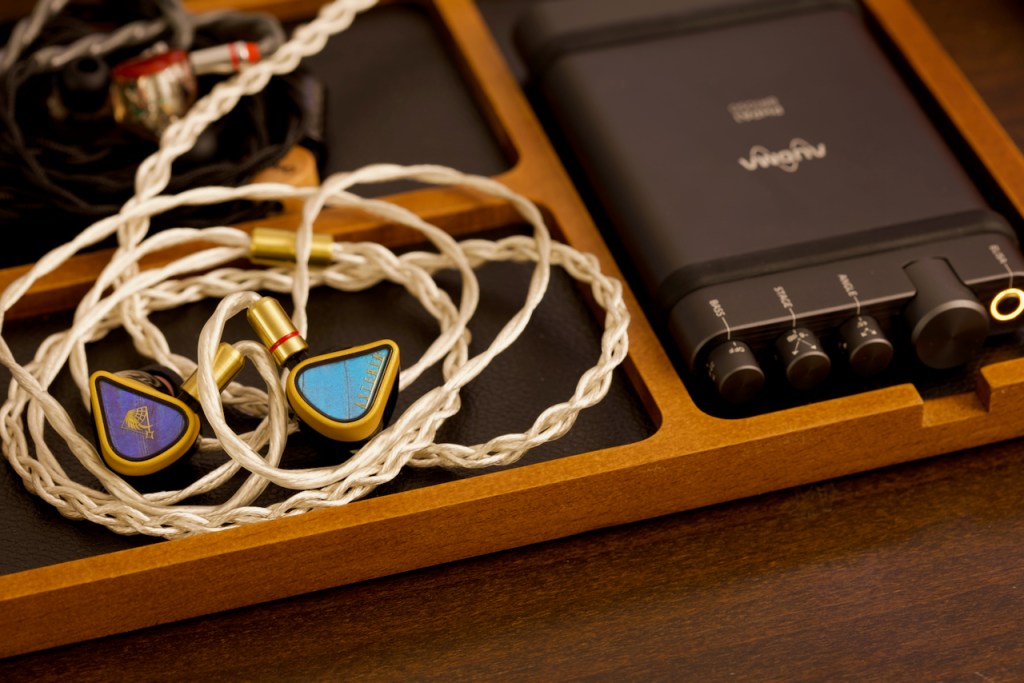
The Lyra cable is of high quality, based on the Astral Acoustics Silver reference cable, if I understood correctly. It is supple and malleable, with no form memory and I haven’t encountered any microphonics.
The included pouch is pleasant pleasant to hold and well made, in addition to being large enough to hold the IEMs and the cable.
Asteria is a set that fills a niche I didn’t even know existed, let alone that I want that I like. it is clearly detailed, yet it sounds musical. It’s bassy, but not overwhelmingly so. The first time I listened to them, I had the feeling the treble can sometimes be too much, but that was at CJL, with the volume cranked up to stratospheric levels. At the time I thought it to be overpriced, as nothing stood out for me during the 10 minutes I have auditioned it.
The set I’m reviewing here has been provided by a god friend, and it underwent a nice burn-in process, half playing by itself and half in my ears. No economic incentive was received, this is my unsolicited review, fueled only by my joy of sharing my experience.
Pairings (cables, tips, sources)
The first time I put this set in my ears, this time at home, with the current set, I felt it was a bit shouty. Alas, after brain burn-in, tips rolliing and some cable rolling I have settled for the following combination, which I really liked: Asteria, Plussound SPC XL cable, Nipo N2 in high gain, CP145 or Divinus Wide Bore or Eletech Stage tips.
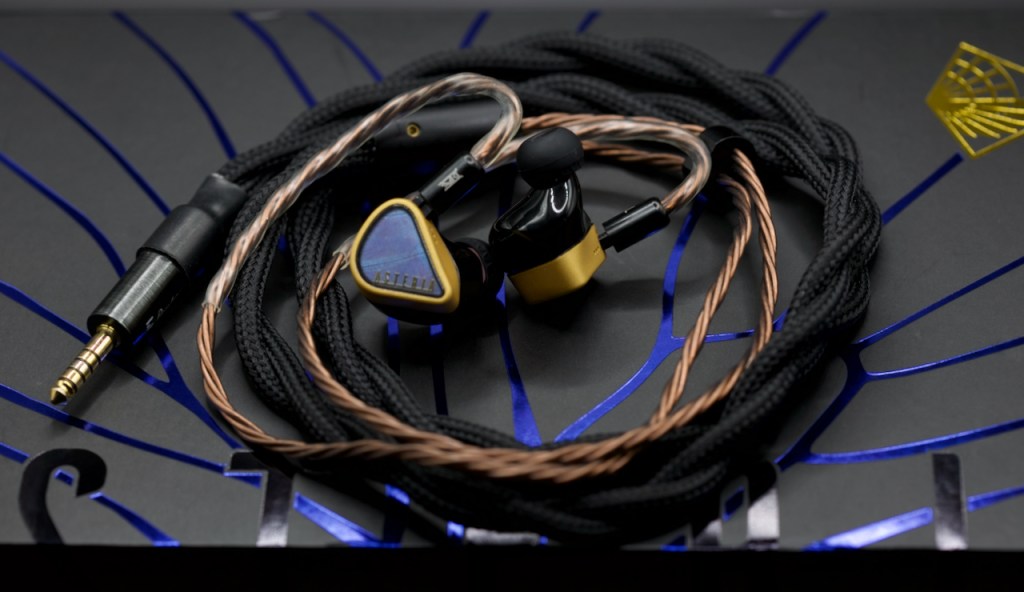
I hear the PS cable to provide a bit more energy in the mid treble and air, while making the edges of the notes a tad crisper. Not a huge difference, but an audible one.
The Asteria is a hard to drive IEM, requiring the same levels as Storm. This, of course, means that you would need a hefty source, but, in return, they are quiet as a mouse, even with the iFi Kensei HD (without using the impedance matching slider). I’ve entrusted the job of driving Asteria to my trusty Nipo N2. Alternative sources were Nipo N2+Apos Gremlin; P6P+Brise Tsuranagi and, the surprise, Audma HPA1 Brioso ,either in DAC mode or as an amp for N2/P6P. In terms of dongles, Rhapsodio Fantasies and Nipo A100 did a good job driving it, even without an amp. Impressive performance.
A special mention goes to Gremlin: it adds some much appreciated grittiness, bringing the Asteria in the X territory, with a tad less bite in the treble.
I think the description provided on the manufacturer’s site is so good , that I have very little to add. I find the sound very cohesive, to the point that it may seem boring (yes, I am guilty of that). The more I listened, the more I realised that this set sounds not like one of my existing sets, but more like each of them. It can do slow music,, such as vocal centered female artist song, sound as sweet as on Steranko S40, while having the details of GMA (in a way).
It makes almost no sense to describe their sound in the usual Bass/Mids/Treble manner, because their parts are so well integrated that I’d rather dig directly into the comparisons. However, allow me just a couple of observations.
First, they are not fatiguing. Once my accommodation period has ended, I got so used to them that almost did not want to return them. Even with brighter sources, they maintain their composure and sound good regardless of the volume.
They have a generally tightly controlled bass, with a big quality, of intervening only when called upon by the music, the rest of the time waiting patiently like a percussionist waiting for that moment to hit the timpan. This must be the Ballance flow mentioned above. Impressive stuff.
Attention though, controlled does not mean lacking, it simply means that it is not in your face. The transients and the decay times are very fast, the bass being easily capable of keeping up with even the fastest metal acts. There is just the smallest amount of elasticity to the bass, enough to make it flow seamlessly. The toms sound massive, drum fills being utterly fun, in particular when the drummer is moving up and down across the kit. Mid-bass is a constant presence, with a delicate texture, a bit atypical for such a forceful IEM. The articulation is very good indeed, and the texture is somewhere between S40 and NGaudioErebus.
Mids are as velvety as Steranko S40’s, but maybe less buttery. Voices, being Elton John or Chimene Badis sound natural and forceful. Guitars and other instruments are presented in balance, with a correct amount of grittiness. I could always use a bit more, as I am not after an overly polished sound, but they come very close.
The treble is, maybe the part where I would have added a bit more intensity and air, but the details are all present. The extension is good, and quite source dependent. The Teac UD-507 and the Brioso calmed down any possible shoutiness (I am sensitive to 3,5-4,5 KHz Peaks). Should you want more treble, Apos Gremlin gives them more energy in the treble, while adding a further organic touch to the bass, in particular mid-bass. Quite tasteful, if you ask me. Another option is the PS cable, as mentioned before.
Unlike some other sets I have reviewed before, the Asteria fares the same across many genres. So rather than repeating the same thing over and over again, I have tried to compare them with IEMs that I feel perform best for those respective genres. The aim here is not to establish which one is better and which one is worse, but to give you an idea of what they may sound like.
The one IEM that is strikingly close to Asteria is the elusive Steranko S40 (2DD, 12BA, 8EST), a boutique IEM from HK. The version I have compared here is the V2, with the metal nozzle. You’ll see thrown in an Elysian X (review here) (1DD, 4BA, 4EST), a Letshuoer Cadenza 12 (2DD, 10 BA) and the Storm (2xSlam drivers, 5BA,2EST). Asteria, X and Storm require serious power, so I have used an amp with them.
Let’s see some comparisons:
For the Love of pain by Testament (N2)
This is a test of two philosophies, one is the raw, very gritty sounds, with very airy treble and an expansive stage (X), where the bass is more aerated and in general the sound field feels a bit more light, while the bass guitar is there to support the rhythm and the charge is led by the bass drum and cymbals. The other (Asteria) has a heavy ended approach, bass hitting you like a pneumatic hammer, drums being thunderous, while the bass guitar appears to be more in charge. Cymbals are here to lend support this time.
X sounds very nimble, it’s pure madness, a sound a bit closer to my heart.
While Asteria is heavier, it does not feel slower. With the treble a bit recessed, the double bass drums have just the right balance of impact slam and decay. The mid-bass is more present, probably just as an effect of the mids being a little bit recessed by comparison with the exuberant X.
Cadenza 12 is a 2DD, 10BAs hybrid, that sounds vaguely similar. It has less sub-bass, and that is immediately obvious. Overall is flatter than the other two, but it is holding its ground fairly well. The bass guitar is more forward than with X, but overall it sounds leaner, it’s missing that rumble brought in by the sub-bass.
Storm – does its beastly thing, blasting music at you from all around the stage. With perfectly detailed treble and that fine sand–like, nimble bass with thunderous drums and the bass guitar easy to follow, in particular around the 5min mark. Not only that the details are top notch, but somehow combining the GMA and Asteria into one piece, Storm throws details at you, while sounding more musical than many IEMs, no doubts, thanks to its desktop speakers-like sound field.
A better life – Dream Theater (N2, no amp) for testing the overlaying of voices and guitars. Asteria sounds natural, but a tad dark for my taste. The voice sounds just a bit too close to the instruments, but it keeps its composure and the words are easily understood. The guitar is smooth, the drums sound impactful, the usual perfection one would expect from DT.
X is like coming home, once more the charge being lead by the hi-hats. More air, more theatrical. The drums might not have the same impact, but the voice is more emotional, more direct. Upon increasing the volume, X might be a tad strident for some. For me it remains ok, but if you know you’re sensitive to the 3-4Khz peaks, maybe Asteria is the safer choice.
Birds ov Paradise –Till dig (N2, no amp)
Bass test – there is ample amount with X, while keeping the highs airy and the electronic effects moving swiftly from L to R. Overall, a balanced rendition, with the bass kept in check to not overwhelm the rest of the frequencies. The increasing intensity at 2:48 mark to 3:00 builds up some tension, before going into a suspense-like phase, and eventually coming back half a minute later. X paints a spacious image, like floating in space.
Asteria is a whole different story. It’s darker and it feels more intimate. No longer floating in space, you are in the club, dancing next to other people and can almost feel their warmth. Asteria is hypnotic with this track.
Deep within the corners of my mind – Melody Gardot (P6P+Tsuranagi V1)
S40 is majestic with kind of music, there is no hint of harshness at any point, while the voice sounds natural and…sexy. The voice is centered and very close. A sense of directness that makes this slow song seem whispered in your ear by the singer herself. The level of details is high, you can already hear her breathing, the movements of her mouth…all there… any more details would probably distract from the music itself. The song flows seamlessly, ending much too soon.
Asteria has a larger stage with more distance between the voice and the accompanying instruments. There is more vocal clarity, but it comes at the price of a hint of sibilance (the manufacturer’s promise is largely kept in this regard, as this is the only situation where I heard sibilance. The voice sounds a little bit colder and less intimate. Technically superior, but emotionally S40 seemed more apt.
One important note here, other songs from the same album, where there’s a more prominent instrumental part, tend to sound bigger, larger, more spectacular and more layered on Asteria. It’s not a matter of better or worse, but one of preferences, would you rather have the utterly relaxed S40 approach or the more lively, Asteria one?! The differences are small, in any case.
I got 5 on it – Da Luniz (Brioso, no Elisa, no Bass)
A blast from the past. This song has eardrum splitting bass, and Asteria does not disappoint. There is a bit of roll-off, but tastefully done and frankly, with Divinus wide bore tips, the bass is more than enough. The treble is well controlled, it has good air, no harshness whatsoever, while the voices are very easy to understand. Good extension in the treble, with no sign of harshness, Asteria went for details over volume approach. Well executed, indeed. The bass is rumbling, well textured and it´s got a visceral punch.
Enter S40, there is less rumble relative to Asteria, but the bass is just as full. Maybe a smidge less impact, but the difference is so minimal I might have imagined it. This new version of S40, the V2, with a silver nozzle has more bass and more importantly better control thereof. It’s tighter than before and I’d even say tighter than Asteria. Overall, S40 is a bit warmer than the Asteria in the mids, but both are very opensounding.
X takes things up a notch with even more microdetails, like his breathing-in. It’s a faint detail, that rather than distracting is giving an air of authenticity. The sound is crisper and more textured (I’ve already established elsewhere that X is the king of textures. Going back to the other two sets, the big breaths of air are there (I am insisting on that, because years ago I had very good places at one of his concerts, and I was surprised how loud he was breathing in.)
Brtizlav’s Nigun – Giora Feidman (Brioso, no Elisa, no Bass)
You’d think this is a an easy piece for any IEM, but appearances can be deceiving. There are plenty of textures and there is no hiding behind other instruments.
Unsurprisingly, S40 shines, it’s sweet and mellow and the beginning, but as the intensity of the songs picks up, S40 is doing a good job scaling up. The clarinet sounds natural and lively, with a nice texture that is strong enough to cut through the increased intensity all the way to the end of the song.
Asteria sounds a bit more accute to me, with larger stage and an equally good texture. It does seem to have a completely black background, which is not a surprise, seeing it is much harder to drive S40.
The biggest difference here is the sound field. Asteria recreates the concert-hall sound better than S40, with it’s more intimate soundstage and somehow more contained sound.
Crystal Mountain – Death (Brioso, no Elisa, no Bass)
This songs sounds like a metal drummer is manning the bass drums and a jazz drummer has put in the cymbal work. V shaped IEMs are best for this song. The delicacy of the cymbals, the quick left/right alternance, it’s all spot on with Asteria. I do not hear the endless treble extension of X, but it is compensated by a natural, detailed texture. The drums sound like a brick wall coming down on you. The grittiness of the guitar is not at X levels, but it is good nonetheless.
S40 with its forward mids, does not have the best tuning for this kind of music, but it does a respectable job anyway. The drums are fast, there is good impact, the fast decay times keeping things in check admirably. The treble has more energy than Asteria, but somehow does not feel more detailed. Not less either. You immediately recognize the shimmery, articulated sound of ESTs, as opposed to the more robust BA treble on the Asteria. S40 has the mid-bass slightly elevated compared to Asteria, and this is catnip for me. Narrower stage, but, frankly, it’s so entertaining, that it hardly matters.
X is the boss here. First of all, the mid-bass is by a margin the nicest of the triad. There is more textured, the bass guitar line having a track of its own. The guitars are as gritty as it gets, and the drums are thundering, very fast attack and decay times, so each note is sharp, precisely contoured and perfectly differentiated from the rest. Then, there is the treble. This is a work of art, combining the texture of Asteria with the airiness of S40 and some more.
Storm takes things up a notch, with a bas that may not have the same bass guitar texture, but is so fluid, so nimble, you find it everywhere in the field. Imagine bigger stones filling a jar, then stones of smaller size filling some of the gaps and finally sand, making everything airtight. This is how I hear Storm’s stage. It remains, for me, the best for this kind of music.
Syndenes Magi – Arabs in aspic This is a prog rock, very good for testing the layering. This version is in Norwegian, but an English version of this album is also available. It reminds me a lot of Pink Floyd.
Asteria has the perfect presentation, spacious, well layered, but with its characteristic smooth transition between layers, everything flows with easy. It sounds relaxed at times, but when they kick it up a notch, Asteria comes alive and the percussion is flowing from left to right in a nice stereo effect. The sound density is amazing, the instruments sound realistic and with Asteria I tend to forget I am listening to IEMs, so good is their field of sound
Storm starts in big manner, the organ sound in the beginning of the song seemingly coming from my laptop and not from right within my ears. In fact, there is a certain degree of similarity here, the forceful sound, the impact of each instrument, the stereo effects. Storm sounds more open, larger, with its typical spherical stage expanding without end. The treble is more intense and has a timbre that sounds the most natural to me. Storm has a more pronounced separation, but not that overly analytical approach of some IEMs. It remains utterly engaging to me. It’s hard to believe this album came out in 2017 and not back in the 70s.
Conclusion: Whether you are after detailed presentation or a musical one, Asteria serves both purposes successfully. It is utterly musical, but pay attention and that music is filled with microdetails. From Giora Feidman’s big grasps of ait or Melody Gardot’s faint breathing, to the intricate layering of rock and classical instruments in Empire of the clouds, Asteria is no slouch when it comes to details. They have managed to put all these details in, while keeping it easy flowing and non-fatiguing. The build quality is stellar, the comfort is good and the IEMs themselves are responding very well to tips rolling. I also found the cable rolling to be relatively evident, but of course, YMMV.
If you look at the manufacturer’s claims, I think they have reached most, if not all of their goals.
Who is this for?! Pretty much everybody, it is one of the rare all-rounders. I have pitted against my best sets and even where it didn’t completely conquered my heart, it still shone like the star that it is. Very goodproposition package, including a nice carrying case (as opposed to S40 with its nice chest-like box, but no pouch). The cable is of high quality, seemingly derived from Astral Acoustics reference silver, which I don’t think needs much introduction. It’s main competitor is the S40, as they have a somehow similar approach, mids forward, not too much treble, and slightly rolled-off bass..
Despite my initial skepticism, Asteria convinced me and it may soon join my roster.
 Mikaik-audio